
Lieferung heute & morgen

Qualitätsgarantie

Willkommens-Angebote freischalten: KOSTENLOSE Lieferung | Bis zu 80 % RABATT | Kostenlose 30-Tage-JoyPlus-Testphase
App herunterladen
A new illuminated bathroom mirror can transform a bathroom. It's often the centerpiece that combines functionality and design. However, the market is flooded with models whose advertised features often fail to deliver in practice. Before you make a decision, it's crucial to understand the common pitfalls that can lead to disappointment and unnecessary expenses.
As your Joybuy Product Recommendation Officer, I'll help you distinguish between marketing promises and genuine, useful features. This guide focuses on the critical points that truly matter when making your selection.
Many buyers only realise after installation that their new mirror doesn't meet their expectations. Pay special attention to these three weaknesses:
To avoid a bad purchase, you should focus on verifiable technical specifications rather than vague marketing claims.
The lighting is the core feature of an LED bathroom mirror. Two values are crucial here:
The choice depends on your storage needs and spatial constraints.
The IP (Ingress Protection) rating indicates how well an electrical device is protected against the intrusion of foreign objects and water. For the bathroom, an IP44 rating is the established minimum standard. The first digit (4) stands for protection against solid objects (>1 mm), and the second digit (4) for protection against splashing water from all directions. A mirror with this rating is designed for safe installation in Zone 2 of the bathroom (within a 60 cm radius of a shower or bathtub).
Here are some models that represent a considered choice for different user profiles, based on objective features.
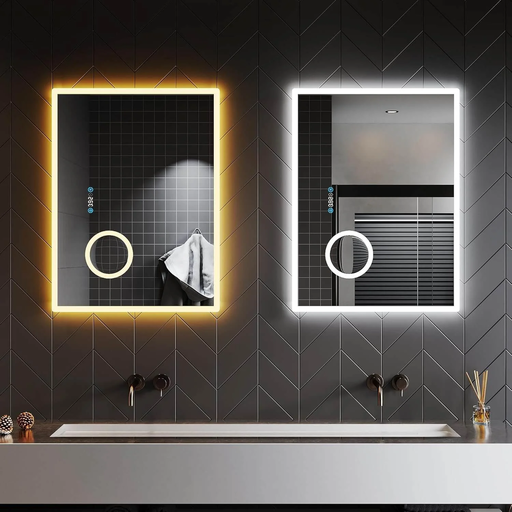
Why This Fits Their Persona: Ideal for users who prefer a clean, modern design without the bulk of a cabinet but still want smart features. The integration of a clock, temperature display, and 3x magnification into the mirror surface maintains a minimalist aesthetic.
The lighting is adjustable to three colour temperatures (cool, neutral, warm white), thus avoiding the pitfall of an unsuitable, fixed light colour.
Integrated additional features (clock, temperature, magnification) in a slim design. Separate switch for the anti-fog function.
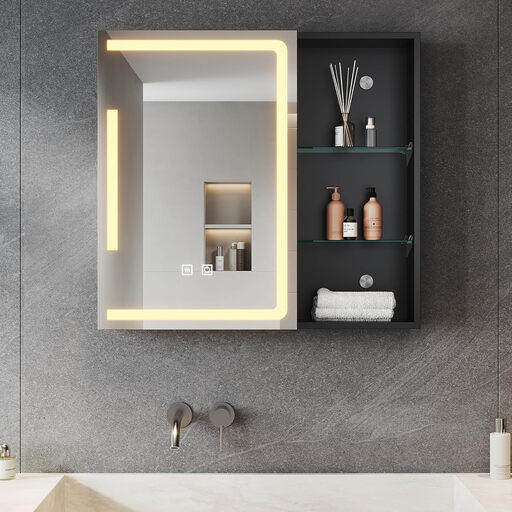
Why This Fits Their Persona: Perfect for those who need maximum storage and functionality. This mirrored cabinet with lighting and a socket solves the problem of cluttered surfaces and a lack of power sources at the sink. The modern design as a black bathroom mirror also makes a visual statement.
The combination of closed and open storage with adjustable glass shelves offers flexible organisation that goes beyond the rigid compartments of simpler models.
Integrated shaver socket (German standard), steplessly dimmable light with 3 colours, and soft-close hinges for silent operation.
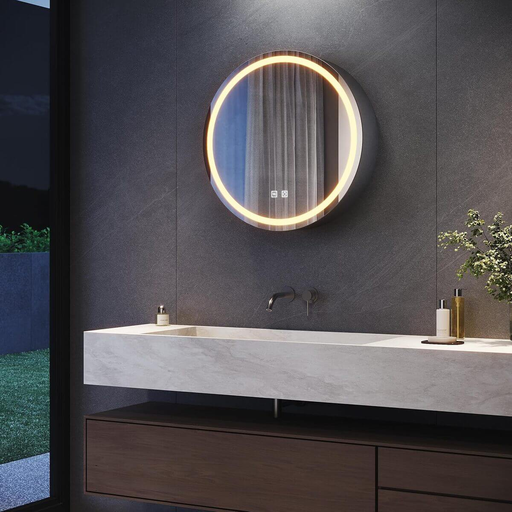
Why This Fits Their Persona: For anyone who wants to stand out from the standard rectangular shape. The round mirrored cabinet is a design highlight that still meets all practical requirements for storage, lighting, and power supply.
This model proves that exceptional design doesn't have to come at the expense of functionality. It integrates a socket, anti-fog function, and dimmable light into an unconventional shape.
Unique round design. Despite its shape, it offers internal compartments for organisation, an anti-fog function, and an integrated socket.
We have compiled a complete, up-to-date list of products that fully meet these strict selection criteria and UK safety regulations.
In most cases, a mirror's lighting is designed as supplementary or task lighting. It optimally illuminates the face for daily grooming but is generally not sufficient to light an entire bathroom as the sole light source. A separate ceiling light is still recommended for general illumination.
Most models are designed for direct connection to a 230V wall power outlet, ideally controlled by a wall switch. Some mirrors with a touch switch can also be connected directly to a continuous power source. For safety reasons, installation should always be carried out by a qualified electrician.
IP44 is an important safety standard for damp environments. It guarantees that the electrical component is protected against the ingress of solid objects larger than 1 mm (e.g., wires) and against splashing water from all directions. This minimises the risk of short circuits and electric shocks and ensures a longer lifespan for the electronics.