
Lieferung heute & morgen

Qualitätsgarantie

Willkommens-Angebote freischalten: KOSTENLOSE Lieferung | Bis zu 80 % RABATT | Kostenlose 30-Tage-JoyPlus-Testphase
App herunterladen
Choosing the right lighting for your bathroom can be a challenge. It's not just about brightness—it's about safety, durability, and atmosphere. Many buyers invest in LED recessed spotlights for the bathroom, only to discover later that their choice is unsuitable or even unsafe. Before you make a decision, it's crucial to understand the most common pitfalls that lead to unnecessary costs and disappointment.
This guide will help you avoid these mistakes and make an informed decision based on technical facts and practical requirements.
To find the right ceiling spots for your bathroom, you should focus on a few critical technical features. These determine safety, compatibility, and functionality.
The IP (Ingress Protection) rating indicates how well a light fixture is protected against the ingress of foreign objects and water. In the bathroom, this is the most important parameter.
Choosing the correct IP rating is not a matter of taste but a legal and insurance necessity.
Before you buy a recessed spotlight set, measure the available space in your ceiling.
The right lighting can completely change the mood of a room. Flexible control options are therefore a valuable feature.
Here are some recommendations tailored to different user profiles and their specific requirements.
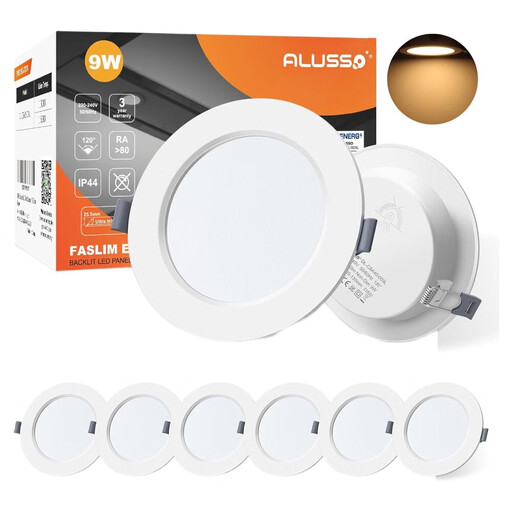
Why This Fits Their Persona: Ideal for users seeking a straightforward, safe, and efficient lighting solution. This set focuses on the essentials: reliable function and simple installation.
With its IP44 rating, it is explicitly designed for damp rooms, bypassing the safety trap. The ultra-slim design of 25.5 mm also fits into ceilings with limited space.
A direct 230V connection without a transformer makes for easy installation. The set provides uniform and energy-efficient ambient lighting in a pleasant Warm White (3000K).
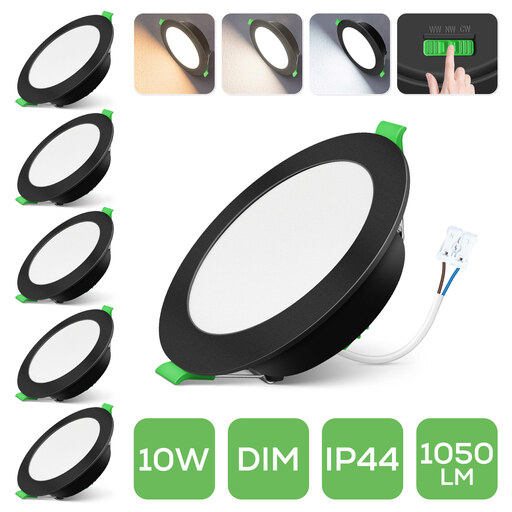
Why This Fits Their Persona: Perfect for anyone who wants full control over the lighting mood in their bathroom. This model combines modern design with maximum flexibility.
Thanks to the 3CCT function, you avoid the trap of a fixed light colour. You can switch between Warm, Neutral, and Cool White at any time to adjust the atmosphere.
The combination of dimmability (10-100%) and colour temperature change offers ultimate control. Its slim profile (34 mm) and IP44 rating make it highly versatile.
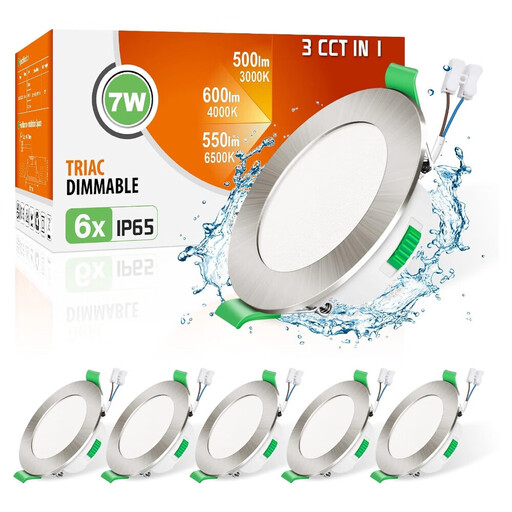
Why This Fits Their Persona: The solution for challenging installation scenarios, such as directly over the shower or in ceilings with extremely limited space. It offers maximum safety and flexibility.
With an IP65 rating, this spotlight is protected against water jets, making it suitable for the most demanding zones in the bathroom. The ultra-slim installation depth of just 29 mm solves any ceiling space issues.
Combines the highest level of water resistance (IP65) with full light control (dimmable and 3CCT). The high-quality aluminium housing also ensures excellent heat dissipation and durability.
We have compiled a complete, up-to-date list of products that fully meet these strict selection criteria and UK safety regulations.
1. Do I always need an electrician to install LED recessed spotlights in the bathroom? Yes, absolutely. For safety and insurance reasons, any work on 230V electrical installations, especially in damp environments like a bathroom, must be carried out by a qualified electrician. Improper installation can lead to electric shocks, fires, and voiding your insurance coverage.
2. What does 3CCT mean for LED recessed spotlights? 3CCT refers to the ability to set three different colour temperatures. Typically, you can use a small switch on the fixture, either before or after installation, to choose between Warm White (approx. 3000 Kelvin, for a cosy atmosphere), Neutral White (approx. 4000 Kelvin, for balanced everyday lighting), and Cool White (approx. 6500 Kelvin, for an energising, daylight-like brightness).
3. How many recessed spotlights do I need for my bathroom? A general rule of thumb is one spotlight per 1.5 to 2 square metres of ceiling area for good general illumination. However, this heavily depends on the ceiling height, the desired brightness (lumens), the beam angle of the spots, and the layout of the room. For precise planning, it is advisable to create a lighting plan that also specifically illuminates functional areas like the mirror or the shower.