
Lieferung heute & morgen

Qualitätsgarantie

Willkommens-Angebote freischalten: KOSTENLOSE Lieferung | Bis zu 80 % RABATT | Kostenlose 30-Tage-JoyPlus-Testphase
App herunterladen
A bathroom towel holder should keep towels within easy reach, allow sufficient air circulation and fit the available space. In practice, however, poor purchases are not caused solely by the material or design. The mounting surface, clearances and load capacity are often more important.
A no-drill towel holder with suction cups will not automatically stick to every surface. Smooth, non-porous and completely dry surfaces such as glass, metal, smooth tiles or acrylic are more suitable. Textured tiles, wallpaper, painted walls and open-pore stone can affect adhesion.
Even where a load capacity is stated, the weight should not be applied generally to every bathroom. What matters is whether the surface forms an airtight seal and whether the suction cup has been fitted correctly.
A slim towel rail saves space, but may only have room for a single towel. If several damp towels are hung closely on top of one another, they will dry more slowly and need more space between them. Families may therefore find a towel stand, several hooks or a multi-tier towel ladder more practical.
Metal is not automatically rustproof, and wood is not automatically suitable for every permanently damp environment. With a metal towel holder, pay attention to the surface finish and cleaning instructions. A wooden towel holder or bamboo holder needs sufficient clearance from standing water and should be cared for with a soft, slightly damp cloth.
The mounting method should suit your living situation:
Before buying, measure the width, depth and height of the intended space. For wall mounting, you should also check whether water pipes or electrical cables could run through the drilling area.
Manufacturers’ load-capacity specifications only apply under the stated conditions. For example, the TAILI suction hook has a maximum load capacity of 11 lb on smooth, non-porous surfaces. This is approximately 5 kg. The specification does not apply to uneven tiles, painted walls or wallpaper.
With a towel holder with shelf, you should also consider the fixing points and the mounting hardware used. A shelf is often loaded with toiletries, baskets or folded towels. Suitable wall plugs or a load-bearing wall anchor are required for heavy items.
Powder-coated metal, stainless steel, brass, plastic, wood and bamboo differ in weight, appearance and care requirements. Smooth surfaces that can be wiped regularly are a sensible choice for damp rooms. There should ideally be some space between several towels. Open designs promote air circulation better than tightly fitted, enclosed storage.
The following selection groups products according to typical usage scenarios. Dimensions, materials and load-capacity details are taken from the respective product information.
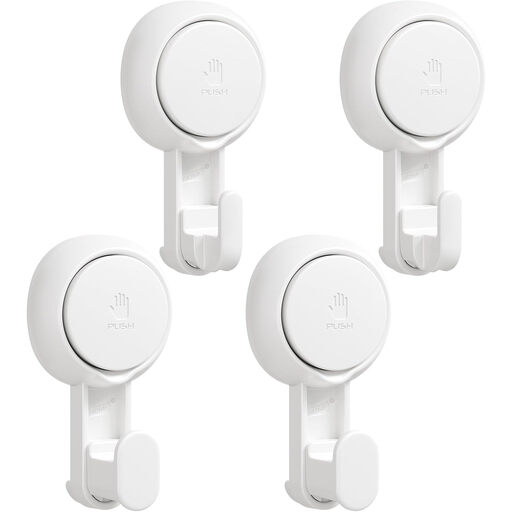
Why this product suits this profile: The four-piece set can be fitted without drilling, adhesive or tools on suitable smooth surfaces, and repositioned several times. This makes it suitable for rental properties and flexible additions to the bathroom.
The product information explicitly states which surfaces are suitable and unsuitable, as well as a maximum load capacity of 11 lb per hook. This makes it easier to assess suitability before installation.
Four hooks, a 360° rotating hanger and tool-free installation on smooth, non-porous surfaces.
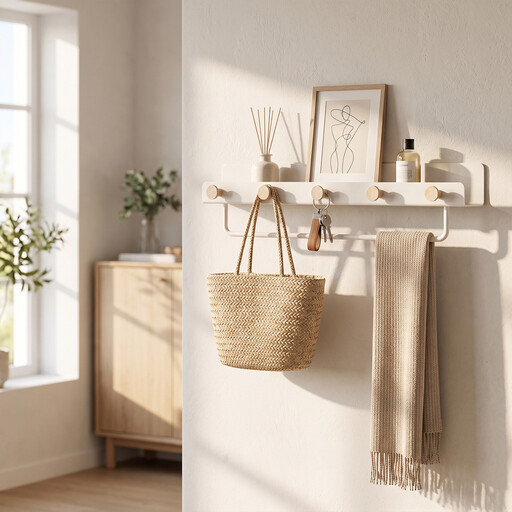
Why this product suits this profile: The combination of FSC-certified rubberwood, a clear lacquer finish and powder-coated metal brings hanging space and storage together in one wall-mounted unit.
The wall mounting is not presented as universally load-bearing: a suitable wall anchor or wall stud is required for the stated maximum load of 44 lb.
Five hooks, a towel rail and a shelf; according to the product information, the materials are water-resistant and rust-resistant.
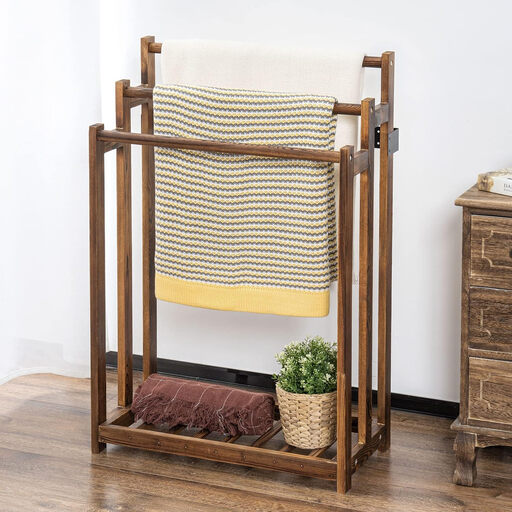
Why this product suits this profile: The freestanding design with three tiers is aimed at households that want to store several towels, dressing gowns or folded textiles.
The dimensions of 23,5 × 36 × 11,5 inches should be checked against the available floor space before buying. The lower shelf provides extra storage but requires a clear area to stand on.
Three hanging tiers, a solid wooden construction and the option to use it as a freestanding or floor-mounted model.
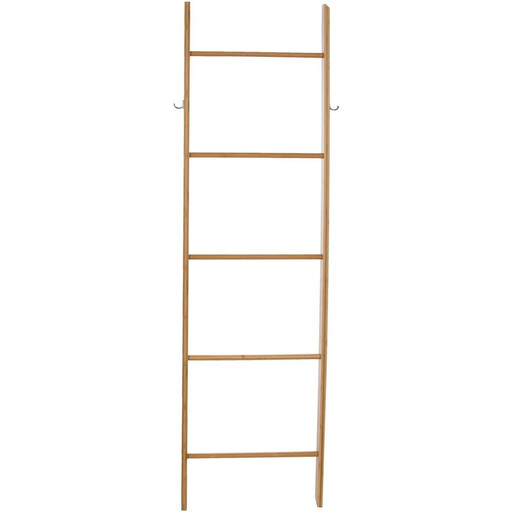
Why this product suits this profile: A towel ladder makes use of wall height without requiring a wide wall-mounted installation. Measuring 45,2 × 4 × 170 cm, it fits into many narrow spaces, provided the ladder is secure.
The shallow depth is clearly stated. Before setting it up, check the floor clearance, stability and distance from the shower or bath.
Bamboo frame, stainless-steel side hooks and several tiers for vertical hanging.
We have put together a complete, regularly updated list of products that fully meet these strict selection criteria and the safety regulations applicable in the EU.
The surface should be smooth, clean, dry and non-porous. Fit the suction cup or adhesive surface according to the instructions. Before hanging anything, check that the fixing is fully attached. Uneven tiles, wallpaper and painted walls are unsuitable for many suction systems.
This depends on the design. Towels should not lie completely against the wall. With several rails or tiers, space between the towels is useful so that air can circulate. The holder should also not be installed directly in the splash zone unless the product is designed for it.
A wall-mounted holder saves floor space, but requires a suitable wall and, where applicable, drilling. A towel stand can be moved more flexibly, but needs floor space. For rental properties or frequently changing room layouts, a freestanding model, door-mounted holder or towel hook may be the more suitable solution.