
Lieferung heute & morgen

Qualitätsgarantie

Willkommens-Angebote freischalten: KOSTENLOSE Lieferung | Bis zu 80 % RABATT | Kostenlose 30-Tage-JoyPlus-Testphase
App herunterladen
A bathroom towel rail should keep towels tidy, allow air to circulate and suit the space you have. But in small bathrooms, cloakrooms or rented homes, design isn’t the only thing that matters. The fitting method, door measurements, stability and care requirements all affect how practical a model will be day to day.
A slim towel rail can still be awkwardly positioned if doors can’t open fully or towels get pushed against the wall. Before buying, check the width, depth and height, as well as the distance from the basin, shower and radiator.
For an over-door towel rail, you’ll also need to consider the door thickness. A model that fits over a standard door won’t necessarily fit a cupboard door or an extra-thick bathroom door.
A towel rail designed to hold several towels is only practical if there’s enough space between them. Towels that overlap or hang too close together will dry more slowly and can restrict air circulation. Offset levels, swivel rails or sufficiently wide rails can help.
“Wood effect” doesn’t mean solid wood or bamboo. For metal, check the finish, such as whether it has a powder coating. For wood, look for guidance on moisture, cleaning and maximum load. In a bathroom, a wooden towel rail shouldn’t be left standing in water or placed permanently in a poorly ventilated alcove.
The right fitting depends on your home and the type of wall you have:
Before ordering, note down these three measurements:
For several towels, a stepped design is often more practical than multiple parallel rails at the same height. A compact towel rail is often enough for a cloakroom. Families and larger households may need more levels or an additional towel stand.
Powder-coated metal can offer a durable finish, but take care to avoid scratches and follow the manufacturer’s cleaning instructions. Bamboo and teak bring a natural look to your bathroom. Clean wooden surfaces with a damp cloth, then make sure they aren’t left wet for long periods.
Also check for:
For example, the Towel Rack Teak Wood has a stated maximum total load of 3 kg. According to the product information, it should only be placed on stable, level and dry surfaces. Specific details like these are more useful than general claims such as “extra sturdy”.
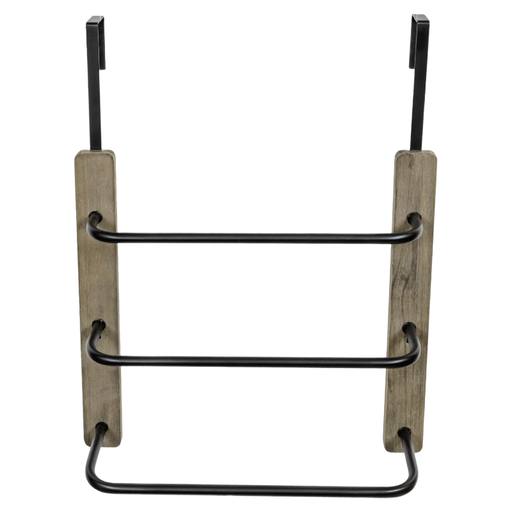
Why it suits this profile: According to the product description, this over-door towel rail requires no tools and fits over doors up to 4.4 cm thick. That makes it a useful option for rented homes and small bathrooms.
The maximum door thickness is clearly stated. Three metal bars arranged one above the other leave space between several towels rather than bunching them together on a single rail.
Tool-free fitting; dimensions of 56,9 × 45,2 × 19,6 cm; a combination of solid wood and matt-coated metal, according to the product information.
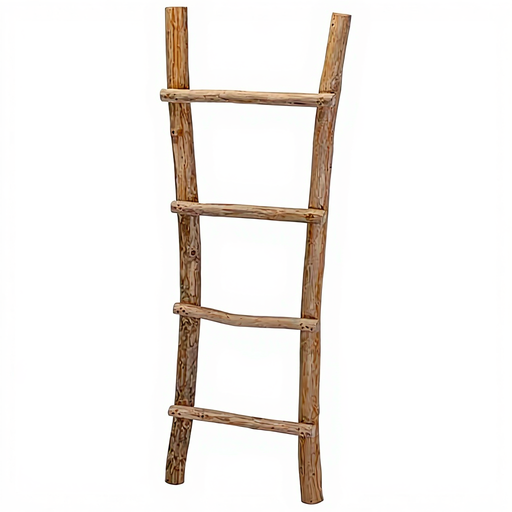
Why it suits this profile: Solid teak and a natural design complement bathrooms with a warm, understated style.
The product information gives a maximum total load of 3 kg, along with specific guidance on keeping it dry, wall fixings and care.
Teak is described as naturally moisture-resistant; the stated load limit helps you plan realistically.
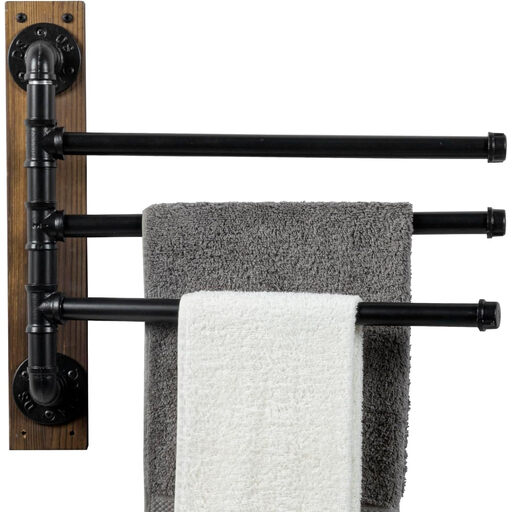
Why it suits this profile: Three swivel rails are useful for households that need a flexible way to hang towels, clothes or other fabrics.
The 180-degree swivel function creates space when hanging items and lets the rails fold back flat when not in use. The product description specifies wall mounting with a pre-drilled wooden strip and fixings.
Three swivel metal bars; closed depth of approximately 7,9 cm according to the product information; a combination of coated metal and wood.
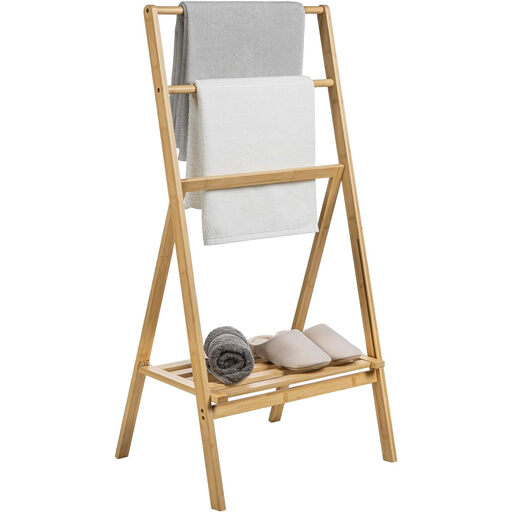
Why it suits this profile: This freestanding towel rail combines several levels with shelves and can be folded away, according to the product description.
Dimensions of approximately 55,1 × 44,5 × 111 cm make it easy to check how much space it will take up. The open design and several shelf levels provide useful storage, rather than being purely decorative.
Bamboo construction; folding frame; rectangular shelves for towels, baskets or toiletries, according to the product description.
We’ve put together a complete, regularly updated list of products that meet these strict selection criteria and the safety regulations in force in the EU.
For rented homes, a towel rail that doesn’t require drilling, an over-door model or a freestanding towel stand can be practical choices. For over-door models, check the door thickness and make sure the door can still move freely. Freestanding models don’t need holes in the wall, but they take up floor space and should stand securely.
It depends on the number and length of the rails and the space between levels. For several towels, stepped or swivel designs are usually more practical than a single rail. Make sure the towels aren’t so close together that they touch each other or the wall.
Metal surfaces can usually be cleaned with a soft, slightly damp cloth. Don’t leave wood wet for long periods. Unless the manufacturer specifically says otherwise, avoid abrasive cleaners. Regularly check that wall fixings, screws and feet are secure.