
Lieferung heute & morgen

Qualitätsgarantie

Willkommens-Angebote freischalten: KOSTENLOSE Lieferung | Bis zu 80 % RABATT | Kostenlose 30-Tage-JoyPlus-Testphase
App herunterladen
A bathroom towel rail needs to do more than simply hold a towel. It should suit the wall, the size of the room and the way it is used. A small rented bathroom has different requirements from a family bathroom, cloakroom or kitchen. If you focus only on design or a low price, you can easily end up with a solution that does not hold securely, takes up too much space or quickly becomes impractical in a damp environment.
A no-drill towel holder with a suction cup will not automatically stick to every wall. Smooth, non-porous and dry surfaces such as glass, metal, smooth tiles, stainless steel or acrylic are suitable substrates. Uneven tiles, textured panels, wallpaper, painted walls or porous natural stone can, on the other hand, impair adhesion.
Dust, grease and moisture should be removed before installation. With suction-cup models, you must also observe the stated maximum load. This prevents a damp bath towel or an additional dressing gown from overloading the hook.
A narrow towel rail saves wall space, but it does not always provide enough distance between several towels. If layers of fabric lie close together, air circulation can be restricted. For several towels, multiple hooks, offset rails or swivelling arms are therefore a sensible choice.
Even a space-saving towel holder should not be installed directly behind a door, in an area exposed to heavy splashing or immediately next to a heat source. Accessibility, freedom of movement and a position that stays as dry as possible are the key considerations.
Metal, wood and plastic have different care requirements. Powder-coated metal may be suitable for bathrooms and kitchens, but water residue should still be removed regularly. Wood adds a natural look, but it should not be left permanently in standing water or in poorly ventilated, very damp areas.
With a metal towel holder, the surface, edges and fixing points are all important. With a wooden towel holder, the type of wood, protective coating, stability and permitted total load matter. A decorative design is no substitute for secure installation.
Before drilling, check whether pipes or electrical cables are located at the intended installation point. For wall-mounted models with a high load capacity, it is important to fix them to a suitable substrate or use an appropriate wall-plug system.
The maximum load must match the way the holder will actually be used. A bathroom towel hook is intended for a towel or flannel, while a wide rail or towel shelf can hold several textiles. The manufacturer’s load specification generally applies to a suitable substrate and professional installation.
TAILI suction hooks are specified as having a maximum load of 11 lb, or around 5 kg. According to the product description, this applies to smooth, non-porous surfaces. The hooks should not be loaded beyond this limit and should be checked for secure attachment before each use.
Measure the available wall or door area before buying. A multi-level model may require more depth than a simple towel rail. A cloakroom will often only need a single hook or a compact freestanding holder. In a family bathroom, a towel shelf with hooks can provide additional storage for toiletries and textiles.
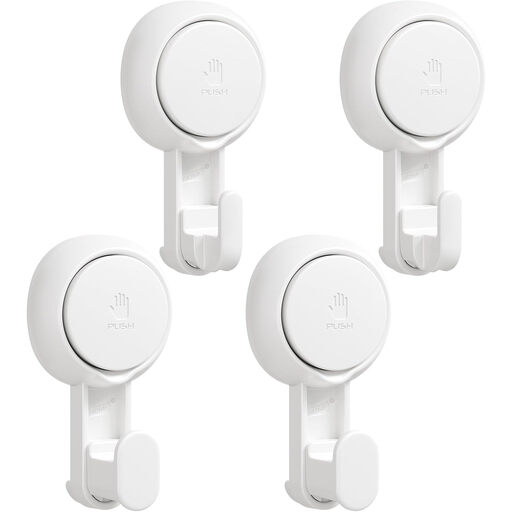
Why this product suits this profile: The four-pack is ideal for renters and households that want to create several small hanging points without tools.
Installation requires no drilling, adhesive or screws. However, the product specifications limit use to smooth, dry and non-porous surfaces.
Four 360-degree swivelling hooks made from plastic, TPE and PC; according to the product specifications, each supports up to 11 lb on a suitable substrate.
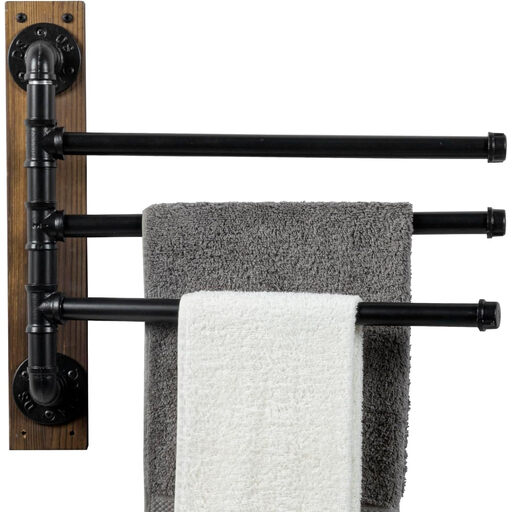
Why this product suits this profile: The combination of three swivelling rails, black metal and a wooden shelf provides separate hanging space in a permanently wall-mounted design.
The three arms swivel through 180 degrees and can be folded flat when not in use. This makes it easy to adjust the distance between towels for everyday use.
Three 180-degree swivelling arms, a foldable design and standard fixing materials included.
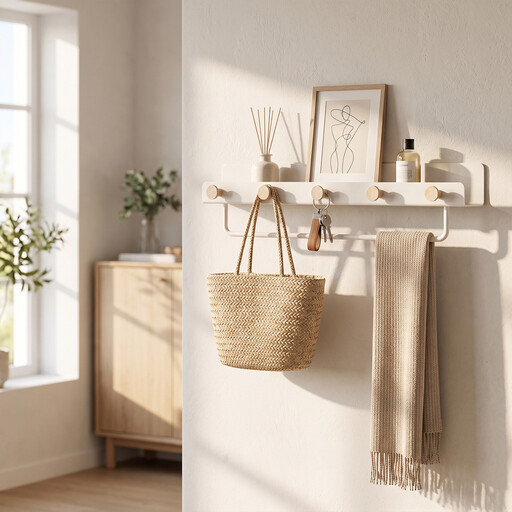
Why this product suits this profile: The 3-in-1 system is designed for households that want to keep towels, accessories and bathroom essentials together on one wall.
Instead of distributing several individual holders around the room, this wall shelf combines a storage ledge, five hooks and a towel rail. The wall fixing must be suitable for the specified load.
FSC-certified rubberwood according to the product description, powder-coated steel, five hooks, one rail and one shelf.
We have put together a complete, regularly updated list of products that fully meet these strict selection criteria and the safety regulations applicable in the EU.
A wall-mounted metal towel holder is ideal when you want permanent installation and clean, streamlined lines. For a narrow wall, an iron model measuring 600 × 85 × 110 mm may be suitable, provided the dimensions match the available space and installation position.
A freestanding towel stand such as the Black Natureo Towel Holder requires no wall installation and can stand on a shelf or sturdy piece of furniture. Its compact size of 15 × 15 × 30 cm is designed for hand towels or guest towels. For doors, a three-tier over-the-door holder offers a no-drill alternative. The door thickness must fall within the manufacturer’s specified range.
In the kitchen, a towel holder for the shower and kitchen can be used in a variety of ways. Also check that the material is easy to clean and that the holder does not extend into the immediate vicinity of the hob, sink or splashing water.
Renters can consider suction-cup hooks, door-mounted holders or freestanding models. Suction cups require a smooth, dry and non-porous surface. With door-mounted holders, check the door thickness and closing function. These solutions are not automatically suitable for wallpaper or uneven walls.
The installation surface must be clean, dry and suitable for the type of fixing being used. For wall-mounted models, the wall plugs and screws should match the substrate. Suction-cup hooks must only be loaded up to the specified maximum capacity. Regularly checking that the holder remains secure is particularly sensible when using damp or heavy textiles.
Yes, provided it is designed for damp rooms and is not left standing in water permanently. A protective coating can make cleaning easier, but it is no substitute for proper ventilation. Wooden holders should be cleaned with a soft, slightly damp cloth and checked for cracks, warping or loose fixings.