
Lieferung heute & morgen

Qualitätsgarantie

Willkommens-Angebote freischalten: KOSTENLOSE Lieferung | Bis zu 80 % RABATT | Kostenlose 30-Tage-JoyPlus-Testphase
App herunterladen
A bathroom towel rail should keep towels within easy reach, help them dry quickly and fit the space you have available. In practice, however, three common buying mistakes can lead to unnecessary expense:
Before you buy, it’s worth considering the installation method, dimensions, material and how you plan to use it.
A towel rail without drilling can be a good option for rented homes, downstairs WCs or temporary solutions. For self-adhesive models, the wall should be dry, dust-free, grease-free and flat. Follow the manufacturer’s instructions on how long the adhesive needs to cure. A secure fit isn’t guaranteed on textured tiles, delicate paintwork or damp surfaces.
A wall-mounted towel rail fixed with screws can be secured for the long term if the wall is suitable and the correct wall plugs are used. Before installation, check whether water pipes or electrical cables might run behind the chosen spot. If you’re renting, also consider any costs involved in making good and check your landlord’s requirements.
For a more flexible option, consider a freestanding towel rail, an over-door model or a towel ladder. These usually don’t need to be fixed to a wall, but they do take up floor or door space.
A single towel rail around 60 cm long will often suit one bath towel or several smaller towels. Multiple rails or levels can be useful if you want to hang towels separately. Leave enough space between them to allow air to circulate.
When planning for a small bathroom, look for a space-saving towel rail. Folding, swivel or over-door models make use of the available space differently from a wide wall-mounted rail. Before buying, measure the width, depth and height of the intended spot. For an over-door model, the thickness of the door is also important.
A towel rack or a towel rail with a shelf gives you extra storage for folded towels, toiletries or baskets. However, the shelf increases the depth required, so make sure it doesn’t encroach on the space you need to move around.
A stainless-steel towel rail is an obvious choice for a humid room. Even so, check the finish and care instructions. Stainless steel, chrome-plated brass, coated metal and bamboo all differ in appearance, ease of cleaning and sensitivity to moisture.
A bamboo towel rail brings a warm, natural look to the bathroom. It shouldn’t be left standing in water, and should be cared for according to the manufacturer’s instructions. Coated metal surfaces can usually be cleaned with a soft cloth. Abrasive cleaners may damage coatings, paint or chrome finishes.
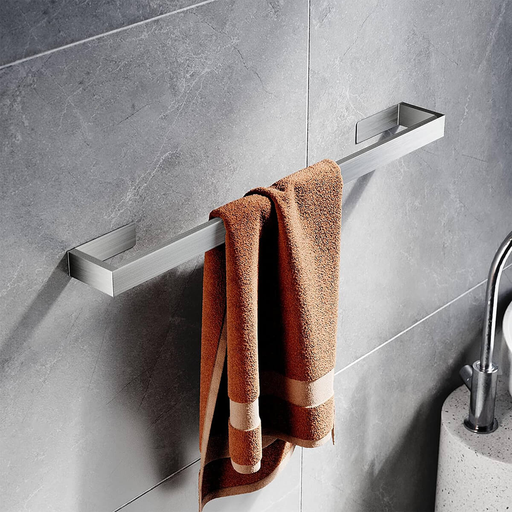
Why this product suits this need: This self-adhesive rail is worth considering if you want to mount it on a wall without drilling. At 600 mm long, it has room for several smaller towels.
The installation method is clearly described as self-adhesive. This makes it easy to check whether a no-drill fitting is suitable for your wall before you buy.
Brushed stainless steel; self-adhesive wall fitting; stated product length of 61.5 cm.
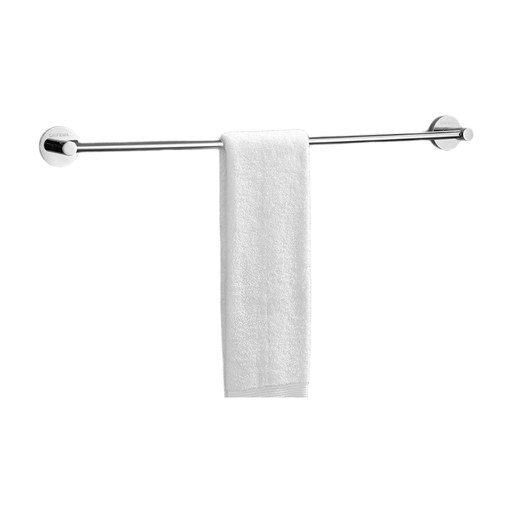
Why this product suits this need: The single brass rail with a chrome finish is a good fit for a clean, simple bathroom or kitchen where a traditional screw fitting is suitable.
It is described as screw-mounted, and installation components are listed. This makes it clear that it isn’t a no-drill rail.
60 cm rail; brass with a chrome finish; listed as suitable for bathrooms and kitchens.
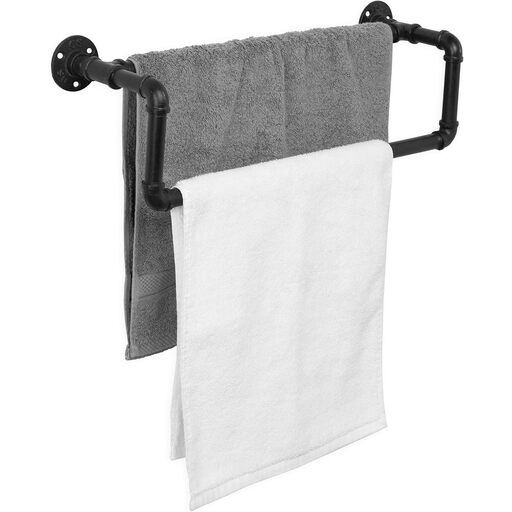
Why this product suits this need: With two levels and a width of 55.1 cm, this rail is suited to households looking to hang several towels or items of clothing on the wall.
The two separately described rails make the capacity easier to judge than a design description alone. Plan ahead for wall mounting, as fixings are not included.
Two levels; metal construction in matt black; dimensions of 55.1 × 13.5 × 14.7 cm.
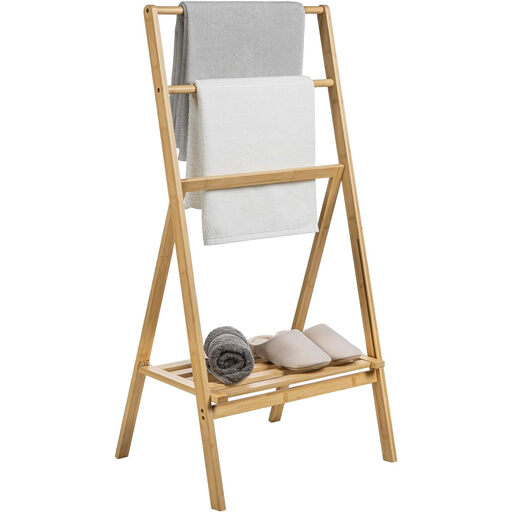
Why this product suits this need: This freestanding towel stand with a shelf is a good option for households that don’t want to drill and need extra levels for towels or bathroom essentials.
It is described as freestanding and foldable, so there’s no need to assume that wall fixings or tools are essential.
Bamboo construction; folding frame; stated dimensions of 55.1 × 44.5 × 111 cm; shelves.
We’ve put together a complete, regularly updated list of products that meet these strict selection criteria and the safety regulations in force across the EU.
A towel ladder makes use of vertical space and can be leaned against a wall without permanent fixing. Check that it’s stable and won’t get in the way of doors. An over-door model is practical in small rooms, provided it’s compatible with the door thickness and frame.
For a kitchen or utility room, a model with several rails, hooks or shelves can be a useful choice. If it will be used frequently, make sure it’s easy to clean. A towel rail with lots of details may offer more storage, but it can also have more corners where dust or moisture can collect.
For rented homes, consider self-adhesive models, freestanding towel stands, towel ladders or over-door hooks. With a towel rail without drilling, the wall surface, adhesive area and manufacturer’s instructions all need to be suitable. Removing it without leaving marks isn’t guaranteed on every surface.
The depth you need depends on the fitting and the size of the towel. The important thing is to make sure the fabric doesn’t rest directly against the wall and that the rail won’t clash with the basin, furniture or doors. Before installation, compare the product’s exact dimensions with the space available.
Metal surfaces can usually be cleaned with a soft, damp cloth. Avoid abrasive cleaners on chrome and painted finishes. Bamboo needs extra protection from constant splashing and should be cared for according to the relevant instructions. So when choosing a material, consider not only how it looks but also how much moisture it will be exposed to where you plan to place it.