
Lieferung heute & morgen

Qualitätsgarantie

Willkommens-Angebote freischalten: KOSTENLOSE Lieferung | Bis zu 80 % RABATT | Kostenlose 30-Tage-JoyPlus-Testphase
App herunterladen
A bathroom towel rail should do more than simply keep textiles in one place. It needs to suit the available space, the condition of the wall and the number of people using it. If you focus only on design or a low price, you can easily overlook important details.
Product images often show spacious bathrooms, while the actual floor or mounting areas are considerably smaller. So check the model’s width, depth and height, as well as its distance from the shower, washbasin, doors and radiators. Multiple rails positioned one above another also need enough space between levels to ensure that towels do not remain pressed against each other.
A no-drill towel rail can be practical in rented homes. However, suction cups and hooks only work reliably on suitable, smooth and clean surfaces. A heavy bathroom towel rack with shelf, on the other hand, will usually require secure wall mounting with suitable wall plugs or anchors.
A freestanding towel rail also needs a sufficiently level surface. With narrow or tall designs, check whether additional stabilisation is provided.
“Metal” alone says little about whether a product is suitable for a damp room. Look for details such as stainless steel, powder coating, rust resistance or a specifically described protective finish. For a wooden towel rail, the type of wood, surface treatment and care instructions are important. Painted or clear-coated wood should not be left in permanent contact with standing water.
First, consider how many towels will regularly be hung up. A compact towel rail with one bar is often enough for a guest cloakroom. In a family bathroom, a towel stand with multiple levels may be more suitable. A swivelling design allows you to spread the rails apart when needed and then fold them back towards the wall to save space.
Vertical solutions are ideal for small bathrooms. A towel ladder makes use of the room’s height and often requires only a narrow footprint. Folding models are easier to store when not in use. When checking the dimensions, make sure you consider the actual footprint rather than just the external measurements when folded.
For wall mounting, the fixing method must be suitable for the wall surface. Tiles, plasterboard, concrete and masonry require different wall plugs or mounting systems. The manufacturer’s stated maximum load capacity only applies when the correct mounting materials are used and the installation instructions are followed.
A towel rail with shelf should not be assessed solely by the load capacity of its rails. The shelf and its fixings must also be able to support the weight of baskets, toiletries or folded textiles. In rented homes, an over-the-door model or a suitable hanging basket can provide a no-drill alternative.
A metal towel rail with a powder-coated finish can offer a surface that is easy to care for. However, moisture should still be removed promptly if the coating becomes damaged. Stainless steel is not automatically completely unaffected in every environment, so the precise material specification remains important.
Bamboo and solid wood give the bathroom a natural look. Wipe these surfaces with a slightly damp cloth and dry them afterwards. Harsh cleaning products can damage paintwork, coatings or adhesive joints. With all variants, it is advisable to check the screws, hooks and connecting points regularly.
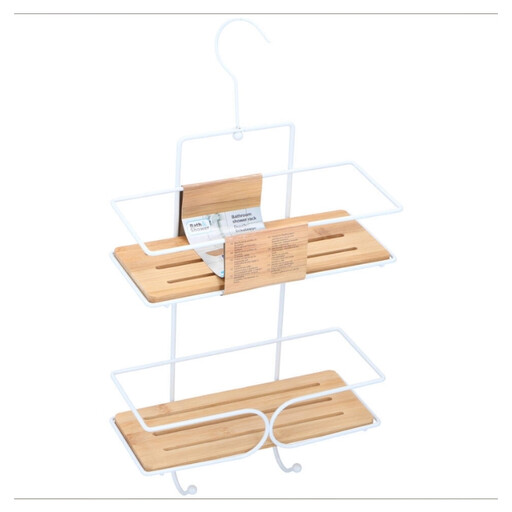
Why this product suits this profile: The compact rack measures 25 × 10 × 47 cm and offers two levels plus two hooks. The suction-cup and hanging-element fixing will appeal to anyone looking for a no-drill installation.
The dimensions are clearly stated and the mounting options are described in detail. Before buying, you should still check whether the surface is suitable for suction cups.
Two shelves, two hooks and a space-saving footprint; suitable for shower essentials and smaller towels.
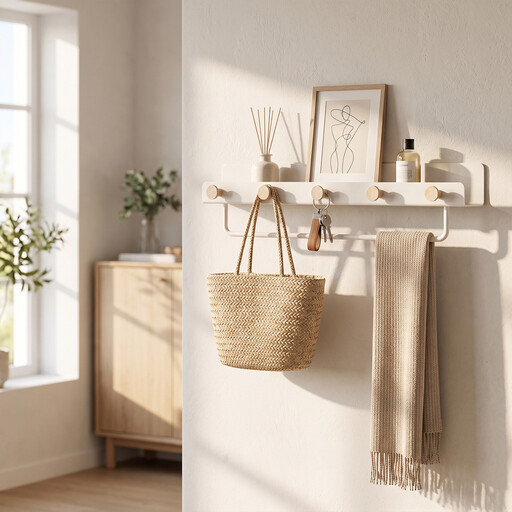
Why this product suits this profile: The combination of FSC-certified rubberwood, a clear lacquer finish and powder-coated metal brings a shelf, five hooks and a towel rail together in one wall-mounted unit.
The materials and maximum load capacity of 44 lb are clearly specified. The wall must be suitable for the stated load, and the mounting materials should be checked accordingly.
Three functions in one model; protective pads on the back help it adapt to uneven walls.
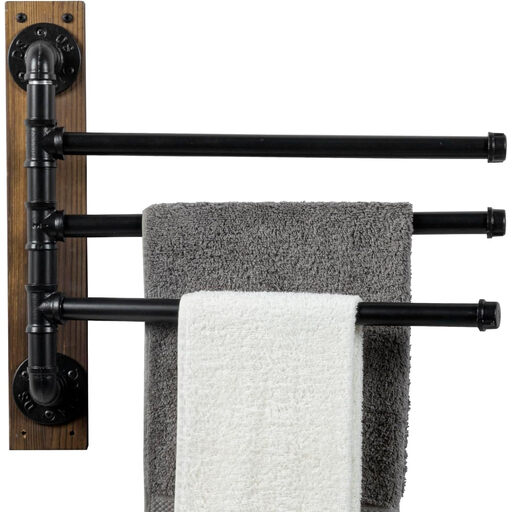
Why this product suits this profile: Three rails that swivel through 180 degrees provide separate hanging space for multiple towels. When folded in, the rail measures 17,3 × 3,1 × 15,7 Zoll.
The swivelling function creates space between textiles and reduces the footprint when not in use. A level wall surface is required for installation.
Powder-coated metal, a solid wood panel and three swivelling rails; standard mounting materials are included.
We have put together a complete, regularly updated list of products that fully meet these strict selection criteria and the safety regulations applicable in the EU.
Depending on the product, suitable options include suction cups, adhesive mounting or over-the-door hanging elements. The surface must be clean, dry, smooth and able to bear the load. For adhesive solutions, follow the stated curing time. Adhesion may be limited on textured tiles, wallpaper or damp walls.
Position the rail so that towels are not exposed directly to splashing water. At the same time, it should be within easy reach from the washbasin or shower. With multiple rails, sufficient space between the levels is important to prevent textiles from overlapping and to avoid unnecessarily restricting air circulation.
Its service life depends on the material, installation, load and care. Wipe away splashed water regularly, avoid abrasive cleaning products and check the screws and connections. With wall-mounted models, check that the fixings are secure after installation and then at regular intervals.