
Lieferung heute & morgen

Qualitätsgarantie

Willkommens-Angebote freischalten: KOSTENLOSE Lieferung | Bis zu 80 % RABATT | Kostenlose 30-Tage-JoyPlus-Testphase
App herunterladen
A bathroom towel rail should keep hand towels and bath towels within easy reach, allow sufficient ventilation and fit the available space. Even so, choosing the right product often leads to disappointing purchases. Many products look larger, sturdier or more versatile in pictures than they actually are in everyday use. Before buying, it is therefore worth checking the mounting method, dimensions, material and stated load capacity.
A wall-mounted towel rail may require screws, adhesive mounting or special fixings, depending on the model. Tiles, plasterboard and concrete all have different requirements. A self-adhesive towel rail without drilling may be suitable for lightweight towels, but should not automatically be assumed to have a high load capacity.
For screw mounting, the wall plugs and screws must be suitable for the wall. Not every product includes all the required mounting hardware. In rented properties, a model that hangs over the door or an adhesive system may be more practical than a permanent drilled solution.
A single towel bar needs enough clearance from the wall so that the towel does not remain in direct contact with it. For households with several family members, a multi-level towel rail or a model with several bars may be a sensible choice. The number of rails is not the only important factor; their spacing and the available wall width also matter.
A stainless-steel towel rail is not automatically equally suitable for every environment. Check the precise material specification, surface treatment and care instructions. Chrome-plated surfaces should generally be cleaned with a soft cloth; abrasive products can cause scratches.
Wood adds a warm look to the bathroom, but needs protection from constant splashing and standing moisture. When choosing a wooden towel rail, check whether the model is intended for use in damp rooms and what maximum load is specified.
Measure the available wall area and the distance from the shower, washbasin and doors. A 60 cm-long rail may be suitable for a bath towel, but could look too wide in a small cloakroom. Compact models are often sufficient for hand towels by the washbasin or tea towels in the kitchen.
Depth is also relevant: multi-level or swivel designs extend further into the room. A towel rack with several levels provides more hanging options, but requires sufficient clearance for movement.
The load capacity must match how you intend to use the product. Will it hold only dry towels, or also dressing gowns and other textiles? Observe the maximum load specified by the manufacturer and distribute the weight evenly. A product that is not designated as a grab rail must not be used for support.
For wall mounting, the substrate should be strong enough and free from concealed cables or pipes. After installation, carefully check that the rail is firmly secured. With a freestanding towel stand, you should also ensure that it is placed on a level, stable and dry surface.
Rust-resistant or suitably coated materials are practical for bathrooms. In the kitchen, a towel rail for the bathroom and kitchen can also be used for tea towels, oven gloves or lightweight kitchen utensils. Nevertheless, the construction should not come into direct contact with water or hot surfaces.
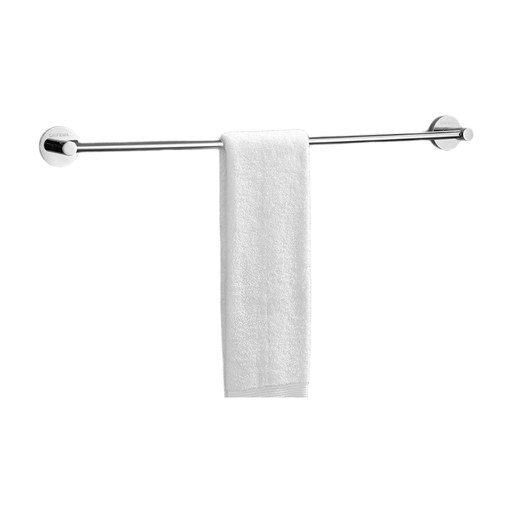
Why this product suits this profile: The single 60 cm bar is ideal for households looking for a clearly defined place to hang one hand towel or bath towel. Screw mounting and the included installation kit make planning easier.
The 60 cm length and single-bar design are clearly stated. This makes it easy to compare the available space with the product dimensions before buying.
Brass construction with chrome finish; screw mounting with installation accessories according to the product description.
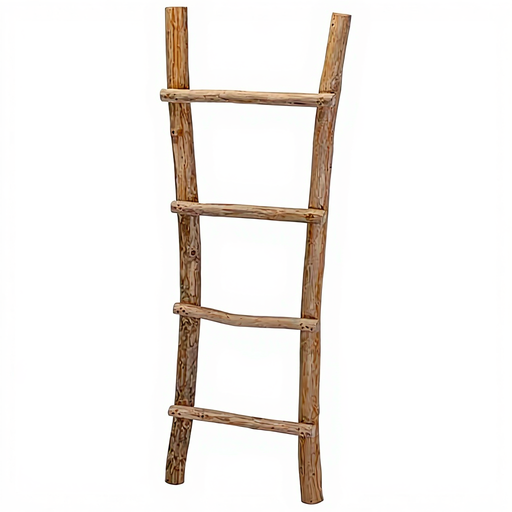
Why this product suits this profile: Made from solid teak, this model is aimed at users who prefer the natural look of wood and several hanging options.
The product details specify a maximum total load of 3 kg and indicate protection against standing moisture. These limits help you assess how the product can realistically be used.
Solid teak wood; suitable for several towels; clean with a damp cloth.
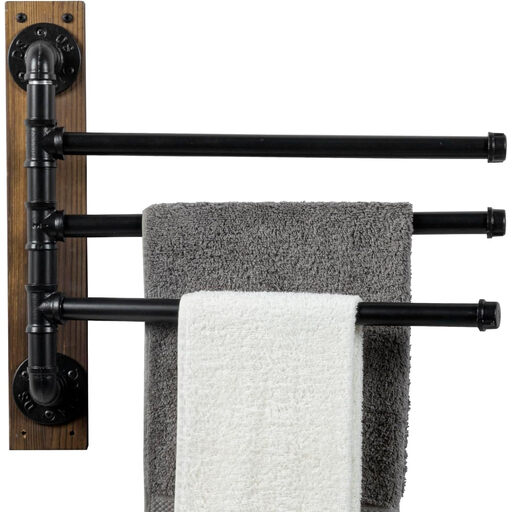
Why this product suits this profile: Three bars that swivel through 180 degrees create separate hanging spaces, making this rack suitable for families, holiday lets or households where towels are changed frequently.
When not in use, the swivel design can be folded flat against the wall to save space. Before installation, allow for the additional depth when the bars are extended.
Three 180-degree bars; wall mounting; combination of powder-coated metal and wood.
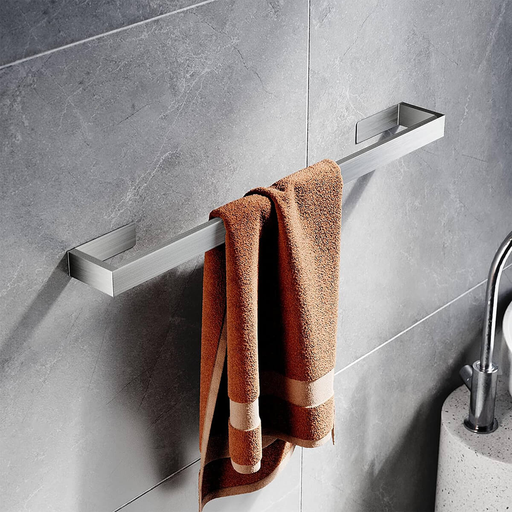
Why this product suits this profile: The self-adhesive design is ideal for users who do not want to drill holes and need a 600 mm hanging rail.
The mounting method is explicitly described as self-adhesive. Before attaching it, the wall should be clean, dry and suitable for adhesive mounting.
Brushed stainless steel; 61.5 cm length; drill-free installation according to the product description.
We have put together a complete, regularly updated list of products that fully meet these strict selection criteria and the safety regulations applicable in the EU.
A freestanding towel stand requires no wall mounting and can be moved around easily during renovations or in rented properties. For very small spaces, a compact towel holder placed on the vanity may be sufficient. A black model often suits industrial or modern interiors; with a black towel rail, however, make sure that the finish complements the rest of the bathroom fittings and check how it should be cleaned.
For doors, a three-tier holder provides a tool-free solution. Check the maximum door thickness and whether the door can still be closed without difficulty. In kitchens, cloakrooms, hotel bathrooms or holiday lets, your choice should also reflect the expected level of use and cleaning routine.
With screw mounting, you drill through the tile and into a suitable substrate. Use the correct drill bit and wall plugs, and make sure there are no pipes or cables behind the wall. In rented properties, a self-adhesive holder may be suitable, provided the surface is clean, dry, smooth and strong enough.
Its service life depends on the material, moisture levels, mounting method and load. A secure screw fixing may be more stable on a suitable wall than an adhesive solution. Regularly check the screws, adhesive surfaces and any visible corrosion. Wood should not be left permanently wet, while metal surfaces should be kept dry wherever possible.
The price depends on factors including the material, size, mounting method and number of bars. Simple single bars are usually cheaper than multi-level or swivel models. Do not compare only the purchase price; also consider the mounting hardware required, care involved and suitability for the intended room.