
Lieferung heute & morgen

Qualitätsgarantie

Willkommens-Angebote freischalten: KOSTENLOSE Lieferung | Bis zu 80 % RABATT | Kostenlose 30-Tage-JoyPlus-Testphase
App herunterladen
A new bathroom vanity should create order and visually enhance your bathroom. However, the sheer number of options can quickly become overwhelming, leading to costly mistakes. Instead of gaining practical storage space, many buyers end up frustrated with ill-fitting furniture that shows defects after only a short time. As your Joybuy Product Recommendation Officer, I'll show you which pitfalls to watch out for and how to find the perfect model for your needs.
Often, it's not the obvious features that cause problems later, but the details left unmentioned in product descriptions. Three issues are particularly common:
To avoid these problems, you should check three core parameters before buying. These will help you separate the wheat from the chaff and find a durable, functional solution.
The material is crucial for the longevity of your cabinet in a humid bathroom climate.
Regardless of the core material, a water-repellent paint or coating is essential to prevent swelling.
The choice of mounting type affects not only the look but also the functionality, especially in small rooms.
Before you buy, measure precisely: the width, height, and depth of the available space, as well as the position and dimensions of your p-trap. A 60 cm vanity unit is a common standard width that fits many bathrooms. For a vanity for a guest toilet, narrower models under 50 cm wide are often required.
Also, consider what type of storage you need. Open shelves offer quick access to towels or decor, while a bathroom vanity with drawers helps to store small items like cosmetics neatly and dust-free.
Here are some models tailored to specific needs and room situations that purposefully avoid the pitfalls mentioned.
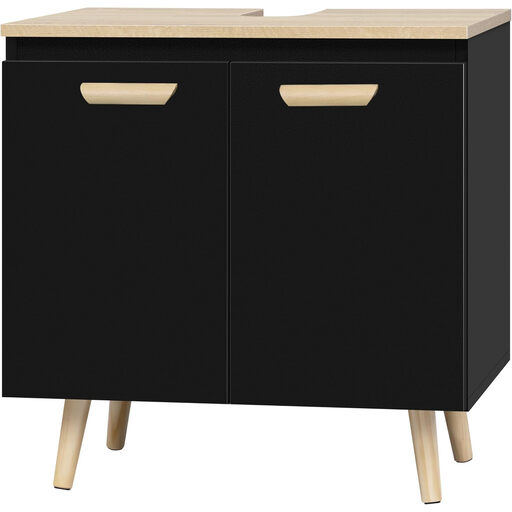
Why This Fits Their Persona: Ideal for anyone looking for a straightforward and functional storage solution without breaking the bank. The simple design fits into almost any bathroom, and assembly is manageable even for DIY beginners, thanks to numbered parts.
The material is described as moisture-resistant engineered wood, which counteracts the problem of swelling. The standard 60 cm width is designed for common sinks, reducing the risk of an ill-fitting p-trap cutout.
Offers plenty of enclosed storage space with two doors. The easy-to-clean surface and stable, freestanding construction make it a solid foundational piece.
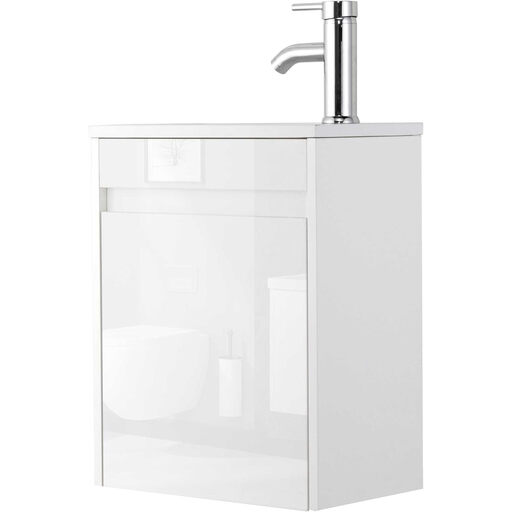
Why This Fits Their Persona: Perfect for very small bathrooms or powder rooms where every centimetre counts. This set combines a sink and cabinet into a compact, wall-mounted unit that visually enlarges the space and adds a modern touch.
Since the sink and cabinet are designed as a set, a perfect fit is guaranteed—eliminating the p-trap pitfall. The wall-mounted design ensures a secure, wobble-free hold, provided the wall is load-bearing.
Extremely space-saving design. The smooth resin surface of the sink is easy to clean, and the set already includes an integrated pop-up drain valve.
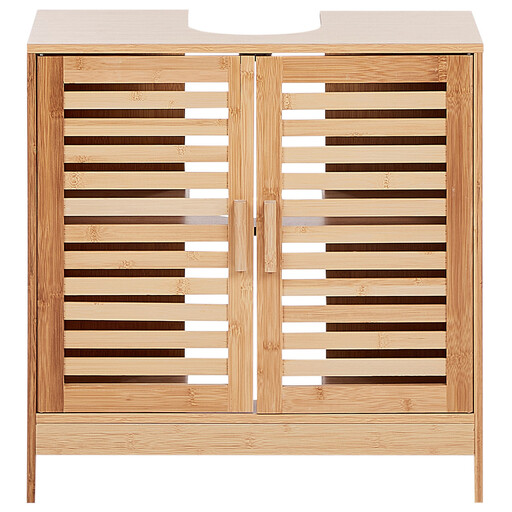
Why This Fits Their Persona: For those who prefer a warm, natural, and Scandinavian-inspired aesthetic in the bathroom. This cabinet brings a piece of nature indoors with its bamboo material and slatted door design.
Bamboo is naturally well-suited for humid environments as it swells very little. This bypasses the trap of low-quality, swelling materials. The slatted doors also promote air circulation inside the cabinet.
Made from a rapidly renewable resource. The two shelves provide structured storage space behind the visually appealing doors.
We have compiled a complete, up-to-date list of products that fully meet these strict selection criteria and safety standards.
1. How do I measure correctly for a bathroom vanity? Measure the maximum width, depth, and height of the space available under your sink. The measurement for the p-trap cutout is also crucial: measure the distance from the wall to the center of the drain pipe (for the depth of the cutout) and the distance from the floor to the bottom of the p-trap (to ensure it fits inside the cabinet). Also, measure the width of the p-trap itself.
2. Can I install a wall-mounted vanity on any wall? No. A wall-mounted installation requires a stable, load-bearing wall, ideally made of concrete, solid brick, or sand-lime brick. For lightweight walls (e.g., drywall), special hollow-wall anchors must be used, and the load-bearing capacity must be checked beforehand. When in doubt, have a professional assess the wall.
3. What is the difference between MDF and particle board in bathroom furniture? MDF (Medium-Density Fibreboard) is made of finer wood fibers pressed under high pressure. This makes it denser, more stable, and less prone to swelling from moisture than conventional particle board. Particle board is cheaper, but its durability in the bathroom depends almost exclusively on the quality and seamless sealing of its outer coating. For greater longevity, a well-coated MDF board is often the more reliable choice.