
Lieferung heute & morgen

Qualitätsgarantie

Willkommens-Angebote freischalten: KOSTENLOSE Lieferung | Bis zu 80 % RABATT | Kostenlose 30-Tage-JoyPlus-Testphase
App herunterladen
A bathroom cabinet should create order without reducing the available movement area. In small bathrooms, guest WCs and rental apartments, design is therefore only one consideration. Dimensions, layout, materials and secure installation are equally important. Focusing solely on a slim profile or a supposed moisture resistance can later lead to unstable furniture, unsuitable doors or hard-to-reach compartments.
“ Slim” often refers only to the width. For practical everyday use, however, height and depth are just as important. A tall bathroom cabinet may take up very little floor space, but it could be unsuitable in front of a window, power socket or sloping ceiling. Before buying, you should measure:
Bathroom furniture is regularly exposed to humidity and splashing water. A surface made from MDF or chipboard may be designed for this environment, but that does not automatically make it waterproof. Standing water, exposed edges or permanently wet floors can damage the material.
Look for a smooth, wipe-clean surface, sufficient clearance from the floor and effective ventilation. Water should be removed promptly. Manufacturer information about material quality and care is more meaningful than broad advertising claims.
A large number of compartments does not necessarily mean a practical layout. Large shampoo bottles require a different shelf height from cosmetics, toilet paper or folded towels. Adjustable shelves, drawers and closed storage areas make it easier to adapt the cabinet to different items.
Open compartments provide quick access but make dust and clutter more visible. Doors keep contents out of sight, while drawers are ideal for smaller essentials. A combination of storage types can be more practical for couples and families than relying on just one format.
A slim bathroom cabinet measuring around 20 cm wide is suitable for very narrow recesses. Where more floor space is available, a model with a depth of 30 to 35 cm can offer considerably more usable storage. A space-saving bathroom cabinet also makes effective use of the room’s vertical space. With tall furniture, wall-mounted anti-tip protection is particularly important.
For the area beneath the washbasin, you must account for the siphon. Check whether the cabinet is designed for a washbasin with or without a pedestal and whether the cut-out matches the existing connections. A washbasin vanity unit must not obstruct pipes, shut-off valves or access to the water installation.
The models featured here use materials including E1-grade MDF, chipboard and metal. For wood-based materials, E1 indicates a formaldehyde emissions class. However, this does not automatically mean that a piece of furniture is suitable for every level of moisture exposure.
The following details are particularly relevant for everyday use:
A moisture-resistant bathroom cabinet should not be placed directly in a permanently wet area unless the manufacturer explicitly permits this.
A bathroom cabinet with drawers is ideal for small items such as brushes, shaving accessories or cosmetics. With a bathroom cabinet with doors, towels, cleaning products and toilet paper remain discreetly concealed. A bathroom cabinet with open compartments offers quick access but requires more frequent cleaning.
Also consider the opening direction and the space in front of the cabinet. In a guest WC, a door may already conflict with the washbasin or the room door.
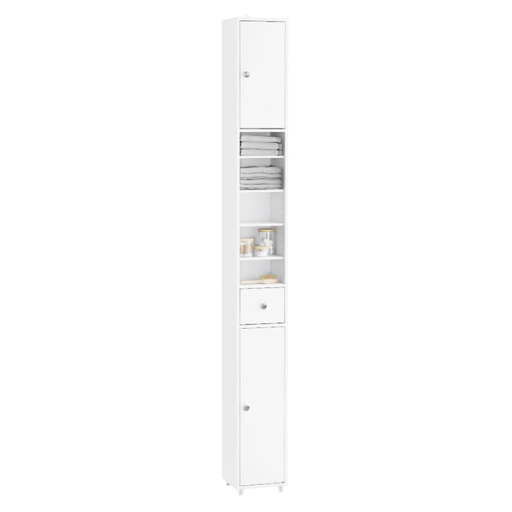
Why This Fits Their Persona: At just 20 cm wide, this model fits into very narrow recesses while making use of vertical space for towels, toilet paper or cleaning products.
The six height-adjustable shelves prevent a rigid layout. The wall-mounting option addresses the tip-over risk associated with a 180 cm-tall cabinet.
E1 MDF, a central drawer, a matt white finish and a stated load capacity of up to 45 kg.
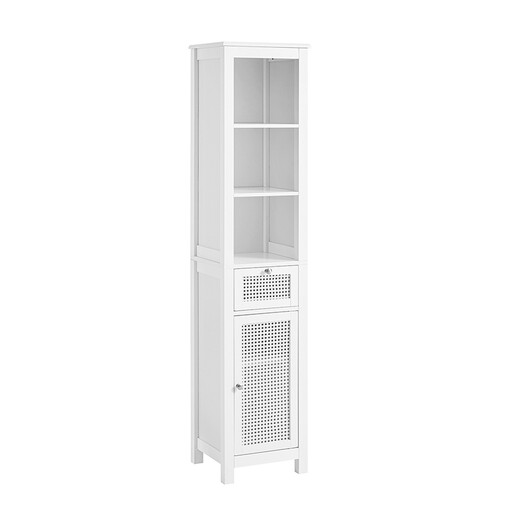
Why This Fits Their Persona: Three open compartments, one drawer and a slatted door appeal to households looking to combine accessible and concealed storage.
According to the product description, the ventilated slatted door and ventilated drawer base are designed to promote air circulation. This does not replace dry, regular care.
E1 MDF, a height of 161 cm, adjustable compartments and a stated total load capacity of up to 55 kg.
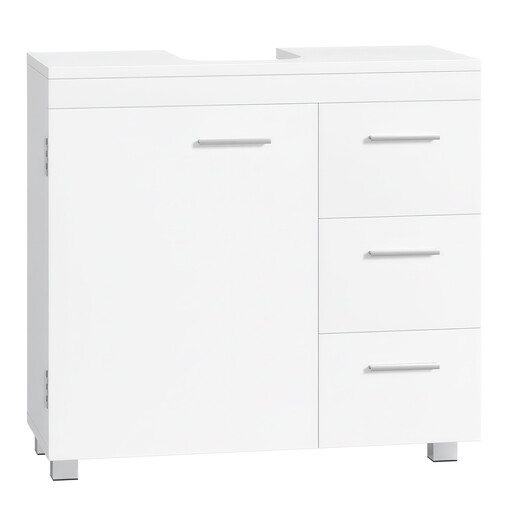
Why This Fits Their Persona: This under-sink model makes use of the space beneath the washbasin and provides three drawers plus two compartments behind a door.
The adjustable shelf accommodates bottles of different heights. Before buying, check compatibility with the siphon, washbasin pedestal and existing connections.
A stated static load capacity of up to 36.2 kg, an anti-tip kit and a combination of drawers and enclosed compartments.
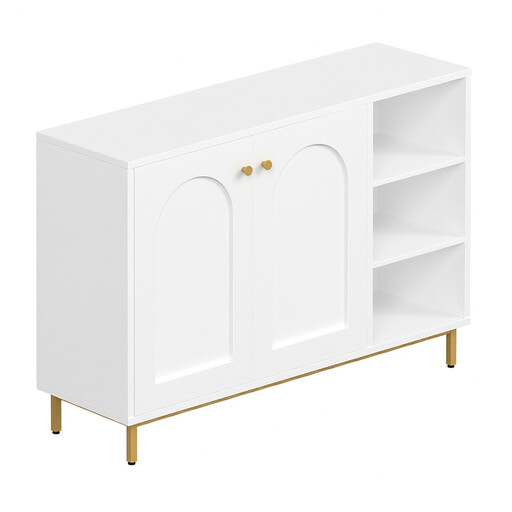
Why This Fits Their Persona: The wider sideboard is designed for households managing multiple categories, including towels, personal-care products and storage boxes.
Three height-adjustable shelves accommodate different compartment heights. The raised feet create clearance from the floor, although splashed water should still be wiped away.
Two doors, three open sections, metal components and a stated floor clearance of 12.5 cm.
Explore the full selection to find more models by placement, layout and intended use. Before buying, always check the dimensions, material specifications and fixing instructions.
Before assembly, make sure the surface is level and structurally sound. Tall or narrow furniture should be secured to the wall according to the instructions using the supplied anti-tip kit. In rental properties, clarify whether drilling is permitted or which alternative fixing solution may be used.
Place heavy cleaning products as low as possible and observe the load limits for individual shelves and drawers. Doors and drawers should close smoothly without force. In most cases, a lightly damp cloth is sufficient for care; standing moisture and aggressive cleaning products can damage the surface.
For narrow recesses, consider a tall bathroom cabinet with limited depth or a corner model. Measure the available space, including the door swing, and check whether a tall unit can be securely fixed to the wall. A washbasin vanity unit makes use of existing space but requires a suitable cut-out for the plumbing connections.
E1 MDF is a material specification, not a blanket guarantee of water resistance. A cabinet is suitable only within the limits set out by the relevant manufacturer’s instructions. Ensure adequate ventilation, wipe away splashes and avoid permanently wet floors or direct sources of water.
Its service life depends on the materials, construction quality, installation, load and moisture exposure. Secure wall mounting, evenly distributed weight and regular drying can support reliable everyday use. Without specific testing and usage conditions, it would not be responsible to state a universal lifespan.