
Lieferung heute & morgen

Qualitätsgarantie

Willkommens-Angebote freischalten: KOSTENLOSE Lieferung | Bis zu 80 % RABATT | Kostenlose 30-Tage-JoyPlus-Testphase
App herunterladen
The right bathroom towel rail helps keep things tidy, supports drying and makes better use of the space available. However, some purchasing decisions can quickly lead to unnecessary costs. A solution may look appealing but still be unsuitable for your wall, door or everyday needs.
Claims such as “extra strong” or “long-lasting adhesion” are not very meaningful without specific conditions. What matters is which surface a product is designed for and what maximum weight it can support. A suction-cup towel rail may work on smooth tiles, but it may not hold reliably on a rough or porous wall.
A wide freestanding towel rail needs not only floor space but also sufficient clearance from the shower, washbasin and doors. With a wall-mounted towel rail, you should also check whether the rails fold out or can be rotated. A space-saving design is only practical if towels do not overlap and have enough air around them.
Wood, metal and plastic react differently to moisture. Powder-coated metal and stainless steel can generally be wiped clean easily. With wood, surface treatment, exposure to splashing water and regular care are important. A towel rail without drilling is not automatically suitable for every wall either: adhesive and suction solutions usually require a smooth, clean and dry surface.
Flexible options are ideal for rented homes or rooms whose layouts change frequently:
Before buying, measure the available width, depth and height. In small bathrooms, slim models, rotating rails or a towel hook are often more practical than a wide freestanding rail. Ideally, several rails should be spaced apart so that damp towels do not remain pressed against one another.
A towel shelf or shelving unit can complement the rail if you need space for folded towels, toiletries or baskets. Additional individual towel hooks are also useful in kitchens, hallways and guest rooms.
Look for specific information about:
A combination of a wood and metal towel rail brings together a warm appearance and a sturdy construction. In an area exposed to a great deal of splashing water, the surface should nevertheless be checked regularly and kept dry.
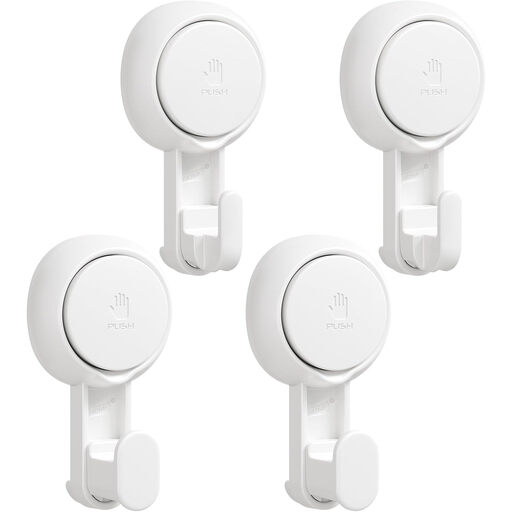
Why this product suits this profile: The four rotating hooks can be fitted without drilling to suitable smooth surfaces and positioned flexibly around the bathroom or kitchen.
The maximum load is specified as 11 lb. At the same time, unsuitable surfaces are explicitly excluded.
Four hooks, 360-degree rotation and the option to refit repeatedly on suitable, dry surfaces.
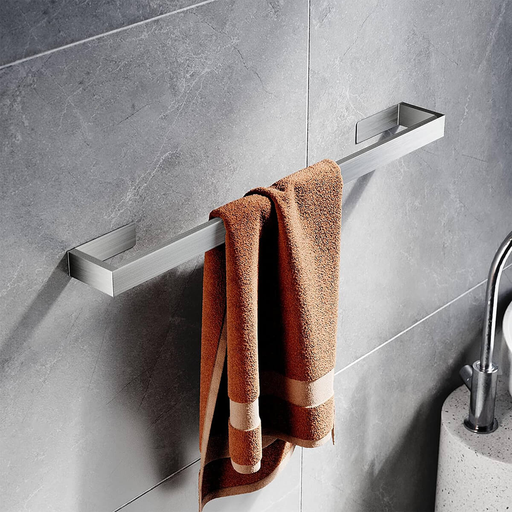
Why this product suits this profile: This wall-mounted holder made from brushed stainless steel combines a clean look with a long support surface for several towels.
The product details specify the material, dimensions and installation method, rather than making only a general claim about moisture resistance or durability.
Brushed stainless steel, self-adhesive installation and a specified length of 61.5 cm.
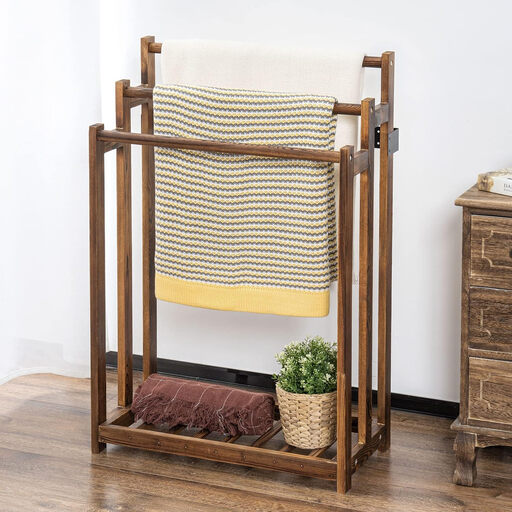
Why this product suits this profile: Three tiers provide space for towels, dressing gowns or clothes. The lower shelf adds bathroom storage for baskets and toiletries.
The freestanding design makes it easy to plan the floor space required. If needed, floor mounting is also possible using the supplied accessories.
Solid wood, three hanging tiers and an additional shelf for freestanding or floor-mounted use.
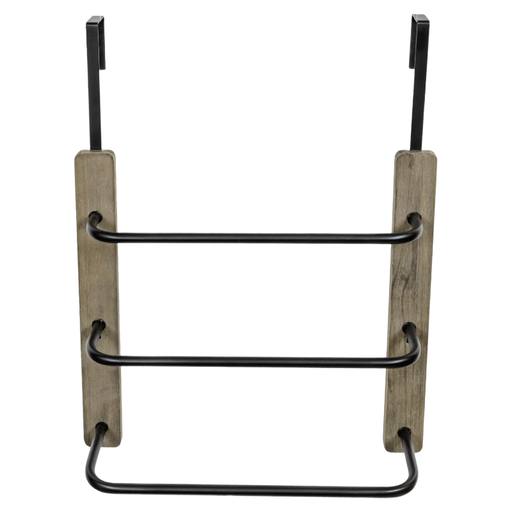
Why this product suits this profile: This over-the-door towel rail makes use of vertical space and requires neither wall drilling nor additional installation accessories.
The suitable door thickness is specified as up to 4.4 cm. This allows you to check before ordering whether the design will fit your existing door.
Tool-free installation, three metal rails arranged one above the other, and a combination of wood and metal.
We have put together a complete, regularly updated list of products that fully meet these strict selection criteria and the safety regulations applicable in the EU.
First, the surface must be clean, dry and free from grease. Suction cups require smooth, non-porous surfaces. Self-adhesive models should be fitted according to the manufacturer’s instructions and left securely fixed for long enough before being loaded. On wallpaper, rough plaster or uneven tiles, an alternative installation method is usually more suitable.
That depends on the design. Towel rails need enough clearance to prevent the towel from resting directly against the wall. With several tiers or rotating rails, the full range of movement should remain unobstructed. Before installation, it is advisable to mark the fully extended design on the wall using masking tape.
Its lifespan depends on the material, installation, load and moisture levels. Stainless steel and coated metal should be cleaned regularly with a soft cloth. With suction cups, adhesion may decrease because of dust, soap residue, heat or an unsuitable surface. If the stated load capacity is observed and the installation is checked regularly, typical performance issues can be identified at an early stage.