
Lieferung heute & morgen

Qualitätsgarantie

Willkommens-Angebote freischalten: KOSTENLOSE Lieferung | Bis zu 80 % RABATT | Kostenlose 30-Tage-JoyPlus-Testphase
App herunterladen
By the Joybuy Product Recommendation Officer Published July 23, 2026
Independence on the road means staying comfortable anywhere, regardless of the outside temperature. Whether you're camping in a tent, relaxing in your own RV, or on a road trip in a van, reliable climate control can significantly enhance your comfort. A battery-powered portable air conditioner promises just that: cooling or heating, even when there's no power outlet in sight.
However, the market offers a wide variety of models that differ greatly in performance, power source, and design. This article is designed to provide clear guidance. We will introduce various concepts, from battery-powered all-rounders to permanently installed 12V systems, and explain the crucial criteria for making your choice.
Selecting the right unit depends on your vehicle, travel destinations, and comfort requirements. The following points will help you make an informed decision.
The type of power supply is the most critical feature for mobile use.
The performance of an air conditioner is typically specified in BTU (British Thermal Unit) per hour for cooling and in watts (W) for heating.
Portable air conditioners come in various designs.
Here, we present three different product concepts suitable for various camping and travel scenarios.
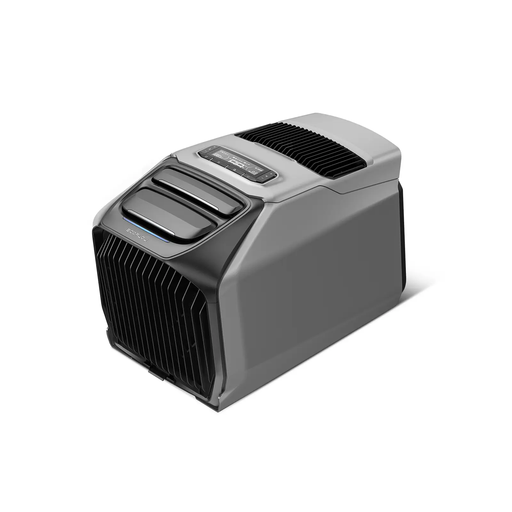
Why It Stands Out: The EcoFlow WAVE 3 is a versatile solution that combines cooling and heating in a compact, portable package. Its strength lies in the optional battery power supply, which enables off-grid operation for up to 8 hours.
Pros:
Who It's For: Ideal for van life enthusiasts, tent campers, and anyone seeking a maximally flexible and self-sufficient climate solution for various scenarios, from an SUV to a small cabin.
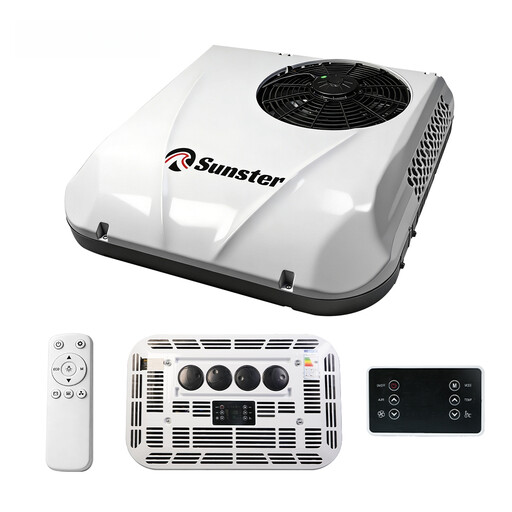
Why It Stands Out: This model is designed as a permanent air conditioner solution for RVs and campers. It is installed permanently on the roof and connected directly to the 12V or 24V electrical system, allowing for seamless integration without messy interior cables.
Pros:
Who It's For: Perfect for owners of RVs, caravans, or converted trucks who are looking for a powerful, permanently installed, and energy-efficient cooling solution for their vehicle.
Important Note: The unit is shipped without refrigerant. A professional must fill it with 450g of R1234yf or R134a separately.
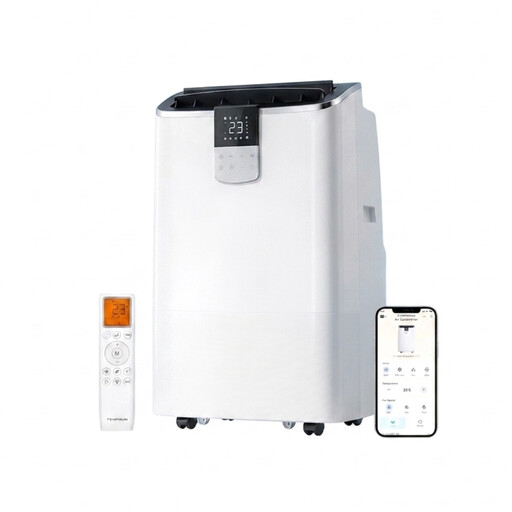
Why It Stands Out: The Temprium air conditioner is a powerful 4-in-1 solution designed to run on a 230V outlet. With 12000 BTU, it offers high cooling capacity suitable for larger rooms or RVs at campsites with shore power.
Pros:
Who It's For: A great choice for users who stay at campsites with power hookups or need a powerful, mobile cooling solution for vacation homes, larger caravans, or for pre-cooling a vehicle before departure.
If the models presented here don't perfectly match your requirements or if you're looking for a solution with a different set of features, you can find a broader selection of units in our category.
? Discover more models in the Portable Air Conditioner with Hose Kit category
1. How long does a battery-powered portable air conditioner run? The runtime heavily depends on the battery capacity, the set temperature, and the ambient temperature. Models like the EcoFlow WAVE 3 can run for 2 to 8 hours on their add-on battery (1024 Wh). The runtime is extended in Eco mode or at lower cooling settings.
2. Can you use a portable air conditioner in a tent? Yes, this is possible and a common use case. It is important that the unit's exhaust hose can vent the warm, moist air outside. This requires an opening in the tent, or a zipper can be left slightly open. Ensure the unit is placed on a stable and level surface.
3. Does a 12V air conditioner need an external power connection? A 12V air conditioner does not need an external 230V power connection like a household outlet. It is powered directly by the vehicle's battery (e.g., in an RV or truck). However, this battery must be recharged regularly, either by the alternator while driving, by a rooftop solar system, or by connecting the vehicle to shore power at a campsite. Therefore, it is grid-independent but not indefinitely self-sufficient without recharging.