
Lieferung heute & morgen

Qualitätsgarantie

Willkommens-Angebote freischalten: KOSTENLOSE Lieferung | Bis zu 80 % RABATT | Kostenlose 30-Tage-JoyPlus-Testphase
App herunterladen
A battery-powered car polisher is useful when larger machines are difficult to use around door handles, headlights, wheels, mirrors or bodywork edges. However, not every compact machine is the right solution. What matters is not just a high speed or a long list of accessories, but the combination of drive system, backing plate, battery and controllable movement.
A high speed can be useful for certain tasks, but it also increases the risk of heat build-up and uneven results. When polishing car paint, multiple speed settings, a controlled start and the right polishing motion are therefore more important than a single maximum speed.
Compact machines often use small 12-volt batteries. Actual run time depends on pressure, material, polishing pad and speed. Claims such as “30 minutes” or “60 minutes” should therefore always be considered in the context of the test conditions. For detailing a car, a second interchangeable battery can be more practical than a built-in battery.
A car polishing set may include plenty of sponges, backing plates and attachments. What matters is whether the backing plate sizes suit the surface you’re working on, and whether the attachments are designed for rotary or random orbital use. A 125-mm backing plate is suitable for larger areas, while 25, 50 or 75 mm plates can be easier to control around emblems, wheels and tight areas of bodywork.
A rotary polisher spins the backing plate on a fixed axis. It can be used directly for targeted work, but requires controlled handling. A random orbital polisher also moves the plate in an eccentric orbit. This type is often used to achieve more even movement across painted surfaces. A DA polisher usually refers to a dual-action drive system, combining rotary and random orbital movement.
A switchable system can be useful for hard-to-reach areas. It lets you adapt the drive to the surface and the task at hand. If you’re new to polishing, it’s a good idea to start at a low speed and apply light pressure on an inconspicuous area.
Check:
For example, the BATOCA S5 product details list six settings from 2,000 to 5,500 rpm. The BATOCA S6 is listed with a speed range of 1,000 to 5,000 rpm for the RO/DA system and 4,200 to 21,000 rpm for the mini system. These figures describe the adjustment range, but don’t by themselves guarantee a particular polishing result.
Look out for:
A set with two batteries can be useful for longer car-care sessions. According to the product details, the BATOCA S5 and S6 each come with two 12 V 2.0 Ah lithium-ion batteries, with a stated no-load run time of up to around 30 minutes per battery. The BATOCA S2 is listed with two 5 Ah batteries and a stated no-load run time of around 60 minutes per battery. Run times under real working conditions may vary.
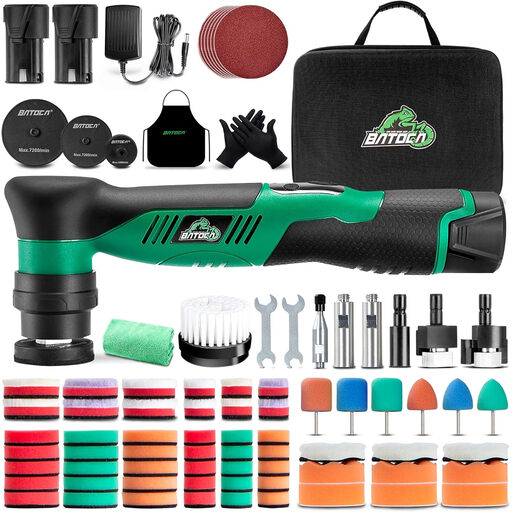
Why this product suits this user: This set is aimed at home users looking for a compact cordless polisher for smaller areas of paintwork, headlights, wheels and emblems.
Two interchangeable batteries help reduce interruptions. Three drive options and six speed settings mean you’re not limited to just one way of working.
25, 50 and 75 mm backing plates; 2 × 12 V, 2.0 Ah; stated speed range of 2,000 to 5,500 rpm.
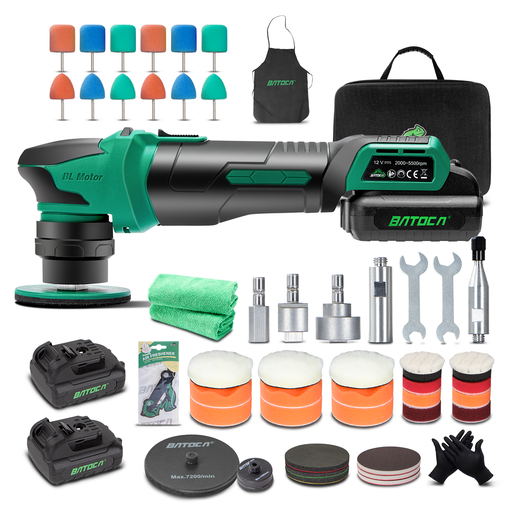
Why this product suits this user: For anyone who regularly details their car, this model offers a brushless motor, two drive systems and accessories for paintwork, plastic and glass.
Switching between rotary and random orbital movement lets you adapt to different detailing jobs. The speed can be set across four levels from 2,000 to 5,500 rpm.
Two 12 V batteries, each with a capacity of 2.5 Ah; 25 and 75 mm backing plates; 3 and 12 mm orbital throw, according to the product details.
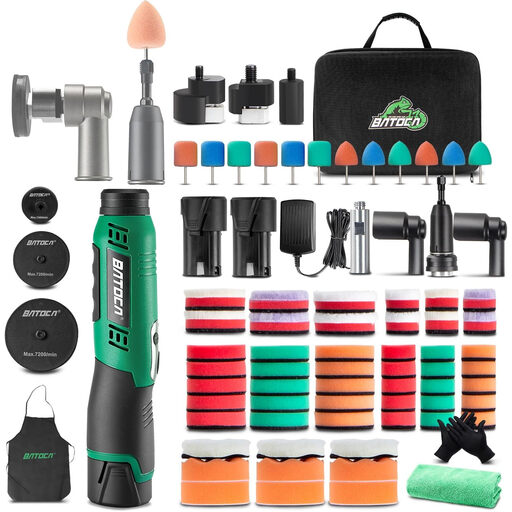
Why this product suits this user: The dual RO/DA system and additional mini polishing head make this a good fit for car detailers, workshops and anyone who needs to reach lots of awkward areas.
Interchangeable drive systems and several backing plate sizes reduce the need for different machines to tackle edges, wheels, headlights and bodywork details.
RO/DA switch, 3 and 12 mm orbital throw, 25, 50 and 75 mm backing plates, plus two 12 V batteries with a capacity of 2.0 Ah.

Why this product suits this user: This machine is suited to anyone who prefers a larger 125 mm polishing sponge and a battery indicator when looking after their car.
According to the product description, the LCD shows speed and battery information. Two batteries and a stated run time of around 60 minutes per battery can help reduce interruptions.
8 mm random orbital movement, six settings with soft start, LCD display and two 5 Ah lithium batteries, according to the product details.
For paint correction, headlight polishing or wheel polishing, choose pads and polish that are suitable for the material. Abrasives aren’t automatically suitable for clear coat. For renovation work, a sandpaper set or suitable sanding accessories may be a better choice. The WORKPRO set, with 93 × 185 mm sheets, hook-and-loop fastening and 40, 60, 80 and 120 grit, is designed for compatible multi-sanders and random orbital sanders. For corners, a triangular set measuring 105 × 152 mm, with grits from 40 to 180, is a good option.
Before each use:
We’ve put together a complete, regularly updated list of products that meet these strict selection criteria and fully comply with the safety regulations in force in the EU.
A compact model with several speed settings, an interchangeable battery and small backing plates is easier for beginners to handle. It’s important to start at a low speed and use light pressure. A switchable rotary and random orbital drive can offer extra versatility, but you’ll need to choose the right mode carefully.
It depends on battery capacity, speed, pressure and workload. The run times given are based on product information, and some refer to no-load conditions. For longer jobs, two batteries and the availability of replacements are practical things to consider. Store lithium-ion batteries in a dry place and follow the manufacturer’s charging instructions.
A mini polisher is mainly designed for details, edges and tight areas. A larger backing plate can make it easier to work on large bonnets or roofs. Depending on the area, a mini machine is therefore better used alongside a larger car polisher when detailing the whole vehicle.