
Lieferung heute & morgen

Qualitätsgarantie

Willkommens-Angebote freischalten: KOSTENLOSE Lieferung | Bis zu 80 % RABATT | Kostenlose 30-Tage-JoyPlus-Testphase
App herunterladen
A battery-powered outdoor table lamp should be flexible to use, free from annoying cables and easy to move wherever you need it. For the balcony, a dinner on the terrace, the campsite or as decorative indoor lighting, it’s not just about design and price. What really matters includes battery life, protection rating, brightness, colour temperature and charging port.
If you read product descriptions carefully, you’ll spot several common buying pitfalls. Some table lamps look like outdoor models but are intended for indoor use only. Others boast exceptionally long runtimes but only quote them for the lowest brightness level. And terms like “waterproof” shouldn’t be taken at face value: the official IP protection rating is what counts.
A metal finish, a handle or a lantern-style shape doesn’t automatically make a lamp suitable for outdoor use. A model with IP20 is designed for dry indoor spaces. According to the product details, the Atmosphera Wiza White USB Outdoor Lamp H23 is rated IP20 and intended for indoor use. It should therefore not be used on the balcony, terrace or in a damp garden.
A proper LED outdoor lamp requires a clearly stated protection rating. IP44 means protection against solid objects ≥1 mm and against splashing water from various directions. That doesn’t replace a sheltered position and does not allow immersion in water. In heavy rain, even an IP44 outdoor lamp should be brought under cover wherever possible.
A runtime of several hours is only meaningful if you know which brightness setting it refers to. A rechargeable table lamp at higher brightness consumes more energy than one in a dimmed night-light mode. Look out for:
A larger battery can extend runtime but often adds weight and charging time. For everyday use on the dining table, moderate brightness is often enough. When camping or during a power cut, long runtime at a low setting may be more important than maximum light output.
An atmospheric garden light should create a pleasant ambience. Different requirements apply for reading, working or safely lighting a path. Brightness is given in lumens. A lamp with 90 lumens is better suited as a decorative light source, while 200 lumens provides more headroom for table areas.
Light distribution also matters: a closed diffuser often produces even 360-degree light. A directed beam, on the other hand, can illuminate a specific area more precisely. Also check the colour temperature. 3000 Kelvin indicates warm white light, while a range of 3000 to 6500 Kelvin can offer different light colours.
For balconies, terraces and gardens, choose a lamp explicitly labelled as an outdoor model with an appropriate IP rating. IP44 protects against splashing water, not against continuous rain, pressure washing or immersion. For indoor spaces, a lower protection rating may be sufficient depending on placement. A lamp with IP20 must not be repurposed for outdoor use.
A dimmable table lamp is practical if you want to use it both for dinner and as a bedside lamp. Touch controls, buttons or a rotary dial each have pros and cons. What matters is whether brightness is adjusted in steps or continuously, and whether the lamp remembers the last setting.
A portable LED lamp should stand securely and be easy to grip. A non-slip base helps on smooth tabletops. For camping or frequent repositioning, compact dimensions and low weight are important. Metal can lend a premium look, while plastic is often lighter. Also check whether a USB cable or mains adaptor is included.
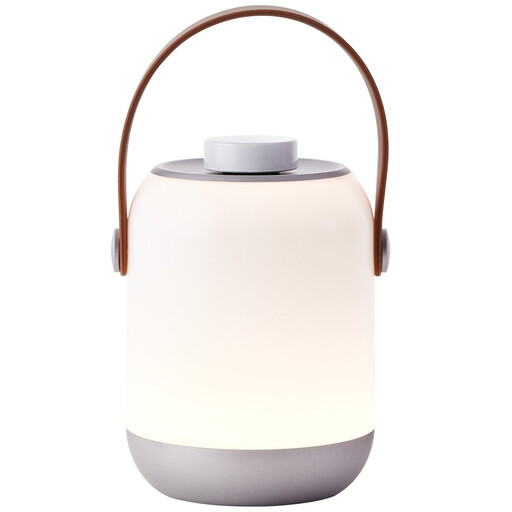
Why this product fits the profile: This compact battery table lamp suits anyone after a straightforward solution for the balcony, a garden party or the bedside.
The IP44 rating and the stated dimming function make its intended use clearer than a design-only description.
200 lumens, warm white light at 3000 Kelvin, compact form factor and a rechargeable battery.
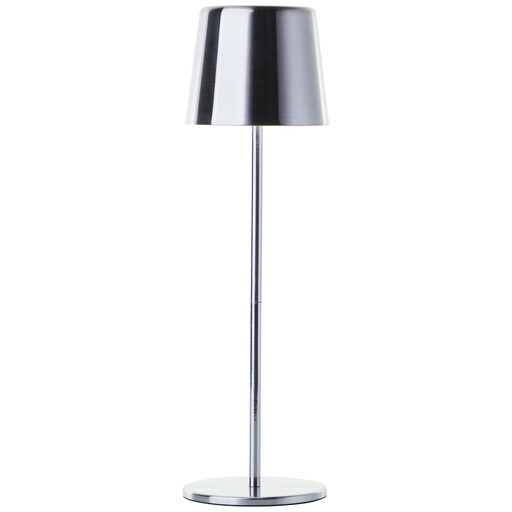
Why this product fits the profile: This model combines a taller build with adjustable colour temperature and brightness, making it suitable for a variety of indoor and outdoor settings.
The IP44 designation distinguishes it from purely decorative indoor lamps. USB port and touch dimmer are clearly specified.
300 lumens, colour temperature from 3000 to 6500 Kelvin, stepless dimming, USB charging and IP44.

Why this product fits the profile: This portable LED lamp with handle is designed for camping, frequent repositioning, outdoor dinners and extra lighting around the home.
The description lists IP44, USB charging and four brightness levels. The stated runtime of up to 80 hours refers to the lowest brightness setting.
4000 mAh battery, four-step touch dimming, 360-degree light distribution and ergonomic carry handle.
A solar table lamp charges via an integrated solar panel and, with suitable sunlight, doesn’t need regular cable charging. In Germany, cloudy days, short daylight hours or a shaded balcony can reduce charging performance. Check the charging time, stated operating time and any built-in timer.
The Katy Solar LED Table Lamp Height 30 cm is described with IP44, warm white light, 90 lumens, a timer and a stated battery life of six hours. It suits users looking for a decorative table lamp for balcony and terrace with minimal charging effort. For consistent brightness regardless of the weather, a USB-rechargeable table lamp is easier to plan around.
We’ve compiled a comprehensive, regularly updated list of products that fully meet these stringent selection criteria and comply with EU safety regulations.
IP44 protects against splashing water, not against all weather exposure. Place the lamp under cover where possible and store it in a dry place during heavy rain, frost or extended periods of non-use. Also follow the respective manufacturer’s instructions.
That depends on battery capacity, LED power and the brightness level. The manufacturer’s maximum runtime often refers to the lowest setting. In addition, a battery gradually loses capacity with charge cycles and age.
Compared with many older light sources, LEDs require relatively little electrical power. Your running costs depend on the wattage, daily usage time and your electricity tariff. With solar models, there are no ongoing mains charging costs; however, the available operating time depends on light conditions.