
Lieferung heute & morgen

Qualitätsgarantie

Willkommens-Angebote freischalten: KOSTENLOSE Lieferung | Bis zu 80 % RABATT | Kostenlose 30-Tage-JoyPlus-Testphase
App herunterladen
A battery-powered leaf blower can clear leaves, sawdust and light debris without a power cable. Many models are also marketed as cordless leaf blowers, battery-powered blowers or air dusters for cars and PCs. However, the intended use matters: a compact electric air duster for keyboards has different requirements from a garden blower for wet leaves.
Before you buy, it’s worth checking the technical specifications rather than relying on eye-catching marketing claims. Three common pitfalls are a frequent source of disappointment.
Figures such as 90,000 or 150,000 RPM look impressive, but they initially tell you only the motor speed. For practical cleaning, air speed, air volume and blowing force matter too. A high-RPM device may be suitable for cleaning a PC, but that doesn’t automatically mean it can shift large amounts of leaves.
Manufacturers often quote a long maximum runtime, but this usually refers to the lowest power setting. Runtime drops significantly at higher settings. For example, according to the product specifications, the Foursun TF100 runs for 120 minutes on low, 40 minutes on medium, 28 minutes on high and 13 minutes on turbo.
If you regularly clear a drive, patio and garden, check the runtime for each power setting as well as the charging time.
Some devices are sold as bare units. The Makita DUB185Z, for example, does not include a battery or charger, according to the product description. This matters if you don’t already have a compatible 18-volt battery. What looks like a bargain could end up costing more once you’ve bought the extra components.
Air speed is usually given in m/s or km/h and describes how fast air flows from the outlet. A high speed helps shift dust, sawdust and compacted dirt.
Air volume is often given in m³/min or m³/h. A higher volume can be useful for moving larger amounts of dry leaves. Blowing force is sometimes quoted in newtons or grams, offering another indication of the pressure at the outlet.
Where possible, compare figures measured using the same method. Figures from different product descriptions aren’t always directly comparable.
For a battery-powered leaf blower, battery capacity, voltage, charging time and the interchangeable battery system are all important considerations. Capacity in mAh is only useful for comparisons between batteries with the same voltage. For longer jobs, a second battery or a leaf blower kit with a battery and charger can come in handy.
Charging usually costs relatively little compared with running a petrol-powered model. However, ongoing costs depend on how often you charge, battery capacity and your electricity tariff. Lithium-ion batteries should be kept dry, protected from excessive heat and charged according to the manufacturer’s instructions.
Different nozzles give you more ways to use the blower. A flat nozzle is often useful for moving leaves across a wider area, while narrow or round nozzles can be used for gaps, keyboards and areas around vehicles. For an electric air duster for electronics, a low setting is particularly important to avoid putting unnecessary strain on sensitive components.
Multiple power settings make it easier to adapt the blower to where you’re using it. In residential areas, schools and other noise-sensitive places, check the sound power level and any local quiet hours. Eye and ear protection are advisable when dust or small particles may be blown around.
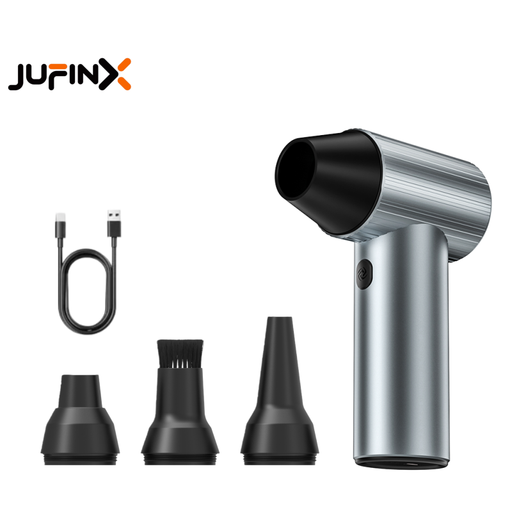
Why this product suits this profile: According to its product title, this compact cordless blower has three speed settings, a rechargeable battery and 20 W fast charging. It’s well suited to occasional cleaning jobs around the car, keyboard and workbench.
The three settings let you work in a controlled way instead of running the blower at full power all the time. Check what’s included and the exact battery capacity before buying.
Rechargeable design, three speed settings and cordless operation.
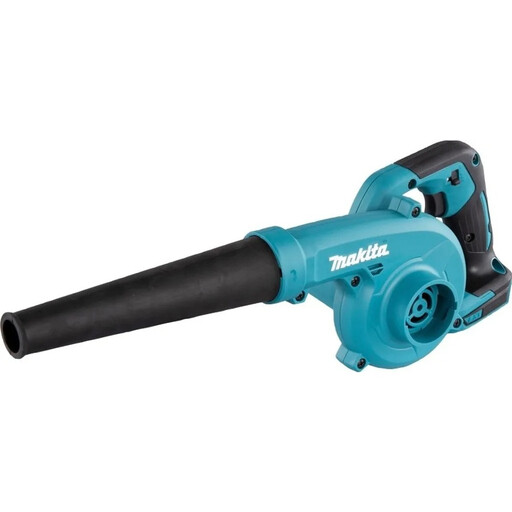
Why this product suits this profile: According to the product specifications, this 18-volt model has three settings, an air speed of up to 98 m/s and an air volume of 3.2 m³/min. It’s aimed at anyone looking for a compact tool that works with an established battery system.
The clearly stated air speed and volume, along with the three settings, make it easier to assess performance. Important: you’ll need to buy the battery and charger separately.
18-volt system, weighs 1.4 kg without the battery, and can also be used as a vacuum with a separately available dust bag.
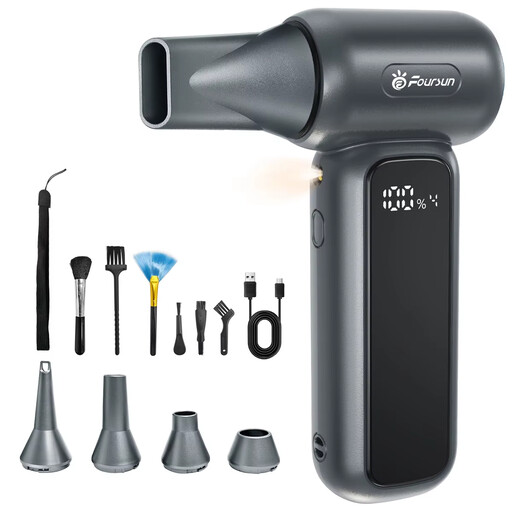
Why this product suits this profile: According to the product specifications, this battery-powered air duster is designed for cars, PCs, the home and other cleaning jobs. Four settings and several nozzles help it tackle a range of tasks, from cleaning more delicate surfaces to shifting tougher dirt.
Runtime is listed for all four settings, so you can get a more realistic idea of the roughly 13-minute turbo runtime than you would from a single maximum-runtime figure.
Brushless motor, Type-C charging port, four power settings and a comprehensive set of nozzles, according to the product description.
We’ve put together a complete, regularly updated list of products that meet these strict selection criteria and fully comply with the safety regulations in force in the EU.
Runtime depends on battery capacity, power setting, temperature and the amount of dirt to clear. For a realistic estimate, compare the manufacturer’s figures for the low, medium and high settings. If you have a large garden, a spare battery may be more useful than a particularly long charging time.
A suitable air duster for cars and PCs can clear dust from gaps and hard-to-reach areas. Make sure it has a low power setting. Keep your distance from sensitive components, don’t direct the airflow at fans for prolonged periods, and disconnect devices from the power supply before cleaning. Avoid moisture and compressed air from unsuitable sources.
Air speed helps loosen stubborn dirt. Air volume is important when you’re moving larger amounts of dry leaves. When choosing a leaf and dust blower, consider both figures, along with blowing force and the nozzles supplied.