Photographers shooting façades from tight spaces
If you want to capture the whole exterior of a building and can’t move further back, the angle of view at the short end is what matters most.


First, check whether you can fit the entire façade into the frame from your accessible vantage point: a longer telephoto end won’t give you a wider angle of view at the short end. A prime lens is a good fit if its fixed field of view suits your position; an optical zoom is more practical if you switch between the whole building and architectural details. For handheld shots, you should also weigh up stabilisation and maximum aperture at the focal length you’ll actually use.
If you want to capture the whole exterior of a building and can’t move further back, the angle of view at the short end is what matters most.
If you switch between the whole building, its window grid and distant details, or want to compose the edges of a building deliberately, a suitable field of view and good control over your framing are key.
If you carry your camera for a long time and shoot in changing light, its portability, stabilisation and controls should suit the way you plan to use it.
A good fit if: You usually photograph entire façades and the fixed angle of view suits the framing you want from your chosen position. Ricoh lists the GR IV as having an approximately 28 mm full-frame equivalent focal length and sensor-shift stabilisation.
The trade-off: Without optical zoom, you can’t bring a distant detail closer; a prime lens won’t give you a wider view if space is tight.
A good fit if: You want to switch between the entire façade and more distant details from the same position. Canon lists a 24–100 mm range for the PowerShot G7 X Mark III, Sony lists 24–200 mm for the RX100 VII, and Panasonic lists 24–360 mm for the TZ300; all are full-frame equivalent.
The trade-off: The zoom models listed start at 24 mm; a longer telephoto end brings details closer, but doesn’t widen the view for a full-building shot.
A good fit if: You have enough distance and want to compose a tighter view of the façade. Fujifilm lists the X100VI as having a fixed 35 mm full-frame equivalent focal length and a hybrid viewfinder.
The trade-off: A 35 mm lens captures less of the surroundings than the 24 mm and 28 mm options listed; if you’re close to the building, part of it may fall outside the frame.
| Priority | What to look for when buying | Who will find this most important? |
|---|---|---|
| Capturing the whole façade | Compare the angle of view at the short end: Canon, Sony and Panasonic list 24 mm full-frame equivalent for their respective zoom models, while Ricoh lists approximately 28 mm for the GR IV. If possible, check the framing from the position you plan to shoot from. | If I need to capture the whole façade from the position available to me, a wide angle of view comes first. Around 26% of consumers put capturing the whole façade at the top of their list. |
| Lines and perspective | Check whether you can judge edges clearly on the screen or through the viewfinder, and leave some room around the edges of the frame. Adobe Learn points out that correcting perspective later can leave blank areas at the edges that need to be cropped. | I want building edges and window lines to be deliberately composed in the frame, rather than having to correct them later. Around 21% of consumers put getting the lines right first. |
| Handheld shooting in low light | Compare stabilisation and maximum aperture at the focal length you’re likely to use. A manufacturer’s stabilisation claims don’t automatically apply to every shutter speed or moving subject. | When I’m out for a walk, I want to be able to shoot without a tripod, even when the light changes. Around 21% of consumers prioritise handheld shooting in changing light. |
| Distant details | Check the optical focal length at the telephoto end and how often you’ll be unable to get close to a detail. Panasonic lists 24–360 mm for the TZ300 and Sony lists 24–200 mm for the RX100 VII, both full-frame equivalent. | If windows or architectural features are far away from where I’m standing, I want to be able to bring them closer. Around 16% of consumers put reach for details first. |
| Carrying your camera on longer walks | Compare the weight and dimensions, including any accessories you actually plan to take with you. Then decide whether a prime lens or zoom will be more useful for your subjects. | On a longer walk, I want my camera to be comfortable to carry without having to compromise on the right angle of view. Around 16% of consumers prioritise portability. |
Telephoto reach is useful for distant details, but it won’t show you more of a building if the angle of view at the short end is too narrow for your position.
First compare the full-frame equivalent focal length at the short end, then consider how much telephoto reach you need.
How well it works depends on the camera, shutter speed and subject; camera stabilisation won’t automatically freeze the movement of people.
Compare stabilisation and maximum aperture for the framing you plan to use and the zoom setting you’ll shoot at.
Adobe Learn explains that straightening an image can create blank corners, which are then lost when you crop.
If possible, leave some space around the façade and check the building’s edges before taking the shot.
Cropping later can reduce the amount of image area you keep.
Under the conditions set out in § 59 UrhG, buildings may be photographed from public paths, roads or squares. This rule does not automatically give you permission to enter private property or take photographs inside a building.
Consider whether you’re shooting from a public place, accessible grounds or indoors. If you’re taking photos on private grounds, check the rules that apply there.
The models below show different approaches to handheld façade photography. Specifications relate to the respective product ranges and are no substitute for comparing cameras at your own shooting location.
According to Canon, the PowerShot G7 X Mark III combines a 24–100 mm zoom with lens-shift stabilisation.
According to Sony, the RX100 VII offers a 24–200 mm zoom and an electronic viewfinder.
According to Ricoh, the GR IV is a compact APS-C camera with a fixed angle of view equivalent to approximately 28 mm on a full-frame camera.
Panasonic lists a 24–360 mm full-frame equivalent zoom for the LUMIX TZ300.
According to Fujifilm, the X100VI has a fixed 35 mm full-frame equivalent focal length, a hybrid viewfinder and sensor-shift stabilisation.
The following Joybuy offers are DJI Osmo Pocket cameras designed for handheld shooting. They’re a separate pocket gimbal option alongside the prime and zoom cameras for photographing façades.
 No image available
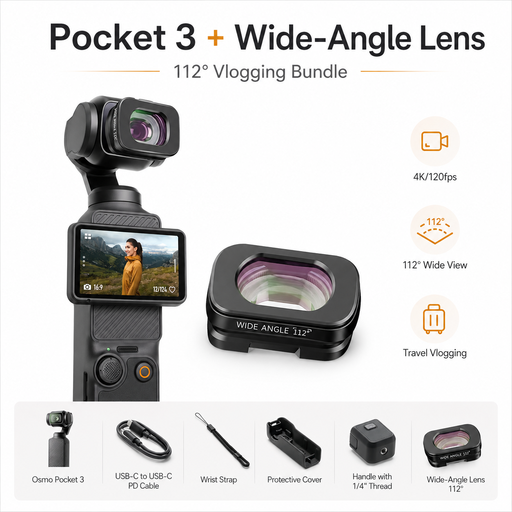
This bundle is worth considering for handheld outdoor shots if you’re looking for a wide field of view and a compact setup; architecture is listed as one of its uses.
The product name lists a 112° wide-angle lens, a 3-axis gimbal, a 1-inch CMOS sensor, 4K/120fps and a 2-inch rotating touchscreen.
 No image available
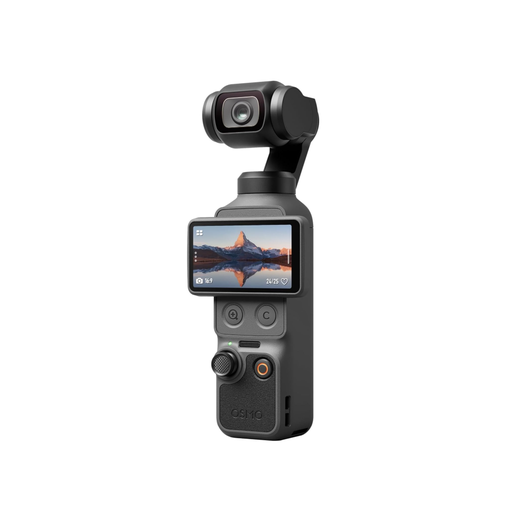
This pocket gimbal camera is worth considering for handheld shooting if you want to switch between different framings.
The product name lists a 1-inch CMOS sensor, 4K/240fps, 3-axis stabilisation, 2x lossless zoom, 107 GB of built-in storage and a rotating 2-inch screen.
No. For a full view, the first things to consider are the angle of view at the short end and where you can stand. For the zoom models considered here, Canon, Sony and Panasonic each list a 24 mm full-frame equivalent focal length at the short end; their different telephoto ranges are for distant details.
Check the alignment and edges of the frame while you’re taking the shot. Adobe Learn points out that correcting perspective later can leave blank areas at the edges that need to be cropped.
Charge the battery, insert a suitable memory card, and test the screen or viewfinder as well as the framing you plan to use. USB-C charging is specified for the Panasonic TZ300, but that doesn’t apply to every model.
For a consumer purchase, the seller is responsible for your statutory rights, not automatically the manufacturer. The Verbraucherzentrale distinguishes this legal obligation from a voluntary guarantee; online orders also generally come with a 14-day right to cancel from the date you receive your order.
§ 59 UrhG may allow photographs and their public reproduction if a work is permanently situated beside a public path, road or square; for buildings, this applies only to the exterior view. It doesn’t give you blanket permission to enter private property or take photographs inside a building. The Stiftung Bauhaus Dessau sets out its own consent requirements for taking photographs on its enclosed grounds.