If you often photograph entire façades from close by, but also want to capture distant details, a wide-angle zoom gives you more flexibility. A prime lens is a better fit if you can choose your position and composition deliberately. Sony Germany lists a 24–200 mm full-frame equivalent range for the RX100 VII, while Ricoh Imaging Europe gives the GR IV a focal length of around 28 mm. Neither focal length alone guarantees detail in bright skies and dark areas of a façade.
Which approach is right for you?
Photographers working in strong backlight
If you want to capture bright skies and dark façades in the same image, consider your exposure settings and any editing you may need to do. Sony Germany explains that Auto HDR combines several shots taken at different exposures, which can cause moving subjects to appear as multiple images.
Photographers composing façades and lines
If you photograph entire buildings and want to keep vertical lines straight, consider the angle of view alongside your potential camera position. Sony Germany notes that tilting the camera upwards can make vertical lines converge.
Photographers looking for details on the go
If you want to take a camera with you and switch between a view of a building and more distant façade details, weigh up zoom range against a wide-angle view. Focal lengths vary by model; for example, Sony Germany lists a 24–200 mm full-frame equivalent range for the RX100 VII.
Which buying criteria matter for backlit Bauhaus façades?
Wide-angle zoom
A good fit if: you want to switch between a full view and more distant façade details.
The trade-off: a zoom range is no substitute for finding the right camera position or choosing your exposure deliberately.
Prime lens
A good fit if: you can choose your position freely and compose your shot using a fixed angle of view.
The trade-off: you’ll need to move more often to change your composition, as optical zoom isn’t available.
Wide angle of view
A good fit if: you want to capture as much of a façade as possible from a confined spot.
The trade-off: a wide angle of view won’t prevent converging verticals if you tilt the camera upwards.
| What matters |
What to check before buying |
Who is it important to? |
| Detail in skies and shadows |
Check the available exposure bracketing options and file formats on the specific model. Combining several exposures can cause moving subjects to appear as multiple images, as Sony Germany explains for Auto HDR. |
If I want to capture bright clouds and dark areas of a façade with detail in both, I look at the exposure options and think about how I plan to edit the images. Around 26% of consumers put control over highlights and shadows first. |
| Fitting the whole building in the frame |
Compare the angle of view at the wide end for stills. Sony Germany lists a 24 mm full-frame equivalent focal length for the RX100 VII; Canon Germany gives the PowerShot V1 a horizontal angle of view of 107° for stills. |
If I want to capture the whole façade from where I’m standing, I check the composition before settling on a focal length. Around 26% of consumers prioritise capturing the entire building. |
| Straight lines and perspective |
Check whether you can keep the camera level from your chosen position, and leave room around the edges of the image if you plan to correct perspective. Sony Germany explains that tilting the camera upwards can make vertical lines converge. |
If I want a controlled view of a façade, I consider my camera position and leave room for any corrections I may need to make. Around 21% of consumers put perspective and the treatment of lines first. |
| Taking your camera with you |
Check the dimensions, weight and viewfinder on the specific model. Sony Germany lists an electronic viewfinder for the RX100 VII; Canon Germany doesn’t list a viewfinder for the PowerShot V1. |
If I want to take my camera with me regularly when walking between several buildings, size, weight and ease of use matter to me. Around 16% of consumers put portability first. |
| Distant façade details |
Check the optical zoom and focal length range, but don’t confuse these with the angle of view you need for a full view of the building. Sony Germany lists 24–200 mm for the RX100 VII and Panasonic Germany lists 24–75 mm for the DC-L10, both full-frame equivalent. |
If I want to get closer shots of windows, lettering or other details from the same spot, optical reach matters to me when choosing a camera. Around 11% of consumers prioritise distant subjects. |
Which assumptions should you avoid?
-
More zoom doesn’t automatically mean a better full view
When photographing an entire building from a fixed position, first check whether the angle of view at the wide end is wide enough. A longer telephoto range is more useful for distant details.
Start by comparing the angle of view for stills at the wide end, then consider the telephoto range you need.
-
HDR isn’t the answer to every backlit scene
Combining several shots taken at different exposures can make moving people or other moving elements appear multiple times in the image. Sony Germany highlights this risk with its Auto HDR feature.
Check the features of the specific model. If there’s movement in the scene, consider taking a single shot as an alternative.
-
A wide-angle lens won’t automatically keep building lines straight
Perspective also depends on how you hold and position the camera. Tilting it upwards can make vertical lines converge, as Sony Germany explains in its architectural photography guidance.
Check the possible camera positions, keep the camera level where possible, and leave some space around the building if you plan to correct the perspective.
-
Freedom of panorama doesn’t give you unrestricted access
Under certain conditions, Section 59 of the German Copyright Act (UrhG) covers the exterior views of buildings from public paths, roads or squares. It doesn’t override access restrictions or conditions set by the person responsible for the property.
Check your location and intended use before taking photographs. The Stiftung Bauhaus Dessau has its own conditions for certain commercial and editorial photography on its premises.
Brands and model ranges to consider
Sony
The RX100 VII is worth considering if you want to switch between different compositions, from a full view of a building to distant details.
- Sony Germany lists a 1.0-type sensor, an electronic viewfinder and a 24–200 mm full-frame equivalent range for the DSC-RX100M7.
- These specifications alone don’t prove that it performs better in backlit conditions than other models.
Ricoh
The GR IV is aimed at photographers considering a compact camera with a fixed angle of view equivalent to around 28 mm on a full-frame camera.
- Ricoh Imaging Europe lists an APS-C sensor and a focal length equivalent to around 28 mm on a full-frame camera for the GR IV.
- The fixed lens doesn’t offer optical zoom for distant details.
Fujifilm
The X100VI is a prime-lens option for carefully composed views of buildings.
- Fujifilm lists a 35 mm full-frame equivalent focal length, 14-bit RAW and a hybrid viewfinder for the X100VI.
- If you’re photographing from a confined spot, its fixed angle of view may be too narrow to capture an entire façade.
Panasonic
According to Panasonic Germany, the Lumix DC-L10 combines a zoom that goes from wide-angle to a longer focal length.
- Panasonic Germany lists a 24–75 mm lens and a 4/3-type sensor for the DC-L10.
- Focal length specifications describe the equipment, not how its image quality compares with other models.
Canon
The PowerShot V1 may be worth considering for stills when you can’t stand far from the building.
- Canon Germany lists a horizontal angle of view of 107° for stills and an automatic exposure bracketing feature.
- Canon doesn’t list a built-in viewfinder for the V1, and the framing for stills and video isn’t the same.
Joybuy products
The following Joybuy products are compact digital cameras to consider for building views and detail shots. Check the angle of view separately to make sure you can fit an entire façade in the frame; zoom specifications alone won’t tell you how wide the view is at the wide end.
 No image available
NAXSIR digital camera, 4K, 64 MP, 18x digital zoom
The 18x digital zoom may be useful for changing your composition. Check the angle of view at the wide end if you want to fit the entire façade in the frame.
The product title lists 4K video, 64 MP photo resolution, autofocus and a 32 GB memory card included.
Joybuy
 No image available
Komery W6 digital camera, 12x optical zoom
The stated optical zoom may be useful for distant façade details. Also check whether the angle of view at the wide end is wide enough for the full view you have in mind.
The product title lists 4K and 64 MP.
Joybuy
 No image available
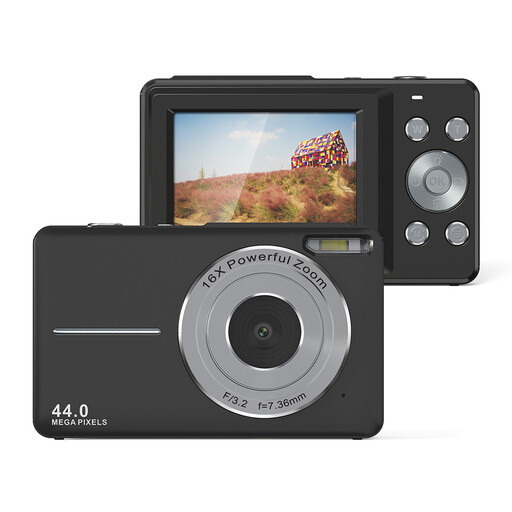
Songdian pocket camera, black, 16x digital zoom
Digital zoom lets you adjust your composition, but it isn’t the same as optical zoom. If you want to capture an entire façade, check the angle of view at the wide end.
The product title lists 4K and 64 MP.
Joybuy
Frequently asked questions
How should I photograph a façade with a bright sky and dark areas?
Start by checking your exposure and composition. If the scene is as still as possible, exposure bracketing may also be an option. Sony Germany explains that its Auto HDR feature combines three images taken at different exposures and notes that movement can cause subjects to appear as multiple images. This doesn’t mean that every camera mentioned here has this feature.
Why do vertical Bauhaus façades sometimes look crooked in photos?
If you tilt the camera upwards, vertical lines can converge. Sony Germany recommends keeping the camera as level as possible for architectural photography. If needed, step back and leave some space around the building if you plan to correct the image in software.
What additional costs and rights should I consider when buying?
Check what’s included and whether you’ll need a memory card or editing software for your workflow. If a product is faulty, remember that your statutory rights are separate from any voluntary guarantee. The Verbraucherzentrale explains the difference.
Can I photograph and publish exterior views of Bauhaus buildings in Germany?
Under certain conditions, Section 59 of the German Copyright Act (UrhG) allows photographic reproduction and public communication of works permanently situated on public paths, roads or squares; for buildings, this applies only to their exterior views. It doesn’t give you unrestricted permission to enter a property. The Stiftung Bauhaus Dessau’s rules generally require prior consent in text form for commercial and editorial photography on its premises, except for current-affairs reporting. Check the specific location and intended use.
What if people are recognisable in front of the building?
Section 22 of the German Art Copyright Act (KunstUrhG) applies when recognisable portraits are distributed or publicly displayed. Whether consent is required or a legal exception applies depends on the specific circumstances; it can’t be determined solely by the building being the subject of the photograph.


