What should you look for when buying?
When photographing beaded bracelets under artificial light, your choice mainly comes down to reflections, colour reproduction, ease of setup and whether you already own lights.
Photo box with integrated lighting
Suitable if: you want to photograph small bracelets in a limited space with a repeatable setup.
Trade-off: It’s quick to set up, but the light is less flexible to position inside the box than a separate light.
Light tent with your own lights
Suitable if: you have compatible lights or want to set up your own lighting outside the tent.
Trade-off: The tent diffuses the light that falls on it, but doesn’t produce any itself; lights and, if needed, supports are part of the setup.
Separate softbox for a studio light
Suitable if: you want to control the position of the light and the shape of the reflections.
Trade-off: You’ll need a compatible light source and enough room to set it up.
| What matters |
What to check when buying |
Who is it important to? |
| Reflections and soft light |
Check the diffusers and openings; with a softbox, check whether the light source and diffusers can be positioned as needed. |
If shiny beads show bright spots, I want to choose the diffusion and light position so their contours remain visible. Around 36% of consumers put control of reflections first. |
| Colours under artificial light |
Check the specifications for the specific light and take a test shot under the lighting you’ll use, with a neutral reference. |
If I want beads in different colours to look as true to life as possible, I look for consistent lighting and controlled white balance. Around 29% of consumers prioritise colour reproduction. |
| Setup and shooting space |
Check the internal dimensions, camera openings and included backgrounds against your planned arrangement. |
If I need repeatable shots in a small space, the bracelet and camera should fit comfortably in the box. For around 21% of consumers, an easy setup and suitable shooting space are the main priorities. |
| Existing equipment |
Compare the light, power supply, stand, connection and backgrounds with what’s included with the exact model. |
If I want to keep using my existing lights, I check the connections and any missing kit components first. Around 14% of consumers focus mainly on compatibility and a complete package. |
Joybuy products for small product photography
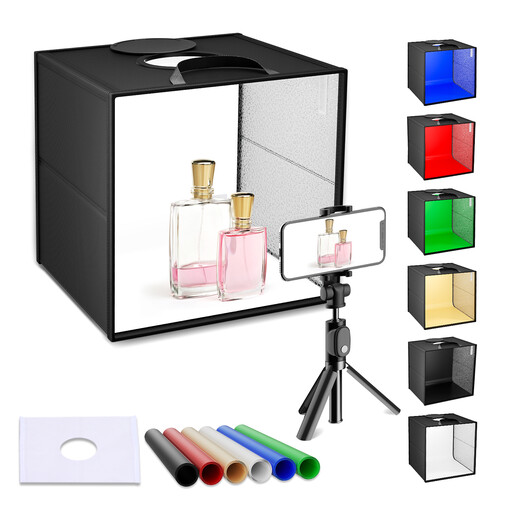
This selection features foldable photo boxes with integrated lighting for small product photography under artificial light.
 No image available
Foldable LED photo box with coloured backgrounds and adjustable brightness
An option for small product photography if you’re looking for integrated lighting and a choice of backgrounds.
Described as a foldable LED photo box with adjustable brightness.
View at Joybuy
 No image available
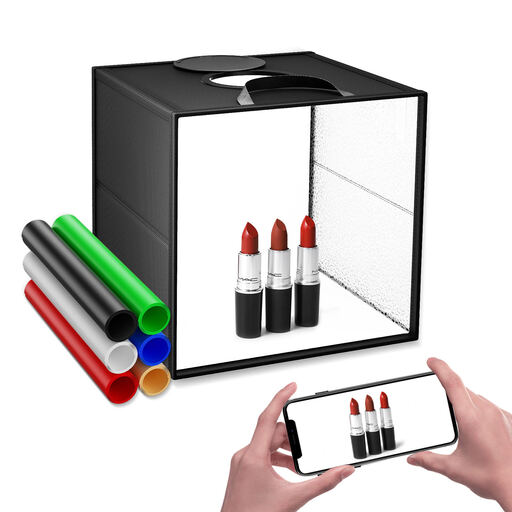
40 cm photo box with 120 dimmable LEDs and coloured backgrounds
An option if you’re looking for dimmable lighting and a foldable box for small product photography.
The product name specifies 40 cm, 120 LEDs, 5600 K, six coloured backgrounds and a diffusion cloth.
View at Joybuy
Frequently asked questions
How can I avoid a colour cast when photographing colourful beads?
Photograph under consistent lighting where possible, and check the white balance using a neutral reference under the light you’re using. Nikon shows that automatic white balance can render colours differently under mixed and certain artificial light sources.
Can I use a softbox without any other equipment?
For the click softbox described by Rollei, you’ll need a compatible light with a Bowens S-Type mount. A light tent also needs a light source unless one is expressly integrated or included in the set.
Does an LED photo box need CE marking in Germany?
Whether a particular model needs CE marking depends on the relevant EU rules. The European Union explains that CE marking is required only for products covered by applicable harmonised legislation; it is a declaration by the manufacturer, not a central EU approval. When buying an electrical product, check the model’s identity, manufacturer information, markings and any required German-language instructions.
Who should I contact if a light bought in Germany is faulty?
If a product is faulty, the seller is generally your point of contact for your statutory consumer rights. The Verbraucherzentrale distinguishes these rights from a voluntary guarantee offered by the manufacturer or retailer; what it covers depends on the relevant guarantee terms. Your specific rights depend on the purchase contract and the fault.
How should I dispose of an old electrical photo box?
In Germany, waste electrical equipment is collected separately and can generally be taken to a local authority collection point. The Umweltbundesamt also notes that certain retailers have take-back obligations; the right return point depends on the device and supplier.


