What should you look for when choosing one?
First, decide what matters most to you: reducing airborne dust, comfortable night-time use, additional allergen control, or the cost and effort of filters and running the purifier.
| What matters to you |
What to check when buying |
Who is this most important for? |
| Filtering airborne dust |
Consider the particle filter, CADR in m³/h and room size together. If a coverage area is stated, check the air changes per hour it is based on. |
If your main aim is to reduce dust stirred up in your bedroom, choose a particle output suited to the room size. Around 33% of consumers would prioritise reducing airborne dust. |
| A good night’s sleep |
Check the noise level and air-cleaning performance on the night setting you plan to use. Also look for displays that can be switched off. |
If the purifier will run while you sleep, consider whether its noise and lights will be comfortable in everyday use. Around 27% of consumers would prioritise using it at night. |
| Additional allergen control |
Think of particle filtration as an additional measure, not a replacement for measures focused on the bed if you have a dust mite allergy. |
If you want to filter allergen-containing dust stirred up into the air, measures focused on the bed should still come first. Around 20% of consumers would prioritise this additional allergen control. |
| Ongoing costs and maintenance |
Compare compatible replacement filters, change intervals, power consumption and your planned daily running time. |
If you plan to use the purifier regularly, filter changes and electricity consumption will affect your ongoing costs. Around 20% of consumers would prioritise ongoing costs. |
Air purifiers at Joybuy
The following Joybuy listings state that they have HEPA filters and give CADR figures. Compare these with your bedroom size and the setting you plan to use.
 No image available
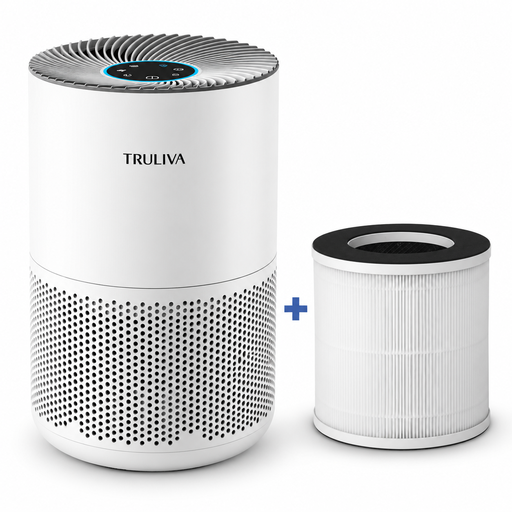
TRULIVA air purifier with 1 extra H13 True HEPA replacement filter
An option if you’re looking for a particle filter and a stated sleep mode. The maximum CADR alone doesn’t describe performance in this mode.
The product title lists a CADR of 260 m³/h, H13 True HEPA, three-stage filtration, a 24-hour timer and a sleep mode at 24 dB. An extra H13 True HEPA replacement filter is also listed.
View at Joybuy
 No image available
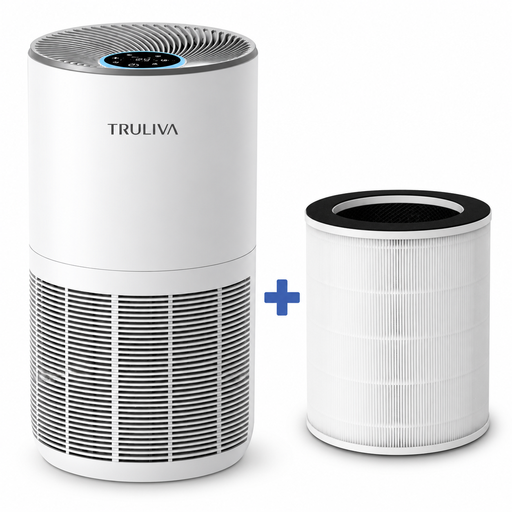
TRULIVA air purifier, 450 m³/h CADR, with an extra H13 HEPA replacement filter
If you’re considering a higher stated CADR, compare it with your room size and the setting you actually plan to use.
The product title lists a CADR of 450 m³/h, H13 HEPA, three-stage filtration, 360° air circulation, a PM2.5 display and a 24-hour timer. An extra H13 HEPA replacement filter is also listed.
View at Joybuy
 No image available
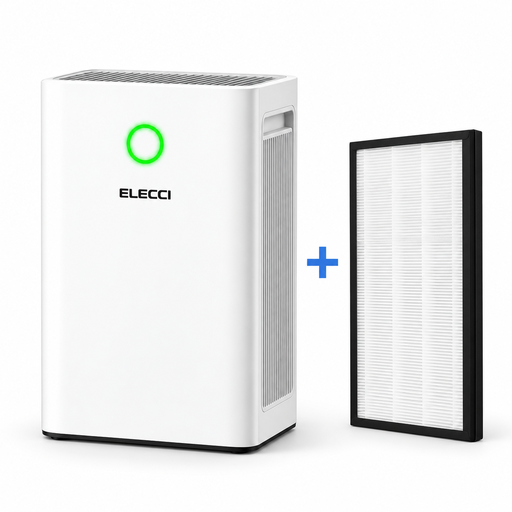
ELECCI air purifier with dual HEPA filtration, 550 m³/h CADR
An option if a high stated CADR and sleep mode are among your priorities. Check its performance on the setting you’ll actually use.
The product title lists a CADR of 550 m³/h, dual HEPA filtration, a washable pre-filter and a sleep mode at 24 dB. Compare the stated coverage of up to 48 m² with the air changes per hour it is based on. An extra HEPA replacement filter is also listed.
View at Joybuy
 No image available
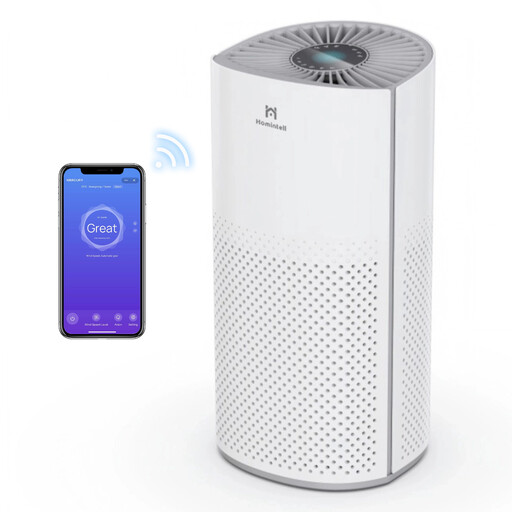
Homintell smart air purifier, 200 m³/h CADR, H13 HEPA and activated carbon
If you’re comparing a stated CADR with HEPA and activated carbon filters, factor in your room size and the setting you plan to use.
The product title lists a CADR of 200 m³/h, H13 HEPA, an activated carbon filter, Wi-Fi control, 30 dB and a room size of 25 m². It also lists an ioniser. The US Environmental Protection Agency (EPA) points out that ionisers can produce ozone, which irritates the lungs, so check the information for this feature on the specific model.
View at Joybuy
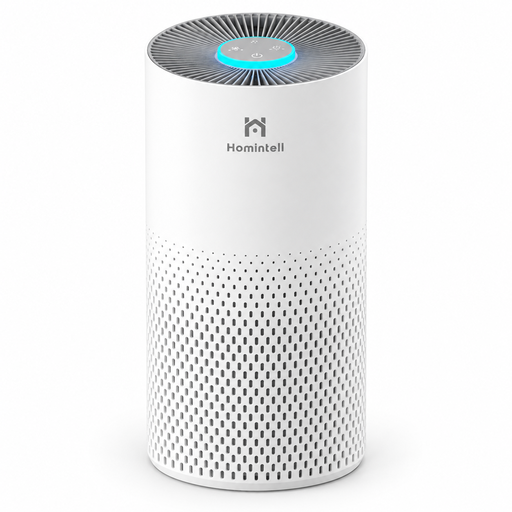 No image available
Homintell air purifier, 150 m³/h CADR, for a stated room size of 18 m²
If you’re choosing a purifier for a smaller bedroom, check whether the stated room size suits the air changes per hour you want.
The product title lists a CADR of 150 m³/h, three speed settings, HEPA and carbon filters, an 8-hour timer, touch controls and a seven-colour mood light. Consider the stated coverage of 18 m² alongside the air changes per hour it is based on.
View at Joybuy
Frequently asked questions
Can an air purifier replace dusting and ventilating?
No. An air purifier filters particles from the room’s air, but it won’t remove dust that has already settled on surfaces or all air pollutants. Tackling sources of dust, cleaning surfaces and ventilating the room are still important, as explained by the US Environmental Protection Agency (EPA) and the German consumer advice centre.
If I think I may have a dust mite allergy, what matters more than an air purifier?
The German Allergy and Asthma Association prioritises measures focused on the bed, including allergen-proof mattress covers. Air filtration can help deal with particles stirred up into the air, but it won’t remove the source in your bed.
Where should I place and how should I maintain my air purifier?
Place the purifier where air can circulate freely, and follow the clearances set out in the instructions for your specific model. Change the filters according to the manufacturer’s instructions; the German Environment Agency notes that filters need to be changed regularly.
What ongoing costs should I budget for?
Compare compatible replacement filters and their change intervals, as well as the purifier’s power consumption based on your planned daily use. If something is faulty, remember that statutory consumer rights are separate from a voluntary warranty, as explained by the German consumer advice centre.
What product information should I check for an air purifier in Germany?
Check the information for the specific model and the regulations that apply to it. Your Europe explains that CE marking is required only for products covered by EU harmonisation legislation that expressly requires it. The German Federal Network Agency lists CE marking, product identity and German-language instructions among the points it checks when carrying out market surveillance.


