
Lieferung heute & morgen

Qualitätsgarantie

Willkommens-Angebote freischalten: KOSTENLOSE Lieferung | Bis zu 80 % RABATT | Kostenlose 30-Tage-JoyPlus-Testphase
App herunterladen
A night light in the bedroom should help you find your way at night without making the room unnecessarily bright. For families with babies and children, ease of use, materials and safe operation are also important. Adults often look for subtle ambient lighting, flexible colour options or a light that works alongside a bedside lamp.
However, some marketing claims can lead to poor choices. What matters is not having as many features as possible, but choosing features that are practical for the room you have in mind.
An RGB night light with a wide range of colours can be decorative. But for finding your way at night or lighting a child’s bedroom, a dimmable warm white night light is often more suitable. Check whether you can adjust the brightness and colour temperature separately. A choice of colours alone is no substitute for good lighting controls.
A night light with a motion sensor responds to movement, while a night light with a dusk sensor measures the ambient light level. The two systems serve different purposes. A motion sensor may be suitable for a hallway or bathroom, while a dusk sensor automatically switches the light on when it gets dark. Furniture, curtains and nearby lamps can affect detection.
A rechargeable night light can be placed wherever you need it, but it will need regular charging. Check the stated battery capacity, charging port and whether a power adapter is included. A model that plugs into the mains doesn’t need recharging, but its position is limited by the location of the socket.
Warm light in the region of around 2,700 to 3,000 Kelvin is often used in bedrooms. It feels less cool than neutral white or daylight white light. Ideally, a dimmable night light should offer stepless adjustment or several clearly defined brightness settings.
A low minimum brightness is also useful for children. The light should not shine directly at eye level or towards the bed. Claims such as ‘eye-friendly’ should be understood as product descriptions from the supplier, not as a medical assessment.
Compare the following:
For a children’s bedroom night light, look for a sturdy housing that’s easy to clean and has no small parts that can come loose easily. Soft silicone models are often simple to wipe clean. However, always follow the manufacturer’s safety instructions: electrical lights must not be immersed in water or placed near sources of heat, and young children should use them under supervision.
If you’re placing a light on a bedside table, consider how much space it takes up. Check the dimensions to make sure it won’t be knocked over by books, toys or bedding.
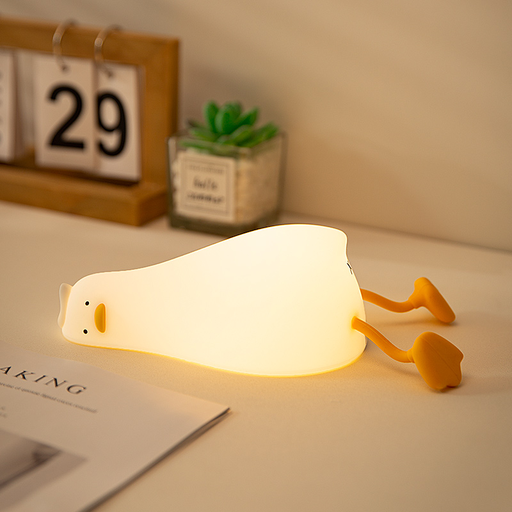
Why this product suits this profile: This compact silicone light is designed for bedrooms, children’s bedrooms and bedside tables. Its built-in battery lets you place it wherever you need it without permanently taking up a socket.
The rechargeable design reduces your reliance on disposable batteries. Before buying, check the charging time and battery life in the specific product information.
According to VIVREAL’s product information: soft silicone housing, 1,200 mAh battery and USB charging.
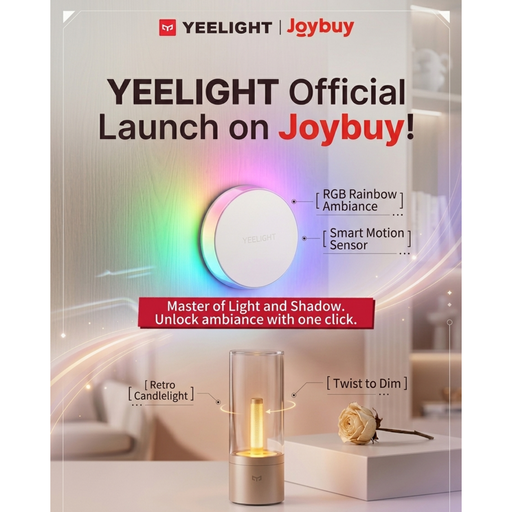
Why this product suits this profile: This magnetic light with a USB-C rechargeable battery is a good choice if you want flexible ambient lighting for your bedroom and a choice of different lighting moods.
The product description lists a motion sensor and 11 preset effects, so you can assess the sensor and mood lighting separately.
Magnetic attachment, RGB lighting, USB-C charging and a motion sensor, according to the product information.
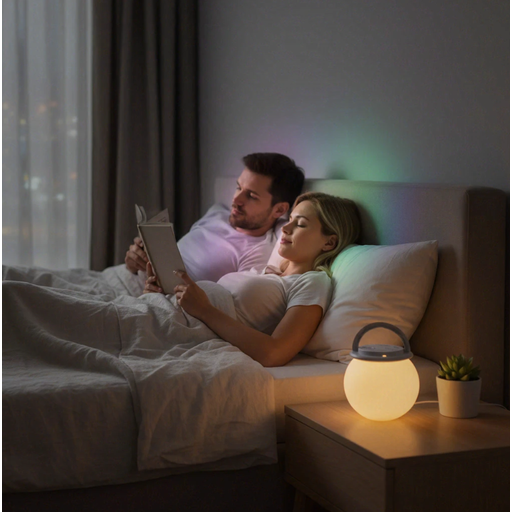
Why this product suits this profile: The combination of warm white light, RGB mode, a timer and stepless dimming is ideal if you want to use one light in different rooms and situations.
Dimming and the timer help prevent the light from staying too bright for too long. Before buying, check which timer settings are available in the product listing.
According to the product information: warm white and RGB lighting, stepless dimming, a timer and a rechargeable design.
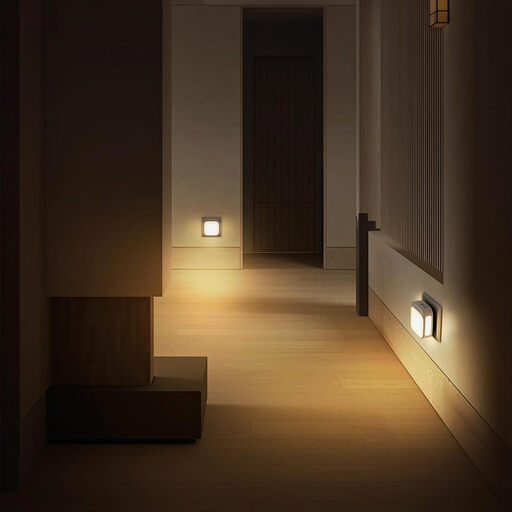
Why this product suits this profile: These two plug-in lights are suitable for a hallway, bedroom or nursery if you want light to come on automatically when it gets dark.
The dusk sensor handles switching the light on and off. This means you don’t have to assume that a motion sensor is needed for every situation at night.
According to the product information: 0.3 W power consumption, warm white light at 2,800–3,000 K and dimming from 10 to 100 per cent.
We’ve put together a complete, regularly updated list of products that meet these strict selection criteria and fully comply with the safety regulations applicable in the EU.
A night light is only practical if it’s in the right place. A narrow bedside table with two drawers can hold a charger, glasses and a book without obscuring the light. If you’re also using a bedside lamp, check the cable routing and distance from the socket.
If you choose a bed with integrated LED lighting, USB and USB-C ports or storage, read the assembly and safety information particularly carefully. For the 90×200 cm bed described, for example, you’ll need to consider the mattress, assembly and maximum user weight of 113 kg. Integrated LEDs aren’t necessarily a substitute for a separate night light, as they’re often designed more for decoration than for helping you find your way.
A warm white night light with a low, adjustable brightness is a practical choice for many bedrooms. Its position, the direction in which it shines and the option to switch it off completely when needed are all important.
Battery life depends on battery capacity, brightness setting, colour mode and sensor use. Brighter light or continuous RGB lighting will usually use more energy. Check the product information for the stated battery life.
Running costs depend on power consumption and how long you use the light each day. A 0.3 W model uses significantly less energy when used occasionally than a more powerful light that stays on all the time. To work out the cost, multiply the power consumption by your electricity price and the number of hours it’s used.