
Lieferung heute & morgen

Qualitätsgarantie

Willkommens-Angebote freischalten: KOSTENLOSE Lieferung | Bis zu 80 % RABATT | Kostenlose 30-Tage-JoyPlus-Testphase
App herunterladen
The first few months with a newborn are a special time, defined by a deep desire for closeness and security. Many parents want to keep their baby as close as possible at night, without compromising the child's safety or their own quality of sleep. A bedside crib offers a smart solution. It attaches directly to the parents' bed, allowing you to soothe, feed, and care for your child without having to get up.
This guide is designed to help you understand the functionality and key features of bedside cribs. We will introduce you to various models and explain which criteria are most relevant for your specific needs.
The decision for a specific model depends on several factors, including the design of your own bed, the available space, and your long-term plans for its use. Here are three key aspects to consider.
A secure attachment to the parents' bed is the most important criterion. Look for a sturdy fastening system that prevents slipping or the formation of a gap between the mattresses. Models that comply with the European safety standard EN 1130:2019 meet the latest standards for children's furniture. Good air circulation, often ensured by mesh windows or slatted sides, is also a crucial factor for a safe sleeping environment.
A height-adjustable model is essential to perfectly align the crib's sleeping surface with the height of the parents' mattress. Check the number of adjustment levels and the height range to ensure it fits your box spring or standard bed. Some models offer added flexibility by converting into a freestanding crib or a mobile bassinet. A convertible crib can even be used for several years as your child grows.
Consider whether you prefer a complete bedside crib set. These bundles often include a suitable mattress, bedding, and sometimes even a canopy. This can save you the effort of searching for compatible accessories separately. The quality of the mattress is particularly important—it should be firm and offer good ventilation. The materials used for the bed frame and textiles should be tested for harmful substances and be completely safe for babies.
Based on functionality, adaptability, and features, we have selected a few models that cater to the diverse needs of families.
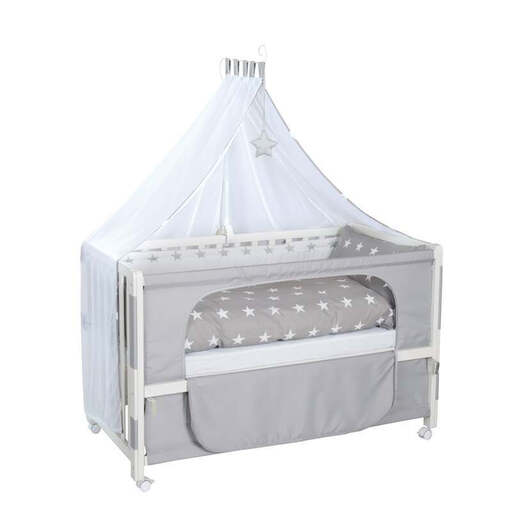
Why it stands out: With its generous 60 x 120 cm sleeping surface and convertible design, the roba Roombed is an especially long-lasting solution. It can be used from birth as a bedside crib, bassinet, and later as a full-sized children's bed.
Pros:
Who it's for: Parents looking for a long-term, convertible sleep solution that will accompany their child from birth through the toddler years.
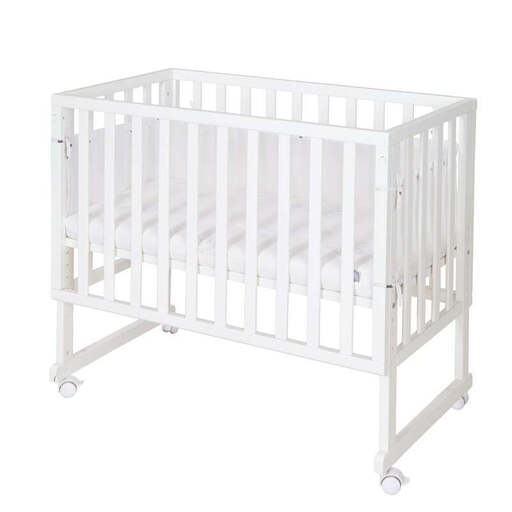
Why it stands out: This model places a special emphasis on safety and sleep comfort, highlighted by the breathable mattress and all-around mesh insert from the "safe asleep" series. According to the manufacturer, roba, the bed is patent-protected and complies with the EN 1130:2019 safety standard.
Pros:
Who it's for: Safety-conscious parents who want a compact, mobile solution for the first 6 to 12 months and value a breathable sleeping environment.
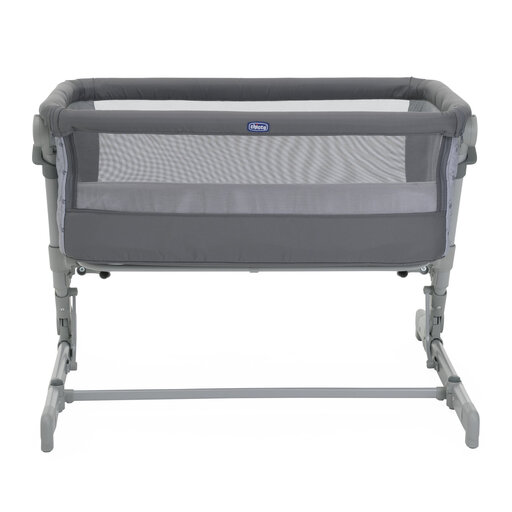
Why it stands out: The Chicco Next2Me Go is distinguished by its extremely fast folding mechanism. According to the manufacturer, Chicco, it can be folded in just three seconds without any disassembly, making it an ideal baby travel cot.
Pros:
Who it's for: Families who travel frequently or need a flexible sleep solution that can be set up and taken down quickly.
A bedside crib is an excellent choice for the first few months of life. As your child grows, the requirements for their room will change. If you are looking for a durable and sturdy sleeping option for a toddler's or child's room, a classic bed frame might be the right choice.
Discover our selection of sturdy metal beds that combine durability with timeless design.
The duration of use depends on the specific model. Compact bedside cribs with a sleeping surface of about 45 x 90 cm are typically suitable for the first 6 to 12 months, or until the child begins to sit up or pull themselves up independently. Larger, convertible models, such as a convertible crib, can often be used as a children's bed until around the age of 4.
Most bedside cribs are attached to the parents' bed frame or base using a strap system or adjustable metal hooks. It is crucial to follow the manufacturer's instructions precisely to ensure a firm, gap-free connection. The wheel brakes should always be locked when the crib is in position.
A bedside crib is designed with one open side that sits flush against the parents' bed, serving as an extension of their sleeping surface. A bassinet is a small, freestanding basket or cot on wheels that is enclosed on all four sides. It is mobile and can be placed anywhere in the room, but it doesn't offer the same immediate closeness as a bedside crib.