
Lieferung heute & morgen

Qualitätsgarantie

Willkommens-Angebote freischalten: KOSTENLOSE Lieferung | Bis zu 80 % RABATT | Kostenlose 30-Tage-JoyPlus-Testphase
App herunterladen
For many expectant parents, a bedside crib is at the top of the shopping list. The idea of having your newborn safe and within arm's reach is deeply reassuring. However, the market can be overwhelming, filled with tempting offers that may later prove to be impractical or even a poor investment. Before you make a decision, it's crucial to understand the common pitfalls that often only become apparent after the purchase.
This guide will help you identify the essential features and find a model that truly fits your needs and daily life.
Many well-intentioned purchases end in frustration because crucial details were overlooked. Pay close attention to these three points to avoid disappointment:
To avoid the mistakes mentioned above, you should base your selection on objective criteria. The following three points are crucial for safe and long-term satisfactory use.
Your child's safety is the highest priority. Be sure to look for compliance with the current European safety standard DIN EN 1130:2019. This standard ensures that the product meets strict requirements, including:
A height-adjustable baby crib is essential. Before buying, measure the height from the floor to the top edge of your mattress. Compare this measurement with the adjustment levels of the bedside crib.
Consider how long and for what purposes you want to use the crib.
Based on these objective criteria, we have identified several models that represent thoughtful solutions for different requirements and lifestyles.
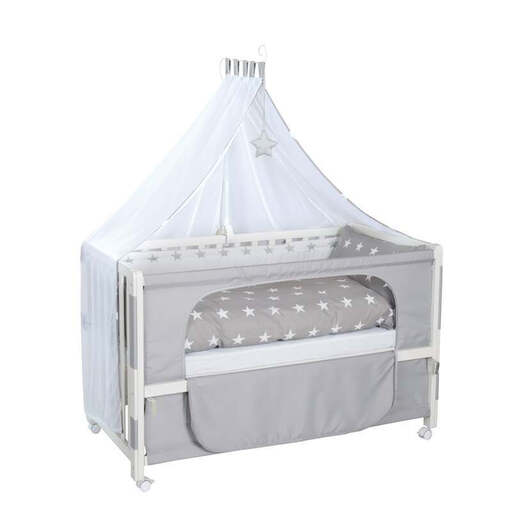
Why This Fits Their Persona: Ideal for parents who want to make a single purchase that will accompany their child for years. It serves as a bedside crib, a bassinet, and later as a full-sized cot.
Avoids the short-lifespan trap with its large 60 x 120 cm sleeping surface and its ability to convert into a toddler bed. The all-inclusive set also prevents hidden costs.
3-in-1 functionality and 6-level height adjustment. Includes mattress, bedding, canopy, and lockable castors for mobility.

Why This Fits Their Persona: Specifically for parents with high beds or box spring beds who need a secure, gap-free connection without compromising on safety.
Solves the incompatibility trap with a 7-level height adjustment up to 44.6 cm and a separately available extension kit (Art. No. 204105) for particularly high or frameless beds.
Meets the EN 1130:2019 safety standard. Includes a breathable mattress and mesh barrier for optimal air circulation and safety.
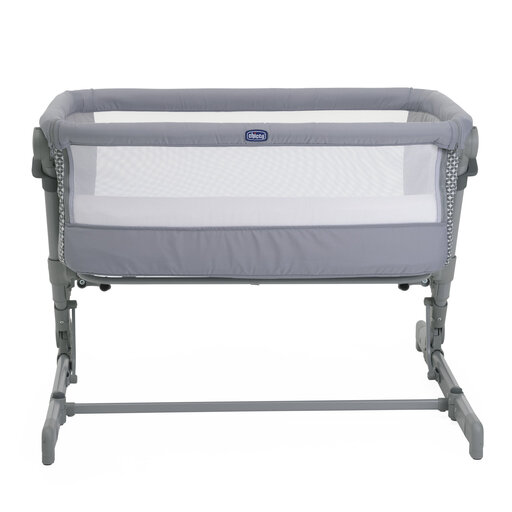
Why This Fits Their Persona: Perfect for families who are always on the go or looking for a flexible solution that can be quickly assembled and disassembled without sacrificing the safety of a bedside crib.
Counters the idea of a rigid, immobile piece of furniture. The folding mechanism, which the manufacturer claims is instantaneous, and the included travel bag make it the ideal travel companion.
Compact folding mechanism and low weight. The 6-level height adjustment and tilt function offer comfort and flexibility, even when travelling.
We have compiled a complete, up-to-date list of products that fully meet these strict selection criteria and safety regulations.
1. What should I look for in a bedside crib for a box spring bed? For box spring beds, two measurements are crucial: the height of the mattress top and the fact that a solid bed frame for attachment is often missing. Choose a model with a very high maximum height setting (ideally over 45 cm) and a strap system that can be looped around the entire bed frame or mattress. Some manufacturers offer special extension kits for box spring beds.
2. How long can a bedside crib be used? The duration of use depends on the size and developmental stage of the child. Smaller models (approx. 45 x 90 cm) are generally suitable up to the 6th to 12th month, or until the child begins to pull themselves up or sit up independently. Larger, convertible models (60 x 120 cm) can often be used as a cot and toddler bed until the 4th or 5th year of age. Always observe the manufacturer's weight and age recommendations.
3. Is a complete bedside crib set a good idea? For most parents, a complete set is a very sensible choice. It ensures that all components such as the mattress, bumper, and fastening materials are perfectly matched and safe. This saves the tedious and potentially unsafe search for compatible individual parts and often offers a price advantage over buying them separately.