
Lieferung heute & morgen

Qualitätsgarantie

Willkommens-Angebote freischalten: KOSTENLOSE Lieferung | Bis zu 80 % RABATT | Kostenlose 30-Tage-JoyPlus-Testphase
App herunterladen
The first few months with a newborn are a special time when closeness and security play a central role. A bedside crib, often called a co-sleeper, allows you to have your baby safely by your side, making night-time feeding and soothing significantly easier. However, the market is overwhelming, and not every model delivers on its promises. Certain design flaws can not only lead to frustration but also compromise safety.
Before you make a decision, you should be aware of the three most common pitfalls that lead to costly purchasing mistakes when choosing a bedside crib:
To avoid these pitfalls, you should focus your selection on a few crucial technical features. These define the safety and practicality of a bedside crib in daily use.
The connection to the parent's bed is the most critical safety feature. Look for a robust attachment system with long, tear-resistant straps that can be wrapped around the entire bed frame or the mattress base of the parent's bed. Models that comply with the European safety standard EN 1130:2019 for cribs and cradles have been tested for stability and safe construction.
Particular caution is needed when choosing a bedside crib for a box spring bed. Due to the height and massive construction of these beds, you need a model with an especially flexible and long strap system, as well as retractable feet, so the bedside crib can be pushed up against the mattress without a gap.
A good bedside crib is height-adjustable, preferably in very fine increments. The goal is to create a completely flush and gap-free sleeping surface between your mattress and the baby's. Measure the height of your mattress (from the floor to the top edge) and compare it with the adjustment range of the bedside crib. Ideally, the baby's sleeping surface can be set to the exact same height. Some models also offer the option to slightly elevate one side (anti-reflux position), which can be helpful for babies with digestive issues.
A safe co-sleeping bed creates a protected sleep environment. Pay attention to the following points:
Instead of making a one-size-fits-all recommendation, we have identified models tailored to different requirements and life situations.
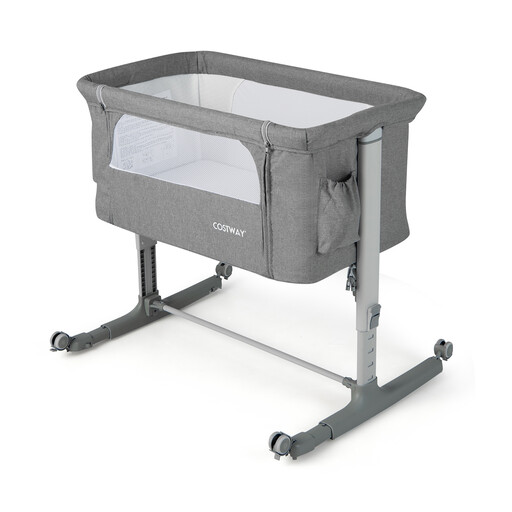
Why This Fits Their Persona: This model is aimed at parents looking for a functional and flexible solution without a large budget. It combines the core functions of a bedside crib with those of a bassinet and a freestanding cradle.
The 3-in-1 functionality prevents the bed from becoming unused after just a few months. With 5 height settings, it offers good adaptability to most standard beds, thus avoiding the pitfall of inadequate adjustment.
Flexibility and Mobility: Thanks to its lockable wheels, it can be easily moved from the bedroom to the living room. The included travel bag also makes it suitable for trips.
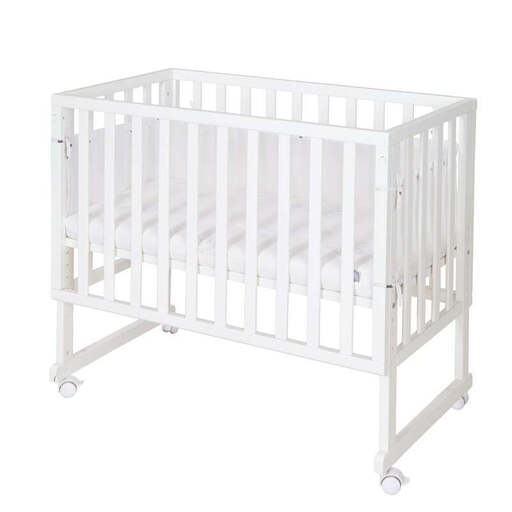
Why This Fits Their Persona: For parents who prioritise certified safety and high-quality materials. This model focuses on a safe sleep environment and a stable, durable construction.
It directly addresses safety concerns: The bed complies with the EN 1130:2019 standard, features a patented fabric barrier, and has a breathable mesh surround. The 7-level height adjustment ensures a precise fit.
Certified Sleep System: The “safe asleep” mattress with its breathable jacquard cover is designed for optimal air circulation. The option to later convert it into a bench extends its lifespan.
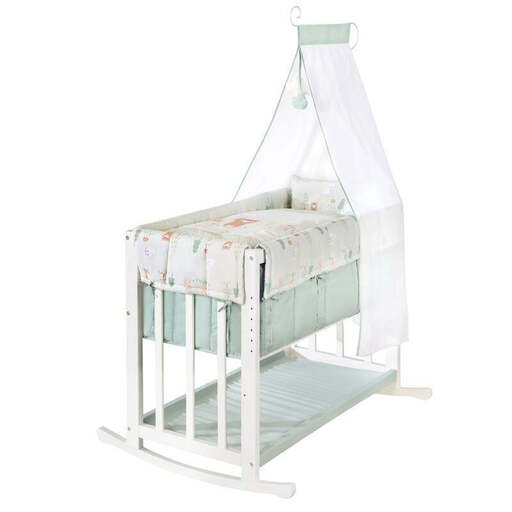
Why This Fits Their Persona: Ideal for parents with tall box spring beds who are looking for a long-term investment. This model is not just a bedside crib, but also a cradle, a bassinet, and later, a bench for the child's room.
With flexible height adjustment from 42.5 cm up to an unlimited bed height (according to the manufacturer) and a special attachment strap, it is explicitly designed for secure fastening to box spring beds. The 4-in-1 function makes it a sustainable purchase.
High Adaptability and All-in-One Set: It is delivered as a complete crib set with a mattress, bedding, bumper, and canopy. Its high flexibility in adapting to the parent's bed is a key advantage.
We have compiled a complete, up-to-date list of products that fully meet these strict selection criteria and safety regulations.
1. How high should a bedside crib for a box spring bed be? The sleeping surface of the bedside crib must be adjustable to the exact height of the top edge of your box spring mattress. Measure this height before purchasing. Look for models with a wide adjustment range (e.g., from 30 cm to over 70 cm) and an attachment system designed for the thick mattresses and frames of box spring beds.
2. Up to what age can you use a bedside crib? A classic bedside crib is typically designed for newborns from 0 to about 6 months, or until the child begins to sit up, kneel, or pull themselves up independently. The maximum weight limit is often around 9 kg. However, multifunctional models that can be converted into a cot or a bench can be used for many years.
3. What is the difference between a bedside crib and a bassinet? A bedside crib has one open side and is attached directly to the parent's bed to create a shared sleeping area. A bassinet is a small, freestanding, and often mobile basket or small bed that can be placed anywhere in the home. Many modern bedside cribs are designed as 3-in-1 or 4-in-1 models and can be converted from a bedside crib to a bassinet with just a few simple steps.