
Lieferung heute & morgen

Qualitätsgarantie

Willkommens-Angebote freischalten: KOSTENLOSE Lieferung | Bis zu 80 % RABATT | Kostenlose 30-Tage-JoyPlus-Testphase
App herunterladen
For many expectant parents, purchasing a bedside crib is a top priority. The idea of having your newborn safe and right beside you is deeply reassuring. However, the market can be overwhelming, and not every model lives up to its promises. Certain defects can lead not only to frustration but also compromise your child's safety. This guide will help you identify the crucial features and make an informed choice.
Many products advertise a universal fit and all-in-one features, but their weaknesses often become apparent in practice. Pay close attention to these three points to avoid a poor purchase:
To avoid the problems mentioned above, you should check three technical aspects before buying. These form the basis for a safe and functional sleeping solution.
Look for a statement confirming that the bed complies with the current European safety standard EN 1130:2019. This standard ensures that the product meets strict requirements for stability, materials, and construction. Among other things, it regulates the height of the side rails, the spacing of the bars, and mechanisms to prevent crevices and gaps when the crib is attached to the parent's bed. A product certified under this standard offers a proven baseline of safety.
A good baby bed should be height-adjustable and offer at least five to seven levels. Measure the height of the top of your mattress and ensure the bedside crib can reach it. For owners of box spring beds, models with a maximum sleeping height of over 45 cm and a special strap system that allows for secure anchoring are often the better choice. The system should fix the bedside crib firmly to the frame or mattress of the parent's bed, with no possibility of movement.
The mattress is the heart of the crib. Ideally, it should have a core with vertical air channels and a removable, washable cover. A sleeping surface of 45x90 cm is a common standard for compact bedside cribs. In addition to the mattress, side walls made of mesh fabric contribute significantly to good air circulation and allow you to keep an eye on your child at all times.
Based on the criteria above, we have compiled a selection of models suitable for various needs and living situations.

Why this model is a great fit: This model from roba is an all-in-one solution for parents who prioritise certified safety. It comes with a breathable mattress and a patented safety system, saving you the time-consuming search for individual components.
Complies with safety standard EN 1130:2019. The 'safe asleep' mattress with its breathable cover and the mesh fabric insert directly address the risk of heat build-up. The included strap system ensures a gap-free attachment.
3-in-1 functionality: Can be used as a bedside crib, a bassinet on castors, and later as a child's bench. The 7-level height adjustment offers excellent flexibility.
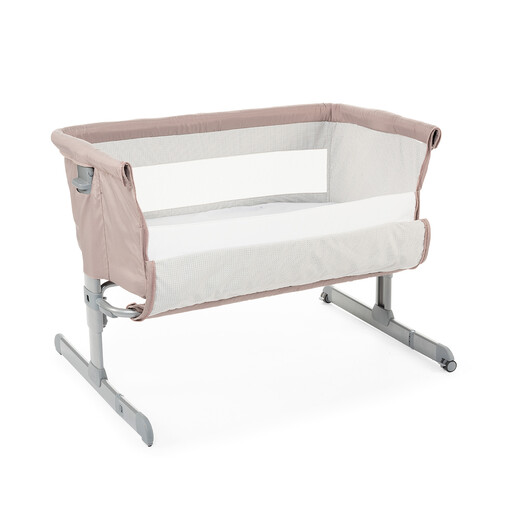
Why this model is a great fit: The Chicco Next2Me is renowned for its high compatibility. It was designed to be securely attached even to beds with drawers or high box spring beds, making it a flexible choice for modern bedrooms.
Solves the compatibility problem with 6 height levels and retractable feet, which allow the crib frame to be pushed right up against the bed frame. The robust strap system ensures a secure, gap-free connection.
High adaptability to different bed types. The tilting function can also be helpful for babies with reflux or a stuffy nose.
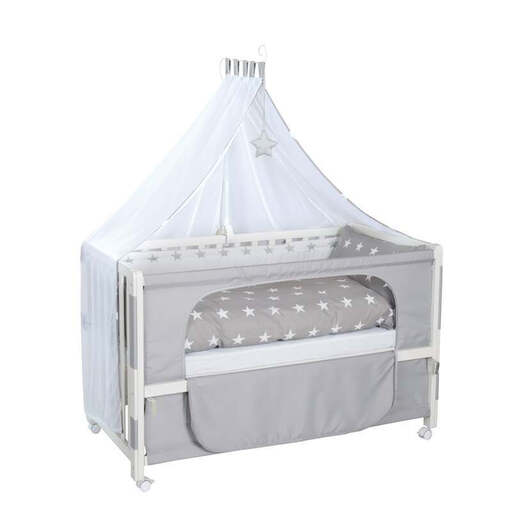
Why this model is a great fit: This larger model is an investment in the future. It not only serves as a bedside crib but can later be converted into a full-sized cot, offering several years of use.
Its convertibility eliminates the need to buy a new bed after just a few months. The 6-level height adjustment and mounting brackets ensure a secure connection to the parent's bed in the initial phase.
Long-term use from birth to the toddler years. It is delivered as a complete set with a mattress, bedding, and canopy.
We have compiled a complete, up-to-date list of products that fully meet these strict selection criteria and safety regulations.
The top edge of the bedside crib's mattress should be exactly level with or slightly below the top edge of the parent's mattress. Look for models with a maximum sleeping height of at least 45 cm and ideally 6 or more adjustment levels. Also, verify that the fastening system is suitable for the frame or mattress of your box spring bed.
Most standard bedside cribs (e.g., with a 45x90 cm sleeping surface) are designed for the first 6 to 12 months. Use should be discontinued as soon as the child is able to sit up, kneel, or pull themselves up independently. Always observe the specific warning labels from the manufacturer. Convertible models can be used as a cot for much longer.
A secure system uses sturdy, non-elastic straps that anchor the frame of the bedside crib directly to the frame or mattress of the parent's bed. After tightening the straps, there should be no gap left between the two mattresses, and the bedside crib should not be able to move away from the parent's bed. Check the tension of the straps regularly.