
Lieferung heute & morgen

Qualitätsgarantie

Willkommens-Angebote freischalten: KOSTENLOSE Lieferung | Bis zu 80 % RABATT | Kostenlose 30-Tage-JoyPlus-Testphase
App herunterladen
The first few months with a newborn are a special time when closeness and security play a central role. A bedside crib seems like the ideal solution: the baby sleeps safely in their own little bed, yet right next to the parents. However, the market is overwhelming, and not every model delivers on its promise. Before you make a decision, it's helpful to know the most common pitfalls that can lead to a bad purchase.
To avoid these problems, it is wise to focus on the objective features that define a functional and safe bedside crib.
An informed purchasing decision is not based on marketing promises, but on verifiable facts. Three core aspects are particularly important.
The European safety standard DIN EN 1130 is a key indicator of a safe baby crib. It sets requirements for stability, materials, and construction. A crib tested according to this standard ensures that:
Making a bedside crib height-adjustable is a basic requirement. However, the adjustment range is what's crucial. Before buying, measure the height from the floor to the top edge of your mattress. The sleeping surface of the bedside crib should be adjustable to this exact height or minimally below it.
This is especially critical for a bedside crib for a box spring bed, as these often reach a height of 60 to 70 cm. Look for models with a particularly wide adjustment range and pay attention to the design of the feet. Retractable or flat feet allow the crib to be pushed seamlessly against the bed frame.
To maximise its lifespan, multi-functional models are an excellent choice. A convertible cot can be transformed after its time as a bedside crib:
Instead of making a one-size-fits-all recommendation, we have selected models that suit the different requirements and lifestyles of families.
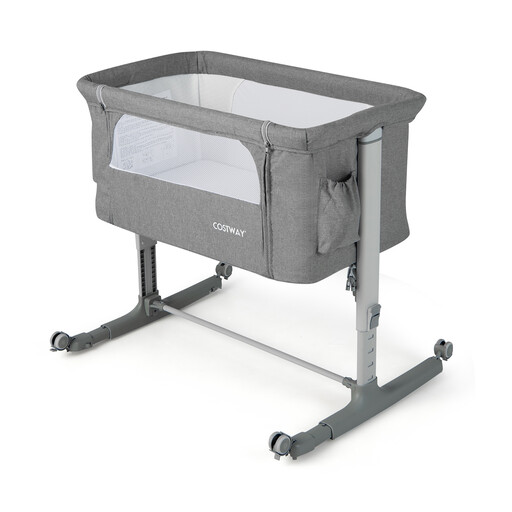
Why it's a great fit: It offers essential features like height adjustment, mobility via wheels, and 3-in-1 use as a bedside crib, cradle, and bassinet at an accessible price point. Ideal for parents seeking a functional and safe solution for the early days.
The 5-level height adjustment and retractable feet help minimise compatibility issues with various bed heights. The 3-in-1 function extends its usability beyond the first few months, avoiding the short-lifespan trap.
Lightweight and equipped with a travel bag, making it practical for trips or visits to the grandparents. The mesh windows on both sides ensure good visibility and air circulation.
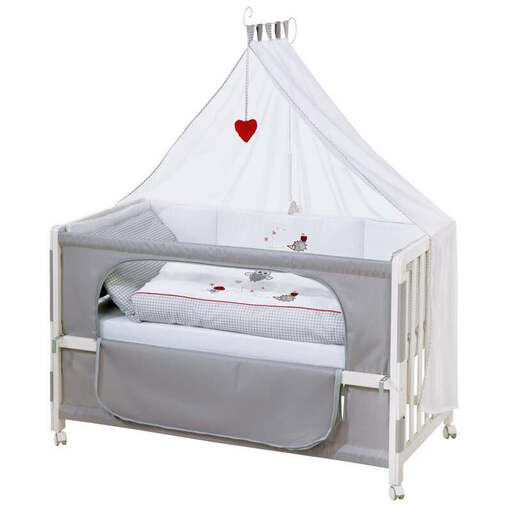
Why it's a great fit: This is a complete solution that grows with your child from birth to the toddler years. It combines the function of a bedside crib with that of a full-sized 60x120 cm baby cot.
Designed as a convertible cot, it is the direct answer to the short-lifespan trap. The 6-level height adjustment and included metal brackets ensure a secure attachment to most parent beds. It is delivered as an all-in-one bedside crib set with a mattress and textiles.
The fabric side with a zipper allows easy access to the baby without having to move the entire crib. The included castors turn it into a mobile cot when needed.

Why it's a great fit: This is not a classic bedside crib, but a flexible baby nest. It is a lightweight, portable accessory for parents who want to create a safe sleeping spot for their baby on the sofa, while travelling, or as a reducer in the parent's bed.
It completely bypasses the compatibility trap as it is not attached to the bed. It serves as a mobile and versatile solution that fills the need for security in various places where a fixed crib is impractical.
The padded edge provides a secure environment. The filling of the sleeping surface is removable via a zipper, which facilitates cleaning at 40°C and ensures good hygiene.
For even more everyday flexibility, a baby nest can also be a smart addition or alternative.
We have compiled a comprehensive, up-to-date list of products that meet strict selection criteria and safety requirements.
Measure the height from the floor to the top of your mattress. A suitable bedside crib should be adjustable to at least this height. Models with an adjustment range up to 70 cm or more are often a good choice. Also, look for retractable feet so that the bed frame is not in the way and the bedside crib fits seamlessly.
Standard bedside cribs (approx. 90x45 cm) are typically used until the age of about 6 to 9 months, or until the child begins to sit up or pull themselves up independently. A convertible cot (e.g., 60x120 cm or 70x140 cm) can often be used into the toddler or even school-age years through conversions.
A complete set can simplify the shopping process and is often attractively priced. However, check the quality of the individual components. A breathable mattress with a washable cover is important. Also, ensure that all necessary fastening parts for your parent bed are included in the delivery.