
Lieferung heute & morgen

Qualitätsgarantie

Willkommens-Angebote freischalten: KOSTENLOSE Lieferung | Bis zu 80 % RABATT | Kostenlose 30-Tage-JoyPlus-Testphase
App herunterladen
The first few months with a newborn are a special time, defined by closeness and a desire for security. A bedside crib allows you to have your baby right next to you at night, which makes feeding, comforting, and nighttime care significantly easier. At the same time, your child sleeps in their own safe space. However, given the wide array of models—from the classic wooden baby bed to the flexible travel crib for babies—the choice can be complex.
This article serves as a practical guide. We explain the most important criteria to consider when making your selection and present a variety of models to help you make an informed decision.
To make the right choice, several functional and safety-related aspects are crucial. The following points will help you objectively compare the features of different models.
Your child's safety is the top priority. Ensure that the bedside baby crib complies with current European safety standards. Relevant standards include EN 1130:2019 for cribs and cradles or EN 716 for children's cots. Key features are:
A key advantage of a bedside crib is its seamless connection to the parent's bed. A height-adjustable bedside crib is therefore a fundamental requirement. Measure the height of your mattress (including any topper) and ensure that the chosen model can be adjusted to this exact height. This prevents a dangerous gap or step from forming between the two mattresses. Also, check if the attachment system is suitable for your bed frame, especially for box spring beds, which often have a wider frame.
Bedside cribs are available in various materials and with different ranges of functionality.
Based on the criteria mentioned, we have compiled a selection of models that cater to different needs and use cases.
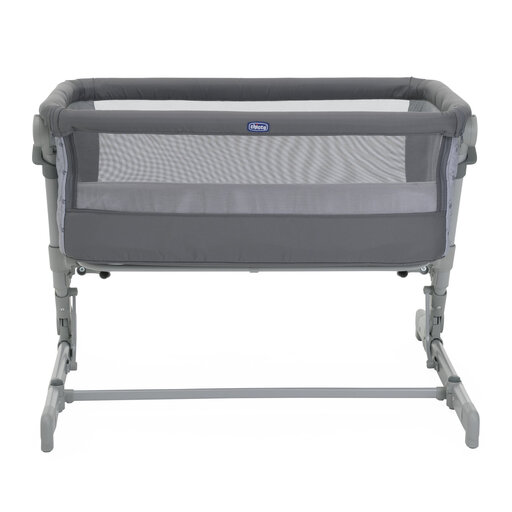
What makes it stand out: The Chicco Next2Me Go is designed for flexibility and mobility. According to the manufacturer, its folding mechanism allows it to be collapsed in just three seconds without having to dismantle any parts. This makes it a practical solution for travel or for families who want to store the bed to save space during the day.
Advantages:
Who it's for: This model is an excellent choice for parents who are often on the go or are looking for a straightforward, easy-to-handle solution for smaller living spaces.
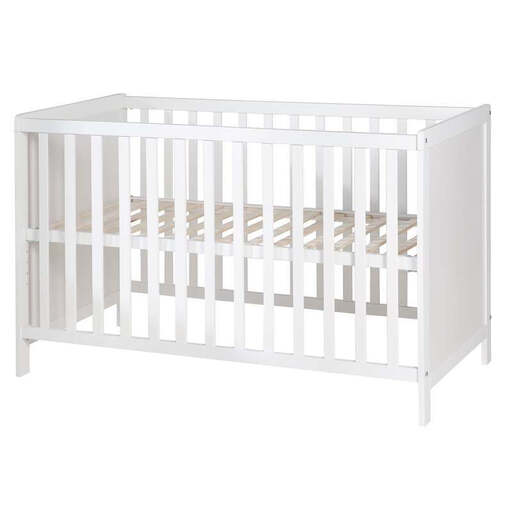
What makes it stand out: This bedside sleeper from roba is designed for long-term use. With a sleeping surface of 60 x 120 cm and a weight capacity of up to 50 kg, it can be used up to the age of five, according to the manufacturer. It converts from a bedside crib to a closed cot and later to a junior bed with an open side.
Advantages:
Who it's for: Ideal for families looking for a sustainable and long-term sleeping solution that adapts to the child's development and can be used beyond the first few months.
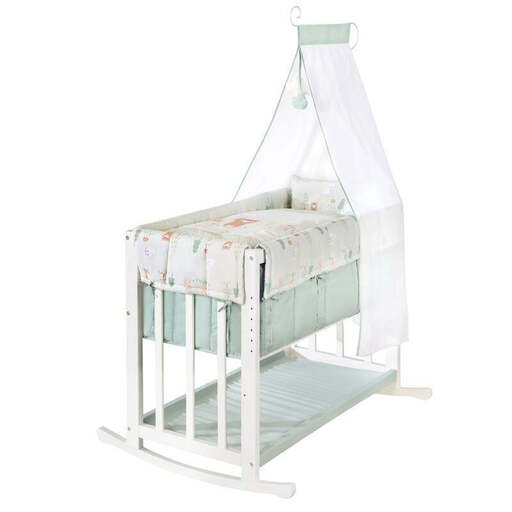
What makes it stand out: The roba 4-in-1 Bassinet is a complete starter package. It functions as a bassinet on wheels, a cradle, a bedside crib, and a bench. The delivery includes a mattress, bedding, bumper, canopy, and canopy rod, all in the 'Woodland Wedding' design.
Advantages:
Who it's for: This set is perfect for expectant parents who prefer an all-in-one solution and don't want to buy all the accessories separately. It offers high flexibility for daily life.
If the models presented don't include the ideal solution for your individual needs, you can find more options in our broader selection. Every family has different requirements for design, material, and functionality.
Discover more sleeping solutions for your little one in our Baby Essentials category.
1. How long is a bedside crib used? Most standard bedside cribs with a sleeping surface of about 90x45 cm are recommended for the first 6 to 9 months, or until the baby starts to sit up or pull themselves up independently. Models with a larger sleeping surface (e.g., 120x60 cm) and conversion options can be used for much longer, sometimes into the toddler years.
2. What should I look for when attaching it to the parent's bed? The most important rule is to ensure an absolutely gap-free connection. The mattress of the bedside crib must be flush and at the same level as the parent's mattress. Always use the provided safety straps and tighten them securely. Regularly check that the straps are tight and the bed is stable.
3. What is the difference between a bedside crib and a bassinet? A bedside crib (also called a bedside sleeper or co-sleeper) is designed so that one long side can be opened to dock it directly against the parent's bed. A bassinet is a smaller, fully enclosed, and often basket-like bed, usually on wheels, that can be moved freely around the room. It offers mobility but not the direct connection to the parent's bed.