
Lieferung heute & morgen

Qualitätsgarantie

Willkommens-Angebote freischalten: KOSTENLOSE Lieferung | Bis zu 80 % RABATT | Kostenlose 30-Tage-JoyPlus-Testphase
App herunterladen
Purchasing the first set of essentials for a newborn is an important task. A bedside crib, placed directly next to the parents' bed, offers closeness and makes night-time feeding or soothing easier. However, the market for bedside cribs is overwhelming, and many offers advertised as "complete sets" hide costly pitfalls. Before you make a decision, you should be aware of the three most common problems that lead to bad buys.
To avoid these pitfalls, it is advisable to focus on objective and verifiable product features. The following three aspects are crucial for making an informed purchasing decision.
A safe baby bed is the top priority. Ensure that the product complies with the current European safety standard EN 1130:2019. This standard sets requirements for stability, materials, and construction to minimise risks such as entrapment or suffocation. An essential component is a reliable attachment system (usually straps) that connects the bedside crib securely and without gaps to the frame of the parents' bed. Additionally, the bars or mesh sides should be high enough to prevent the baby from rolling out, while also ensuring good air circulation.
Compatibility with your own bed depends directly on the adjustability of the sleeping surface. A height-adjustable bedside crib is a basic requirement. Before buying, measure the height from the top of your mattress to the floor. Compare this measurement with the adjustment levels of the bedside crib. For a bedside crib for a box spring bed, models that can reach a sleeping height of 65 cm or more are necessary, often through special extension kits. A stepless or finely graded height adjustment allows for a perfectly flush alignment and prevents dangerous gaps.
A well-designed 3-in-1 baby bed offers real added value as it grows with the child. Typical conversion options include use as a freestanding bassinet on wheels for daytime use or later transformation into a bench seat in the child's room. Check carefully what a bedside crib with mattress set actually includes. A breathable mattress with a washable cover, a crib bumper, and the attachment straps should be standard. Models from brands like roba often offer comprehensive packages that ensure long-term use.
Based on the criteria mentioned, we have identified some products that are suitable for different needs and living situations.

Why This Fits Their Persona: This model is designed for parents seeking a flexible and secure solution for taller beds like box springs. Its functionality is tailored for the crucial first few months.
It solves the compatibility problem with a 7-level height adjustment up to 44.6 cm and, according to the manufacturer, can be adapted to special bed heights with a separately available extension set (item no. 204105).
Meets the safety standard EN 1130:2019. Includes a breathable mattress and castors with brakes for use as a bassinet.
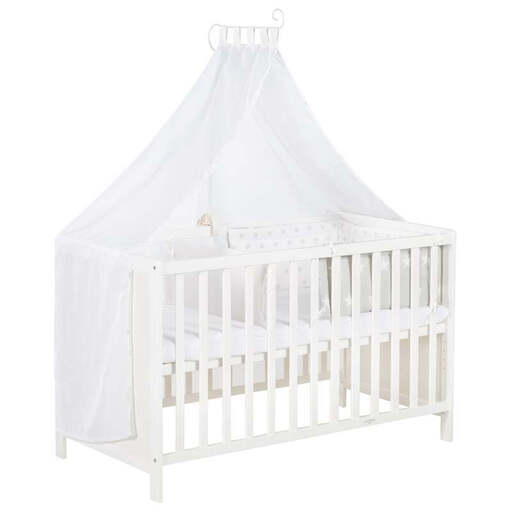
Why This Fits Their Persona: Ideal for parents looking for a sustainable investment. This bed accompanies the child from birth to toddlerhood, adapting to their growing needs.
It bypasses the limited lifespan trap with its larger size (60 x 120 cm) and its convertibility into a junior bed with removable bars. It can be used up to the age of 5 years (or 50 kg).
A true complete set including a slatted frame, mattress, crib bumper, and canopy rod. Meets the safety standard EN 716–1:2017 + AC:2019.
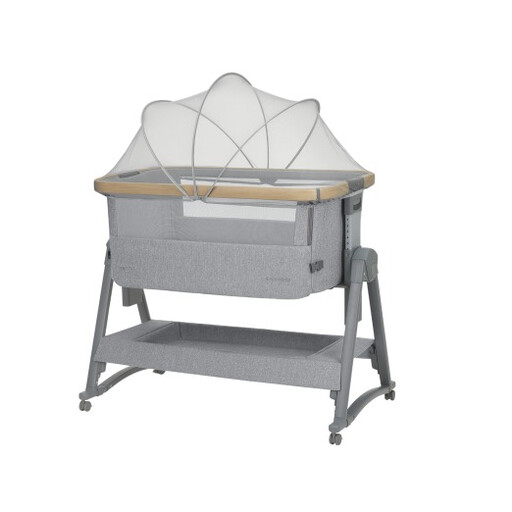
Why This Fits Their Persona: This model is aimed at parents looking for a functional and complete solution for the first six months, without compromising on core features.
Avoids hidden costs by being delivered as a comprehensive package. A mattress, mosquito net, and even a transport bag are already included in the scope of delivery.
Offers practical extra features like an anti-reflux position and a lockable rocking function. The 7-level height adjustment ensures good adaptability.
We have compiled a complete, up-to-date list of products that fully meet these strict selection criteria and European safety regulations.
The sleeping surface of the bedside crib should be at the exact same height as the top of the parents' mattress. For box spring beds, this height is often between 60 cm and 75 cm. Choose a bedside crib whose maximum height setting reaches or exceeds this value. Some manufacturers offer special extension kits to ensure compatibility.
The period of use depends on the model. Smaller bedside cribs (e.g., with a 45 x 90 cm sleeping surface) are generally suitable for the first 6 to 12 months, or until the child starts to pull themselves up or sit independently. Larger, convertible models (e.g., 60 x 120 cm) can be used as a crib and later as a junior bed up to the age of about 5 years. Always observe the manufacturer's weight and age specifications.
The EN 1130:2019 standard is the European safety standard for cribs and bedside sleepers. It specifies requirements for construction, stability, materials, and labelling. These include, among other things, the avoidance of sharp edges, ensuring that no small parts can be swallowed, the stability of the bed against tipping over, and the secure attachment to the parents' bed to prevent gaps where a baby could become trapped. A product that complies with this standard offers a certified level of safety.