
Lieferung heute & morgen

Qualitätsgarantie

Willkommens-Angebote freischalten: KOSTENLOSE Lieferung | Bis zu 80 % RABATT | Kostenlose 30-Tage-JoyPlus-Testphase
App herunterladen
The first few months with a newborn are a special time, defined by closeness and the desire for security. A bedside crib allows you to have your baby right next to you at night, which makes nursing and comforting significantly easier. However, the market is crowded, and not every model delivers on its promise. As your Joybuy Product Recommendation Officer, I'll help you avoid common purchasing pitfalls and make an informed decision.
Many parents invest in a product that turns out to be impractical or even unsafe in daily life. Be sure to avoid these three common problems:
To avoid a poor investment, you should check three technical parameters before buying. These define the safety, comfort, and longevity of a bedside crib.
A crucial criterion is a multi-level, height-adjustable system. Look for models that offer at least 5–7 different height settings to ensure a flush, gap-free alignment with almost any mattress height. Measure the height of your bed (from the floor to the top of the mattress) before purchasing. Equally important is a sturdy strap system that secures the bedside crib firmly to the frame of the parents' bed without slipping.
Modern bedside cribs often offer more than just a place to sleep at night. An integrated and lockable bedside crib with a rocking function can help your baby fall asleep. A baby crib with wheels (ideally with brakes) allows you to use the crib as a mobile sleeping space in other rooms during the day. Some models can also be fully enclosed and used as a standalone crib or a travel crib for newborns. Another useful feature is the anti-reflux baby bed position, where the sleeping surface can be slightly inclined to provide relief for babies with digestive issues.
Your baby's safety is the top priority. Side walls made of mesh fabric are a good choice as they ensure optimal air circulation and allow you to keep an eye on your child at all times. The included mattress should be firm and fit snugly in the crib frame to avoid gaps around the edges. Soft, loose padding or pillows do not belong in a safe baby crib.
Instead of presenting an overwhelming list, we are highlighting one model that thoughtfully meets the criteria above and is well-suited for a specific type of parent.
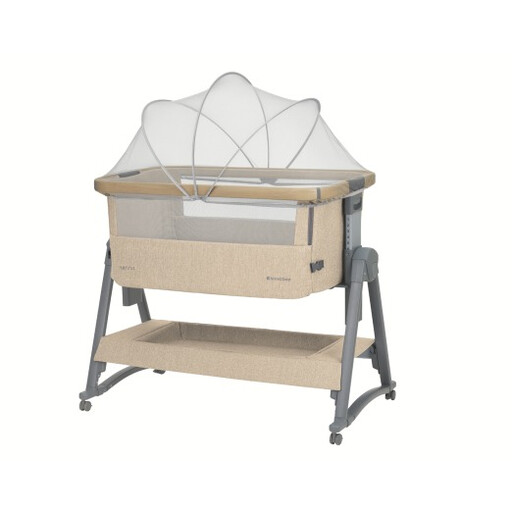
Why This Fits Their Persona: This model is designed for parents who need an all-in-one solution for home and on the go. It combines the functions of a bedside crib, a bassinet, and a travel crib in one product. The included carrying bag and lightweight aluminium frame make it a practical companion.
It addresses the pitfall of limited flexibility with a 7-level height adjustment and an additional safety strap, ensuring a stable, gap-free attachment to the parents' bed. The drop-down front panel allows for easy conversion.
Lockable rocking function for soothing; anti-reflux position for better sleep comfort; 4 wheels with brakes for mobility; mesh sides for optimal air circulation.
If this model doesn't exactly meet your needs, you can find other bedside cribs in our full category, all selected according to strict criteria for safety and functionality.
1. Can a bedside crib also be used as a bassinet? Yes, many modern bedside cribs are designed to be multi-functional. A model is considered a full-fledged bassinet replacement if it has a fourth side panel that can be raised and securely locked, and is equipped with wheels for easy transport between rooms. This provides a flexible 2-in-1 solution for day and night.
2. What is an anti-reflux position on a baby bed? The anti-reflux position refers to a feature that allows one side of the bed's sleeping surface to be slightly raised. According to manufacturers, this gentle incline with the baby's head elevated can help reduce the backflow of stomach acid in babies with reflux or digestive issues. It is important that this is an integrated, stable function of the bed frame and not achieved through unsafe aids like pillows placed under the mattress.
3. Up to what age is a bedside crib suitable? Most bedside cribs are designed for newborns from birth up to an age of about 6 months or a weight limit of approx. 9 kg (20 lbs). Use should be discontinued as soon as the child is able to sit up, kneel, or pull themselves up independently, as there is then a risk of falling out. Always observe the specific information and warnings provided by the manufacturer.