
Lieferung heute & morgen

Qualitätsgarantie

Willkommens-Angebote freischalten: KOSTENLOSE Lieferung | Bis zu 80 % RABATT | Kostenlose 30-Tage-JoyPlus-Testphase
App herunterladen
A bedside lamp is more than just a source of light. It's a functional companion for your evening reading, a guiding light in the dark, and an essential element of your bedroom decor. But the sheer number of options can be overwhelming. Many models overpromise and underdeliver, leading to disappointment. This guide will help you navigate the common pitfalls and find a lamp that truly meets your needs.
Before diving into features, it's wise to understand the typical problems that can arise after your purchase.
To avoid a bad purchase, you should focus on a few core technical specifications. These determine whether a lamp is truly suitable for your purpose.
The light colour, measured in Kelvin (K), has a major impact on the room's atmosphere. For a bedroom lamp, a value below 3,300 K (warm white) is recommended. This light creates a calming and cosy feel. The brightness, measured in lumens (lm), should be adjustable. A dimmable bedside lamp offers the flexibility to switch between bright reading light and soft ambient light.
The control method determines its convenience. A touch lamp, controlled by tapping the base or shade, is practical at night as you don't have to fumble for a small switch. Models with a built-in night light with a motion sensor turn on automatically when you move in the dark—ideal for hallways or a child's room.
There are three common power supply options:
For creating special moods or for use in a child's room, an RGB lamp that can display various colours can be a great choice. An integrated timer that automatically turns the light off after a set period is a useful feature for a kids' night light to help them fall asleep.
Here are a few models tailored to specific user profiles that successfully avoid the pitfalls mentioned above.

Why This Fits Their Persona: Ideal for users who value convenience and a tidy bedside table. The lamp combines lighting and a charging station, making separate chargers and cables redundant.
The sturdy metal base prevents wobbling (Pitfall 1). The 3-step dimming function offers more flexibility than a simple on/off switch (Pitfall 2). The touch control is intuitive, and the charging function is a genuine added value (Pitfall 3).
Two integrated USB ports (USB-A and USB-C) for charging devices simultaneously. The fabric shade provides soft, glare-free light distribution.

Why This Fits Their Persona: Perfect for parents looking for a safe, child-friendly, and soothing night light. Its soft material and battery operation make it a safe companion in a child's bed.
The soft, drop-proof silicone is harmless and durable (Pitfall 1). It's dimmable and cordless, which enhances safety (Pitfall 2). The timer function is a practical extra that's genuinely useful (Pitfall 3).
Made from BPA-free silicone. The integrated battery lasts up to 10 hours and is charged via USB-C. The 30-minute timer function automatically turns the light off.
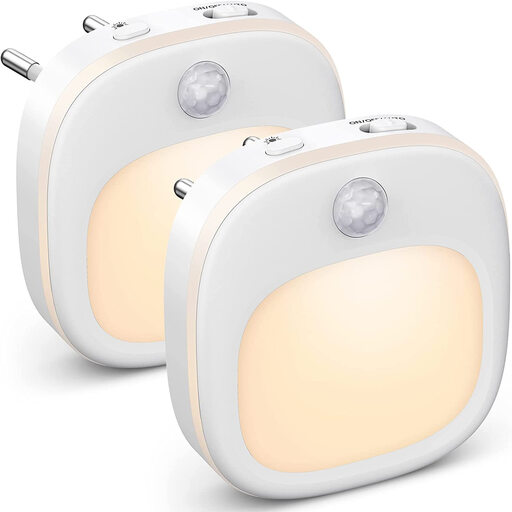
Why This Fits Their Persona: For anyone who wants to navigate hallways, staircases, or the bathroom safely at night without fumbling for a light switch. The automatic function offers both convenience and security.
The compact plug-in design is stable and space-saving (Pitfall 1). With 3 selectable colour temperatures and 5 dimming levels, the light is highly customisable (Pitfall 2). The motion sensor is a targeted, useful feature without any unnecessary frills (Pitfall 3).
Practical 2-pack for outfitting multiple areas. The sensor only activates the light in darkness and when motion is detected, saving energy. Adjustable colour temperature and brightness.
We have compiled a complete, real-time list of products that fully satisfy these strict selection criteria and UK safety regulations.
1. What is the right light colour for a bedside lamp? For use in the bedroom, a warm light colour between 2,700 K and 3,000 K is recommended. This warm white light promotes relaxation and is less disruptive to your sleep cycle than cooler, bluish light. Models with adjustable colour temperature offer additional flexibility.
2. How many lumens should a bedside lamp have? This depends on its intended use. For reading, the lamp should be able to provide around 300 to 500 lumens at its highest setting. As a pure ambient or orientation light, 20 to 100 lumens is sufficient. A good dimmable lamp will cover this entire range.
3. Are battery-powered LED bedside lamps practical? Yes, especially in certain situations. A rechargeable night light is ideal for a child's room, as a nursing light, or when a socket isn't within reach. However, you should pay attention to the battery life. For stationary use on a bedside table, a corded model with a USB charging function is often the more practical long-term solution.