
Lieferung heute & morgen

Qualitätsgarantie

Willkommens-Angebote freischalten: KOSTENLOSE Lieferung | Bis zu 80 % RABATT | Kostenlose 30-Tage-JoyPlus-Testphase
App herunterladen
A bedside table is more than just a surface for your alarm clock and a glass of water. It's a central element in the bedroom that creates order and contributes to the room's atmosphere. But the sheer number of options can be overwhelming, and supposed bargains often turn out to be poor purchases. Many models look appealing online but only reveal their weaknesses during daily use.
As your Joybuy Product Recommendation Officer, I'll help you avoid the common pitfalls. In this guide, I'll show you what to look for to find a functional and durable bedside table that perfectly fits your needs and your living space.
Marketing photos can be deceptive. Many buyers only realise after assembly that their new bedside table doesn't live up to its promises. Pay special attention to these three weak points:
To avoid a bad purchase, you should check a few technical parameters before making a decision. These objective criteria will help you realistically assess a model's quality and functionality.
The choice of material is crucial for the stability and longevity of your bedside table. Common materials include:
A modern bedside table that is built to last is characterised by cleanly finished edges and a robust surface seal.
Carefully measure the available space next to your bed before choosing a model. The ideal height for a bedside table is level with the top of your mattress or a few centimetres below it (usually between 50 and 65 cm).
Depending on your needs, there are various storage concepts:
For a harmonious overall look in the bedroom, a bedside table set of 2 is often recommended to ensure symmetry and a consistent aesthetic.
Everyone has different requirements for their bedroom side table. Here are some recommendations tailored to specific user profiles.
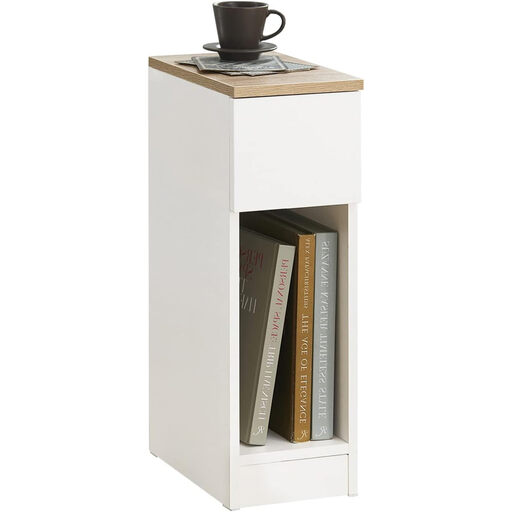
Why This Fits Their Persona: Perfect for those in city apartments or small rooms where every centimetre counts. This model makes optimal use of tight niches without sacrificing functionality.
Solves the problem of impractical dimensions with its intentionally slim design of just 20 cm in width. It fits where standard models fail.
Combines a drawer for private items with an open shelf for quick access. The construction of MDF and particleboard (E1) is robust for its size.
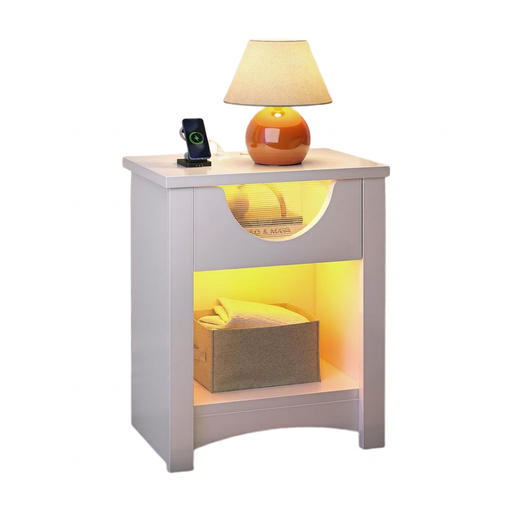
Why This Fits Their Persona: For anyone who charges their smartphone, tablet, or smartwatch overnight and appreciates atmospheric, integrated lighting. A piece of furniture that keeps pace with a digital lifestyle.
Offers more than just a surface. It integrates useful technology that reduces cable clutter and can make extra devices like bedside lamps or chargers redundant.
Integrated USB and USB-C ports plus a warm-yellow LED light strip with a button control directly on the tabletop. The handleless white bedside table also has a very modern look.

Why This Fits Their Persona: Ideal for anyone who prefers a tidy, minimalist look and wants to keep the floor clear—whether for aesthetic reasons or for easier cleaning.
Completely bypasses the problem of wobbly legs, as the floating bedside table is wall-mounted. When installed correctly on a suitable wall, it offers excellent stability.
Comes as a practical bedside table set of 2. The combination of a drawer and an open compartment offers flexible storage. The scratch-resistant melamine surface is durable.
We have compiled a complete, real-time list of products that fully satisfy these strict selection criteria and UK safety regulations.
1. How high should a bedside table be? The common recommendation is that the top of the bedside table should be roughly level with the top of your mattress. This usually corresponds to a height of 50 to 65 cm. This allows you to comfortably reach items from your bed without having to stretch or bend over.
2. What is the difference between a bedside chest and a bedside table? The terms are often used interchangeably, but there is a functional difference. A classic bedside table can be a very simple design, such as a small table with or without a single drawer. A bedside chest is typically larger and resembles a small chest of drawers, offering significantly more storage space.
3. What should I consider when mounting a floating bedside table? With a floating bedside table, secure mounting is crucial. Check the composition of your wall. Solid walls (e.g., concrete, brick) require different wall plugs and screws than drywall (plasterboard). Follow the manufacturer's assembly instructions exactly and do not exceed the specified maximum load capacity to ensure stability.