
Lieferung heute & morgen

Qualitätsgarantie

Willkommens-Angebote freischalten: KOSTENLOSE Lieferung | Bis zu 80 % RABATT | Kostenlose 30-Tage-JoyPlus-Testphase
App herunterladen
A bedside table, also known as a nightstand, is more than just a surface for your alarm clock and a glass of water. It's a key element in the bedroom that creates order and contributes to the room's ambiance. However, the sheer number of options can be overwhelming. Many models look appealing online but turn out to be impractical or unstable after purchase. This guide will help you navigate common pitfalls and make an informed decision.
Before we dive into the key features, let's look at the problems that often only become apparent after assembly and lead to disappointment.
To avoid these pitfalls, you should check three essential aspects before buying. These form the foundation for a piece of furniture that is both functional and durable.
The stability of a bedside table is directly linked to the materials used and its construction.
The right size isn't a matter of chance; it's a question of ergonomics.
Consider what you want to store by your bed.
Here are some models tailored to specific needs and living situations.
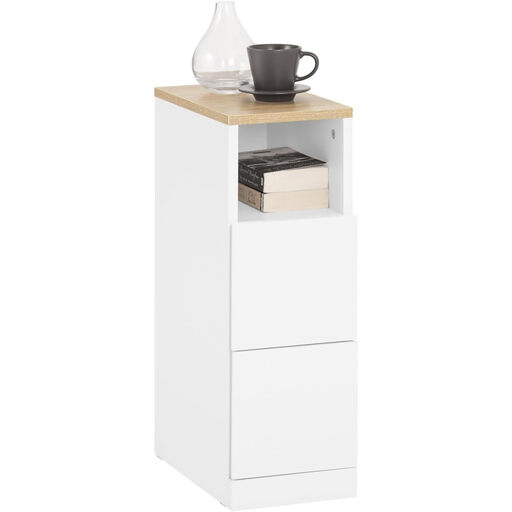
Why This Fits Their Persona: At just 20 cm wide, this nightstand is a solution for bedrooms where every centimetre counts. It fits perfectly into nooks between the bed and the wall that would otherwise go unused.
It solves the problem of improper dimensions by being specifically designed for tight spaces. Instead of a standard, overly wide model, it offers a tailored, space-saving alternative.
Maximum storage on a minimal footprint, thanks to two drawers and an open shelf. The included felt pads protect the floor.

Why This Fits Their Persona: This model integrates a power outlet for charging devices and an LED strip with 20 colours. It's ideal for users who value convenience and modern technology right at their bedside.
It avoids the short-lived tech trap because the power outlet can be flexibly mounted, and the entire unit is supported by a sturdy metal frame, indicating a well-thought-out design.
Combines a charging station, mood lighting, and generous storage (3 drawers and an open shelf) in a single piece of furniture.

Why This Fits Their Persona: For anyone looking for a piece of furniture with character. The unique fish scale pattern, navy blue colour, and champagne-coloured metal legs make this nightstand a true statement piece.
This model escapes the instability trap thanks to its solid metal legs and a thoughtful design with rounded corners, which also enhances safety.
Striking design with a textured finish. The handle can be flexibly mounted on the left or right, allowing for customisation to fit the room's layout.
We have compiled a complete, up-to-date list of products that fully meet these strict selection criteria.
As a rule of thumb, the top of the bedside table should be roughly level with the top of your mattress. For most beds, this corresponds to a height of 50 to 65 cm. This ensures you can comfortably access everything on the table, whether you're sitting up or lying down.
The load capacity of a wall-mounted nightstand depends heavily on the wall's structure and the quality of the installation. Typically, the manufacturer's recommended maximum load is between 5 and 10 kg. It is crucial to use the correct wall plugs and screws for your wall type and to follow the assembly instructions precisely.
Although the terms are often used interchangeably, there are subtle differences. A bedside table is specifically designed for use next to the bed, taking into account typical requirements like the correct height and storage for nighttime essentials. A side table in the bedroom can serve a more general purpose and is often more decorative or used as a surface in another corner of the room. With a bedside table, functionality is the primary focus.