
Lieferung heute & morgen

Qualitätsgarantie

Willkommens-Angebote freischalten: KOSTENLOSE Lieferung | Bis zu 80 % RABATT | Kostenlose 30-Tage-JoyPlus-Testphase
App herunterladen
A bedside table is more than just a spot for your alarm clock and a glass of water. It's a key piece of bedroom furniture that creates order and completes the room's aesthetic. However, the sheer number of options can be overwhelming, and making the wrong choice is frustrating. Flaws often don't become apparent for several months: wobbly legs, insufficient storage, or an awkward height. This guide will help you avoid common pitfalls and make an informed decision.
Purchasing a new piece of furniture should be a well-considered decision. Pay attention to the following points to avoid disappointment.
To find the right model, you should evaluate three crucial criteria. These will help you perfectly balance functionality and aesthetics.
The ideal height for a bedside table is aligned with the top of your mattress. It should be either level with it or a few centimetres below. This allows you to reach items comfortably without having to strain.
The material determines the durability and maintenance requirements of your bedside table.
Consider what you want to store on and in your bedside table.
Here are a few models tailored to specific requirements and living situations.
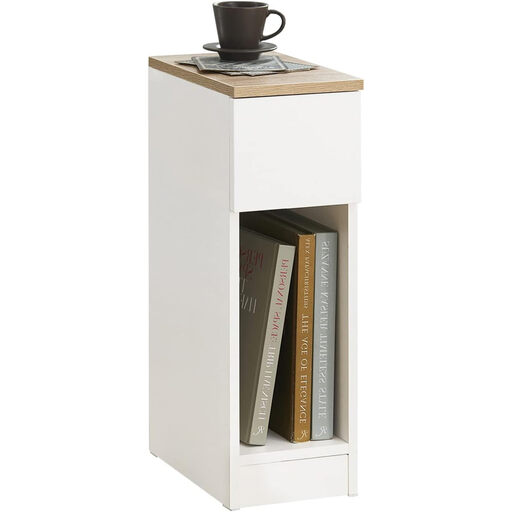
Why it's a great fit: Perfect for anyone who only has a narrow space available next to their bed. This model makes optimal use of limited space by focusing on height and depth.
It solves the problem of improper proportions. At just 20 cm wide, it fits into the smallest gaps without overwhelming the room. The combination of a drawer and an open shelf also prevents a cluttered surface.
Combines closed and open storage within a minimal footprint. The construction of MDF and particleboard (E1 grade) offers a load capacity of up to 20 kg.

Why it's a great fit: For those seeking a functional bedside table that also makes a bold visual statement. The unique design with a textured surface and metal legs enhances any room.
This model marries design with functionality. It sidesteps the pitfall of insufficient storage with a spacious interior compartment while offering a sturdy construction of particleboard and metal.
Decorative fish scale pattern and champagne-coloured metal legs. The handle can be mounted on either the left or right, making it easy to adapt to your room's layout.
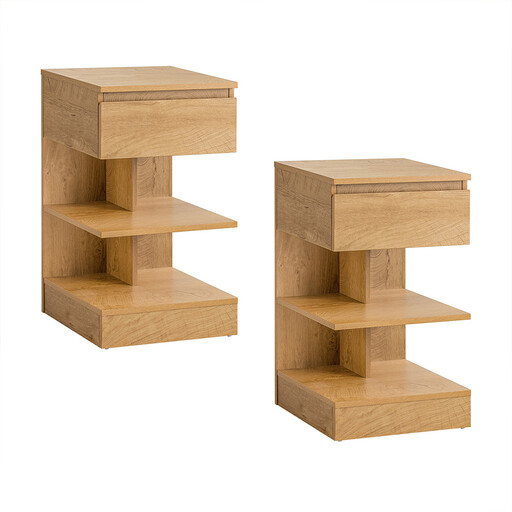
Why it's a great fit: This set is a practical and economical solution for couples looking for a uniform and symmetrical setup for their double bed. It offers a balanced mix of storage and shelf space.
The set solves the problem of misjudging storage needs. Each table has a drawer for private items and two open shelves for quick access. The robust PB construction, with a load capacity of 35 kg per table, prevents instability.
Delivered as a convenient bedside table set of 2, which simplifies creating a symmetrical layout. The combination of a natural wood look and white complements many modern interior styles.
We have compiled a complete, up-to-date list of products that fully meet these strict selection criteria and UK/EU safety regulations.
1. How high should a bedside table be? The common recommendation is that the top of the bedside table should be level with the top of your mattress, or up to 5 cm lower. This ensures convenient access from the bed. Measure the height from the floor to the top of your mattress before making a decision.
2. Which material is most durable for a bedside table? Solid wood is considered very durable and robust, but it may require more maintenance. A very practical and resilient alternative is high-quality MDF or particleboard (Class E1) with a melamine resin coating. These surfaces are scratch-resistant, water-repellent, and easy to clean, making them ideal for daily use.
3. What is the difference between a bedside table and a nightstand? The terms "bedside table" and "nightstand" are now used largely interchangeably. Historically, a "console" was often a piece of furniture fixed to the wall or standing on legs with little storage space. A "bedside table" was traditionally a small cabinet. In modern usage, both terms refer to a small piece of furniture placed next to the bed.