
Lieferung heute & morgen

Qualitätsgarantie

Willkommens-Angebote freischalten: KOSTENLOSE Lieferung | Bis zu 80 % RABATT | Kostenlose 30-Tage-JoyPlus-Testphase
App herunterladen
A modern bedside table is more than just a surface for a book and a glass of water. In a world where smartphones, smartwatches, and tablets are constant companions, the nightstand is becoming a personal tech hub. A bedside table with a charging station promises order and convenience by consolidating charging cables and providing power outlets right by your bed.
But the growing selection also has its pitfalls. Many models entice with tech features while neglecting fundamental quality. Before you decide, it's important to know the most common defects, which often only surface after a few months of use.
The idea is practical, but the execution isn't always successful. Pay attention to these three points to avoid a bad investment:
To find the right bedside table for your needs, you should look not only at the design but, more importantly, at the technical and material specifications.
The type and number of connections determine the practical utility.
A bedside table must also impress as a piece of furniture.
Instead of presenting an overwhelming list, we have matched models based on typical user profiles.

Why This Fits Their Persona: This set of 2 bedside tables is ideal for couples looking for a symmetrical and highly functional solution for their bedroom. Each table combines a charging station with atmospheric, remote-controlled LED lighting, catering to the needs of tech-savvy users.
The integrated power strip with 2 outlets and 2 USB ports per table bypasses the problem of weak USB ports. Users can plug in their own fast chargers and aren't reliant on underpowered, built-in electronics.
Combines power supply, customisable lighting, and storage (2 drawers, 1 open compartment). The 2-meter power cord offers flexibility in placement.
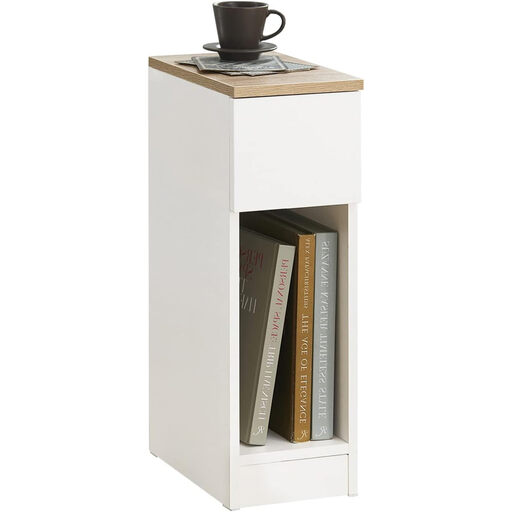
Why This Fits Their Persona: Ideal for users who prefer a clean, modern design in tight spaces and want to maintain control over their charging infrastructure. This narrow side table for the bedroom offers storage without being visually overwhelming.
Instead of relying on potentially outdated built-in tech, this design allows for the integration of your own high-performance power strip. It can be placed in the open compartment or behind the unit, enabling clean cable management.
Slim, space-saving design (20 cm width) with practical storage via a drawer and an open compartment. The construction of E1-grade MDF is sturdy, and the white finish is easy to clean.

Why This Fits Their Persona: Perfect for anyone who values clear floor space and a floating, modern aesthetic. This set provides organised storage and makes cleaning the floor easier. It creates the foundation for a clean, custom charging setup.
This model avoids the problem of visible power cords from the outset, as the power supply is handled entirely externally. Cables from the wall outlet can be elegantly routed up behind the floating body, resulting in a very clean overall look.
The wall-mounted design creates an airy, modern aesthetic and maximum floor clearance. The combination of a closed drawer and an open compartment offers a flexible storage solution.
We have curated a complete, up-to-date list of products that fully meet these strict selection criteria and German safety regulations.
1. How many watts should a bedside table with a USB port have? For a slow overnight charge, 5 watts (5V/1A) is often sufficient. However, to fast-charge modern smartphones, 15 watts or more is often required. If a nightstand offers integrated power outlets, you can use your own manufacturer-certified fast charger, which is always the safest bet.
2. Can you integrate a charging station into a regular bedside table? Yes, this is a very flexible and future-proof method. You can purchase a high-quality power strip with USB ports and place it in an open compartment, in a drawer (with a cutout for cables at the back), or behind the nightstand. This allows you to easily upgrade the charging technology when needed without replacing the entire piece of furniture.
3. Are bedside tables with LED lighting safe? For products intended for the German market, the electrical components, including LED strips and power supplies, must comply with current safety standards (e.g., CE marking). LED lights generate very little heat compared to traditional bulbs, making the fire risk minimal with proper installation and use. Ensure that electrical parts do not come into contact with liquids.