New to making beetroot pasta
You want to make coloured pasta without kneading the dough by hand, and need to get the liquid and shaping discs right. Check the instructions for the specific model you’re considering.


If you’d rather leave the kneading and shaping to a machine, compare automatic pasta makers based on their footprint, minimum batch size and cleaning requirements. If you want to prepare your own sheets of dough and choose their thickness, a motorised roller may be a better fit. Springlane and Philips make standalone pasta makers, while the KitchenAid attachment requires a compatible stand mixer. As beetroot adds extra moisture to the dough, adjust the amount of liquid according to the instructions for your chosen model.
You want to make coloured pasta without kneading the dough by hand, and need to get the liquid and shaping discs right. Check the instructions for the specific model you’re considering.
You’re comparing appliance dimensions, storage space and the room needed to dispense pasta or feed sheets of dough through the machine. The dimensions provided by Springlane and Philips make it easier to compare.
You want to use your existing mixer and need to check whether your chosen attachment rolls out the dough, cuts it or does both. KitchenAid describes the functions of its individual attachments.
For beetroot pasta in a small kitchen, it’s worth weighing up how much of the work you want the machine to do and the portion size first, then considering storage space and cleaning.
| Buying priority | What to check | Who is it important to? |
|---|---|---|
| Beetroot dough | Check the instructions for adding liquid and make sure the shaping discs are suitable. | If I’m making coloured dough, I want to know how the moisture from juice or purée affects the recipe. Around 33% of consumers say dough consistency is their top buying priority. |
| Worktop space and portions | Compare the appliance dimensions, the space needed in front of the outlet and the minimum batch size. | In a small kitchen, it’s not just the width of the appliance that matters; I also need space for ingredients and finished pasta. Around 27% of consumers focus primarily on the space an appliance takes up. |
| Cleaning | Read the cleaning instructions for the specific model, including any exceptions for covers, shaping discs or attachments. | If I need to clean coloured dough off the machine after every batch, I want to know which parts are dishwasher-safe. Around 20% of consumers put cleaning first. |
| Effort and pasta shape | Check whether mixing, kneading, rolling and cutting are included, and which shaping discs come with the model. | Before buying, I want to weigh up whether I’d prefer less hands-on work or more control over the dough sheets and pasta shapes. Around 20% of consumers prioritise the steps handled by the machine or the shapes they want to make. |
A motorised roller and a powered attachment roll out dough that you’ve prepared in advance. The automatic machines described here also mix and knead the dough.
Check the steps involved and what’s included by looking at the full model name.
With a roller, you’ll need to allow extra time to prepare the dough.
The appliance dimensions alone won’t tell you how much worktop space you’ll need for ingredients, dispensing pasta or feeding sheets of dough through the machine.
Allow space in front of and above the appliance, as well as room for a tray and cleaning.
This only applies to the parts specifically listed. For example, Philips excludes the front cover on the HR2665/93.
Check the parts list and cleaning instructions for your specific model before putting anything in the dishwasher.
Functions and compatibility vary by model: the KitchenAid 5KSMPSA roller doesn’t cut pasta, and additional discs for the Rommelsbacher PM 220 must match the F number.
Check the model number, appliance version and included functions before buying an attachment.
The Nina is a standalone pasta maker with an integrated scale and seven shaping discs.
The HR2665/93 is a standalone pasta maker with kneading and extrusion functions.
The Atlasmotor+ is a motorised roller with adjustable dough thickness.
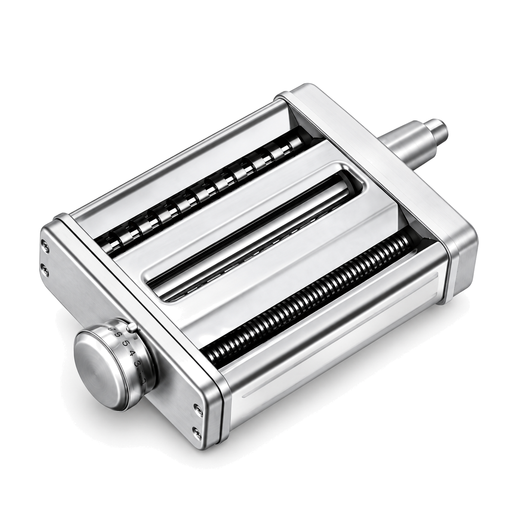
The 3-in-1 pasta attachment 5KSM3MPA rolls and cuts dough using a compatible stand mixer.
The Pastarella PM 220 is a standalone extruder with an integrated scale and controlled water supply.
Here you’ll find a motorised roller, two automatic pasta makers and an attachment for a KitchenAid stand mixer. Adjust the amount of liquid in beetroot dough according to the instructions for your chosen model.
 No image available
A motorised roller for sheets of dough and cut pasta, giving you the freedom to choose the thickness.
Specifications list seven thickness settings from 0,5 to 3 mm, two cutting attachments and dimensions of 20,8 × 14,2 × 21,3 cm. The description says to clean it with a dry cloth and use the supplied brush to clean the blades; do not immerse it in water.
 No image available
For anyone who’d like the machine to handle the mixing and kneading, and wants to try different shaping discs.
The description lists nine shaping discs, a 360° mixing process, reverse function and a separate filling port for water or vegetable juice. Check the instructions for the specific model when making beetroot dough.
 No image available
The stated dough capacity makes it a good fit for anyone looking to make smaller batches.
Features include a rechargeable battery, a removable stainless-steel filling tube and five shaping discs. The description gives a maximum dough quantity of 200 g per batch; wipe the body of the appliance with a soft cloth and do not rinse it.
 No image available
An option if you already own a compatible KitchenAid stand mixer and want to roll and cut dough.
Specifications list eight thickness settings and separate cutters for spaghetti and fettuccine. The attachment requires a KitchenAid stand mixer with a compatible power hub.
No. Adjust the total amount of liquid according to the instructions for your specific model, taking into account the moisture in the juice or purée. KitchenAid lists beetroot as a possible colouring, but that doesn’t mean there’s one standard recipe quantity for all pasta makers.
You’ll need a compatible KitchenAid stand mixer for the KitchenAid 5KSM3MPA. The separately available 5KSMPSA roller rolls out the dough, but doesn’t cut it.
No. Dishwasher-safe only applies to the parts specifically listed, not the entire appliance. For the Philips HR2665/93, the manufacturer excludes the front cover; follow the instructions for your specific model to clean its parts.
No. According to the European Union’s guidance, CE marking is only required for products covered by specific EU rules that expressly require it. Where this applies to a particular standalone electrical appliance, the manufacturer uses the mark to declare that the product complies with those rules; it isn’t an independent comparative test.