
Lieferung heute & morgen

Qualitätsgarantie

Willkommens-Angebote freischalten: KOSTENLOSE Lieferung | Bis zu 80 % RABATT | Kostenlose 30-Tage-JoyPlus-Testphase
App herunterladen
A baby bedside crib should keep your baby close, take up little space and attach securely to your bed. In practice, though, some buying decisions can lead to unnecessary extra costs: the mattress may not fit exactly, the height adjustment may not suit your bed, or the castors and fastenings may prove impractical for everyday use.
This guide explains which details really matter when buying a bedside crib for your baby, and which features suit different homes and ways of using one.
The words ‘height adjustable’ don’t tell you much on their own. What matters is whether you can set the sleeping surface to the same height as your mattress, taking into account the bed frame, rails or box-spring construction. Before buying, measure from the floor to the top of your mattress.
A height-adjustable bedside crib with several settings gives you more flexibility. For unusual bed frames, you may also need an extension kit.
A canopy, bedding or decorative nest may add to what’s included, but they don’t replace secure fastenings. When using a baby co-sleeper, the supplied straps or brackets, the gap between the crib and your bed, and correct assembly are what matter.
A baby cot with a guard rail must also be used in accordance with the instructions. Extra pillows, blankets or loose padding can be hazardous in a sleeping area and should not be placed in the crib unless the manufacturer expressly says they are suitable.
Many compact models are intended for the first few months only. Age guidance is not the only thing to consider: once your baby can pull themselves up, sit up or get onto their knees, you must stop using the crib as a bedside crib if the manufacturer’s instructions say so.
A larger 60 x 120 cm baby cot may be usable for longer than a compact 45 x 90 cm model. However, the actual period of use still depends on the design and safety guidance.
The mattress must fit the intended sleeping surface exactly. You must not use a larger or smaller mattress in a 45 x 90 cm baby cot. The same applies to a 60 x 120 cm cot. Also check:
The roba Safe Asleep range is described as including a mattress with a removable jacquard cover, which the product details say is washable at 60 °C. Check these details against the specific product version before buying.
A baby bedside crib should not simply stand next to your bed: it should be securely attached using the fastenings provided. Check for:
Some roba models are described as having adjustable metal brackets or safety straps. According to the manufacturer’s description, the Safe Asleep 3 in 1 is designed to be attached with straps. A separately available extension kit may be needed for unusual beds and box-spring beds.
A bedside crib with castors is easier to move around your home. When it’s stationary, though, the brakes must be on. Before each use, check that all the castors are locked and that the crib is on a flat, hard surface.
Depending on the model, wooden cribs may be made from MDF, plywood or solid wood. What matters is a sturdy construction, smooth edges and regular checks of all the connections. EN 1130 covers safety requirements for bedside cribs and cots; check the manufacturer’s documentation for the specific product’s declaration of conformity.

Why it suits this kind of buyer: This compact wooden model has a 45 x 90 cm sleeping surface, making it a good choice for parents looking for a space-saving option for the first few months.
The product details list seven height settings, fastening straps, four castors with brakes and a compatible mattress.
Three ways to use it, a washable mattress cover and mesh protection, according to the manufacturer.
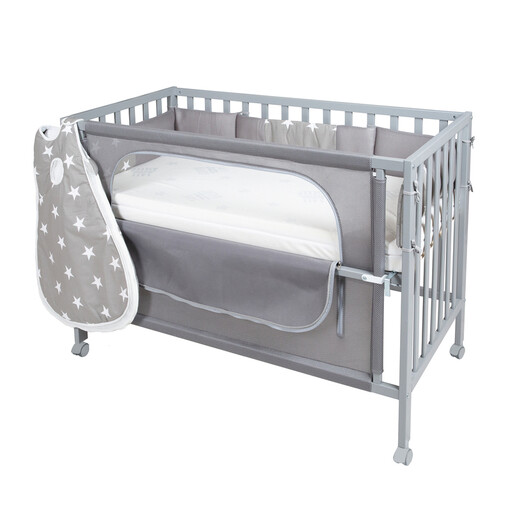
Why it suits this kind of buyer: Its larger sleeping surface and generous set of included items make it a good choice for families who want to use the bed beyond their baby’s first few months.
The 60 x 120 cm sleeping surface, six height settings and the intended attachment method are clearly specified.
The product description says that a mattress, sleeping bag and nest are included. The bed is designed to be used as a bedside crib, cradle and cot.
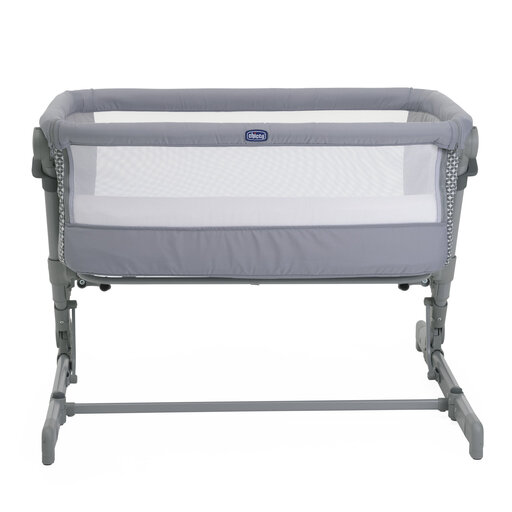
Why it suits this kind of buyer: This foldable model is designed for parents who want to move the bedside crib around the home or take it with them when travelling.
The product details list six height settings, an attachment system, four castors and a removable, washable cover.
Folds away quickly without needing to be taken apart, and comes with a mattress measuring 83 x 50 x 4,5 cm.
We’ve put together a complete, regularly updated list of products that meet these strict selection criteria and the safety regulations in force in the EU.
Following the instructions, secure the crib to your bed using the straps, hooks or brackets provided. Before each use, check that the connection is secure and that there’s no dangerous gap between the sleeping surfaces.
It depends on the model. Compact 45 x 90 cm versions are often intended for the first six to twelve months. Always follow the manufacturer’s guidance, though: if the warnings say to stop using the crib once your baby can pull themselves up, sit up or get onto their knees, you must do so.
On top of the initial price, you may need to pay for fitted sheets, replacement covers, a compatible mattress or an extension kit. Before buying, check whether standard accessories are available and whether the mattress cover can be washed according to its care label.