
Lieferung heute & morgen

Qualitätsgarantie

Willkommens-Angebote freischalten: KOSTENLOSE Lieferung | Bis zu 80 % RABATT | Kostenlose 30-Tage-JoyPlus-Testphase
App herunterladen
A bento lunch box should keep your meals secure on the go, separate different foods and be easy to clean. In practice, unclear product descriptions can lead to the wrong purchase. A box may look compact but have too little capacity; a lid may be described as leakproof even though liquids should only be carried upright; or the compartments may be fixed and not suit your daily meals.
This buying guide explains which features really matter in a lunch box with compartments and which models suit different everyday needs.
A leakproof lunch box needs more than a tightly fitting lid. A seal that goes all the way round and a closure that presses the lid down evenly are essential. Even so, this doesn’t mean you can carry soup in any position. With many containers, liquid or very juicy foods should be carried upright.
Look for specific details such as a silicone seal, clip-lock fastening or screw-top lid. Always consider claims such as “leakproof” alongside the manufacturer’s instructions for use.
A snack box with a divider is handy for fruit, vegetables, nuts or dips. However, a fixed divider means you can’t adjust how the capacity is split. If you often carry larger main meals with sides, you may need a bigger main compartment or separate containers.
A two-part bento lunch box can work well for rice dishes, sandwiches and prepared meals. For yoghurt with granola or dips, stackable 2-in-1 systems are often a better fit.
A dishwasher-safe lunch box should have just a few parts that are easy to reach. Sealing rings, lids and dividers can collect more dirt in narrow gaps. Check whether the sealing ring can be removed and whether all the components can be cleaned separately.
A stainless steel lunch box has a smooth, uncoated interior that’s handy because it’s usually easy to wipe clean. Plastic containers, on the other hand, can be lighter, transparent and suitable for use in the microwave or freezer.
A stainless steel lunch box is robust and less likely to retain odours. The PURECOOK model is listed as being made from 304 stainless steel, with a smooth, uncoated surface. This material is designed for its intended use with food, but must not be used over an open flame. Stainless steel containers are not automatically suitable for microwave use either.
BPA-free plastic is often lighter and allows you to see what’s inside. The LocknLock models listed are made from BPA-free plastic or polypropylene. According to the product details, they are suitable for microwave use without the lid. They are not designed for use in an oven, on a hob or over direct heat.
For everyday use, the capacity in litres isn’t the only thing to consider. Compare:
A compact lunch box for school or work may be big enough for yoghurt and granola at breakfast. For a complete meal-prep box with a main dish, side and snack, a larger model or a set with several containers may be more practical.
A lunch box with a seal should have a clearly described fastening mechanism. Metal clips press the lid against the silicone ring on several sides. Screw-top lids can save space on round or stackable snack boxes. Whichever system you choose, the lid should sit evenly once closed.
Also check the following details:
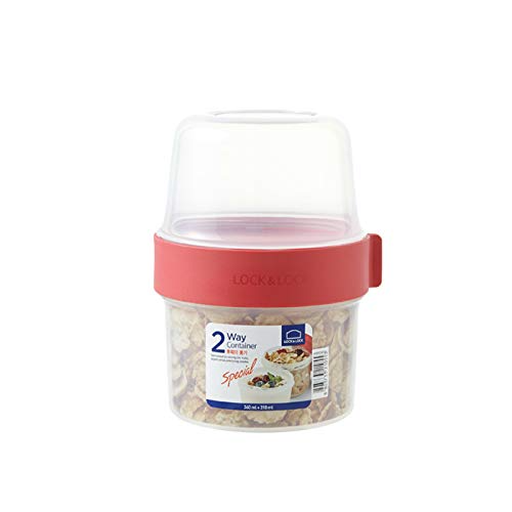
Why this product suits this profile: This compact, two-part box is ideal for smaller breakfasts, snacks and lighter meals. Its stated total capacity is 670 ml.
The separate sections keep foods such as yoghurt and granola, or snacks and dip, apart. Remove the lid completely before heating.
BPA-free plastic, dishwasher-safe and microwave-safe without the lid; rectangular shape with two tiers.
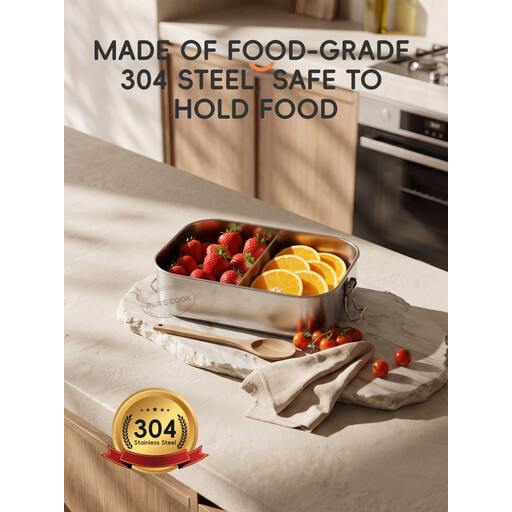
Why this product suits this profile: This two-part stainless steel box is a good choice if you prefer a smooth, uncoated surface and a fixed divider between your main dish and side.
The built-in divider stops the two foods from mixing directly. Clips and a silicone seal help reduce spills when the box is carried upright.
304 stainless steel, two fixed compartments, metal clips, and a box and lid listed as dishwasher-safe.
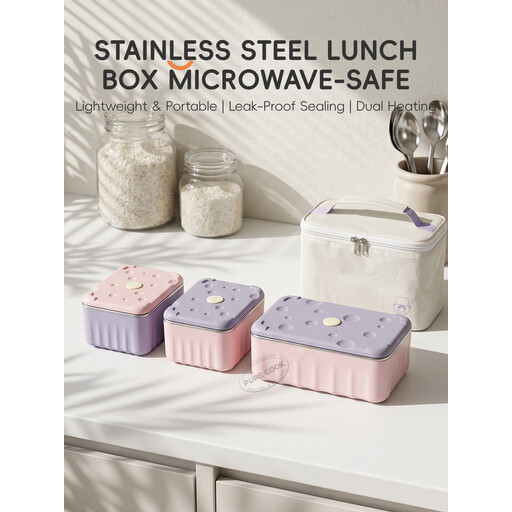
Why this product suits this profile: With one 1,200 ml container, two 600 ml containers and an insulated bag, this set is designed for meal prep, family use and longer outings.
Several containers give you more flexibility than a fixed divider. The insulated bag makes it easier to carry everything together; liquids should still be transported upright.
Three sizes, 304 stainless steel inside, silicone seals and an Oxford bag with an aluminium foil lining.
We’ve put together a complete, regularly updated list of products that meet these strict selection criteria and fully comply with the safety regulations in force in the EU.
A reusable food container stays in good working order if you clean and dry it thoroughly after every use. If your lunch box has a seal, check the silicone ring regularly. Cracks, warping or a persistently loose fit are signs that it needs replacing.
For plastic boxes:
For school or work, compact dimensions, a secure-fitting lid and an easy-to-clean surface are essential. A lunch box with two compartments is suitable for a main dish and a side. For yoghurt, granola and snacks, stackable 2-in-1 containers with separate tiers are a practical choice.
As a rule, stainless steel should not be used in a microwave. Always follow the guidance from the manufacturer and the microwave’s instructions. With plastic models, the lid usually needs to be removed completely. A stainless steel box must not be heated on a hob or over an open flame either.
How long it lasts depends on the material, fastening, cleaning and how heavily it’s used every day. Check the seal, clips, screw-top lid and container regularly. Replace the box if it has cracks, sharp edges, severe warping or a damaged seal.