
Lieferung heute & morgen

Qualitätsgarantie

Willkommens-Angebote freischalten: KOSTENLOSE Lieferung | Bis zu 80 % RABATT | Kostenlose 30-Tage-JoyPlus-Testphase
App herunterladen
Choosing the right filament is a critical factor for a successful 3D print. An unsuitable or low-quality material can lead to clogged nozzles, poor surface finishes, or even the complete failure of a multi-hour print job. The goal of this article is to provide you with objective guidance to help you make an informed decision when purchasing PLA Filament 1.75mm. We will outline key criteria and present a selection of products that stand out for their specific properties.
Before you buy filament, you should consider several technical parameters. These significantly influence the print quality, reliability, and the final outcome of your project.
The consistency of the filament's diameter is crucial for uniform extrusion. The standard for most FDM printers is a diameter of 1.75mm. Pay close attention to the tolerance specified by the manufacturer. A value of ±0.02mm is considered highly precise and minimises the risk of clogging and uneven material flow. A tight tolerance ensures more stable layer adhesion and ultimately results in smoother, more dimensionally accurate prints.
A clean and tangle-free winding on the spool is an often-underestimated quality feature. Poorly wound filament can snag during printing and block the feed, which inevitably leads to a failed print. Additionally, more and more manufacturers are opting for cardboard spools instead of plastic ones. This eco-friendly filament concept reduces plastic waste and makes disposing of the empty spool easier.
PLA (Polylactide) is a popular 3D printing material, especially among beginners and hobbyists, because it is easy to work with. It has a low melting temperature, a minimal tendency to warp, and emits only a faint, slightly sweet odour during printing. Look for information on material purity and batch-to-batch consistency to ensure uniform results for recurring projects.
Based on the criteria mentioned, we have compiled a selection of products suitable for various applications.
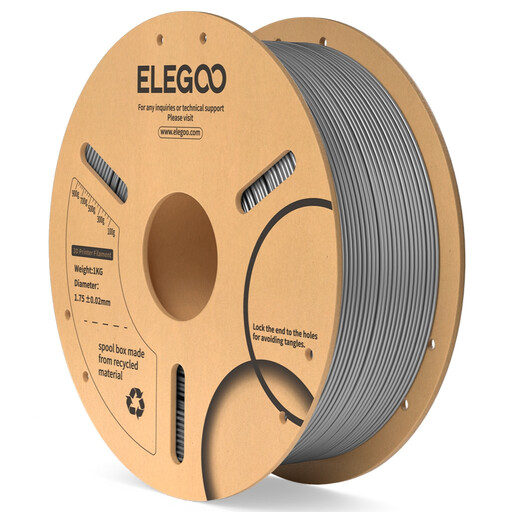
View Product: Elegoo PLA Filament 1kg Paper Spool-Space Grey
Why it stands out: This Elegoo PLA filament combines high dimensional accuracy with an eco-conscious approach. The spool is made of cardboard, making it a more sustainable choice. The mechanical winding and manual inspection ensure clean and tangle-free feeding.
Advantages:
Who is it for? Users who value reliability and more environmentally friendly packaging. It is suitable for a wide range of applications, from prototypes to decorative objects.
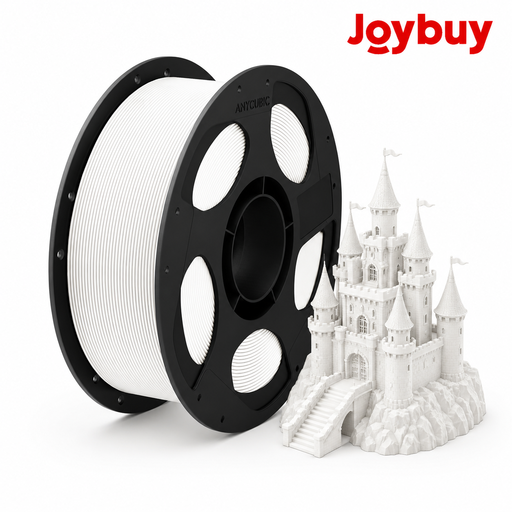
View Product: ANYCUBIC PLA Basic Printing Filament, 1kg Spool - White
Why it stands out: The Anycubic PLA Basic filament is known as a reliable all-round material. It has been developed for broad compatibility with most FDM 3D printers and offers consistent performance for everyday printing tasks.
Advantages:
Who is it for? Makers and hobbyists looking for a dependable and easy-to-print 1kg PLA filament for a variety of projects, from functional parts to figurines.
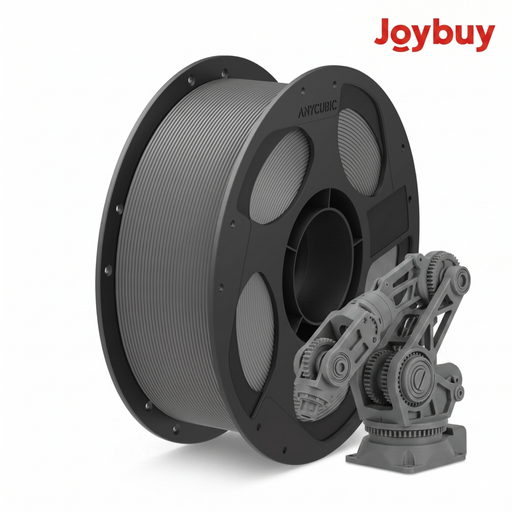
View Product: JOYBUY x ANYCUBIC PLA Basic Printing Filament, 1kg Spool - Texture Grey
Why it stands out: Developed in collaboration with Anycubic, this filament offers a special aesthetic feature: a textured, matte surface. This finish hides the typical layer lines of FDM printing and gives models a high-quality appearance right off the print bed.
Advantages:
Who is it for? Users in product design, architectural modelling, and anyone who wants to create models with a particularly clean and professional look without post-processing.
The selection presented here covers common use cases. However, if you are looking for specific colours, different materials, or other options, you can find a broader range of products in our main category.
Discover Our Entire Selection of 3D PLA Spools
H3: How do I store PLA filament correctly? PLA is hygroscopic, meaning it absorbs moisture from the air. Damp filament leads to poor print quality (e.g., bubbling, brittle material). Therefore, store your filament spools in a cool, dry, and dark place. It is best to keep them in a resealable bag with a desiccant (silica gel).
H3: What does diameter tolerance mean for filaments? The diameter tolerance indicates the maximum permissible deviation from the nominal diameter (e.g., 1.75mm). A tight tolerance like ±0.02mm means that the filament diameter is very consistent throughout the entire spool. This is crucial for a uniform extrusion rate and prevents issues like under- or over-extrusion and nozzle clogs.