
Lieferung heute & morgen

Qualitätsgarantie

Willkommens-Angebote freischalten: KOSTENLOSE Lieferung | Bis zu 80 % RABATT | Kostenlose 30-Tage-JoyPlus-Testphase
App herunterladen
The days of needing a separate, often bulky power adapter for each device in your bag or on your desk are coming to an end. Anyone who owns a laptop, a smartphone, and perhaps a tablet knows the problem: a tangled mess of cables and multiple clunky adapters. Modern charging technology offers an efficient solution. This article serves as a guide to help you understand how GaN chargers work and select the right model for your needs.
Selecting the right charger depends on the devices you use. Three key criteria will help you make an informed decision.
The power output of a charger, measured in watts (W), determines how quickly your devices will charge. A modern fast charger adjusts its power output to match the connected device. The following values serve as a general guideline:
Look for support for Power Delivery (PD). This standard enables intelligent and fast power transfer between the charger and the device via a USB C charger port.
A multi-port charger is ideal for consolidating your device ecosystem. Consider how many devices you want to charge simultaneously. A combination of different ports offers maximum flexibility:
A charger with two or more USB-C ports and an additional USB-A port covers most use cases for professionals and travellers.
GaN stands for Gallium Nitride, a semiconductor material that is replacing traditional silicon in modern power adapters. The advantages are significant: GaN chargers can be built much smaller and lighter while delivering the same amount of power. They also operate more efficiently and generate less waste heat, which increases longevity and safety. So, if you're looking for a compact laptop charger that can also power your phone, a GaN charger is the most technologically advanced choice.
Based on the criteria above, we have compiled a selection of models that cater to different needs.
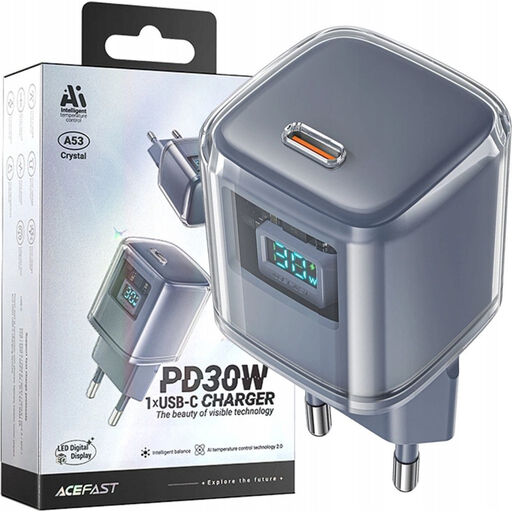
Why it stands out: The integrated LCD display is this charger's standout feature. It provides real-time information about the charging status and power output, allowing for precise monitoring.
Advantages:
Who is it for? Ideal for users who primarily want to fast-charge a single device like a smartphone or tablet and who appreciate technical details and visual feedback on the charging process.
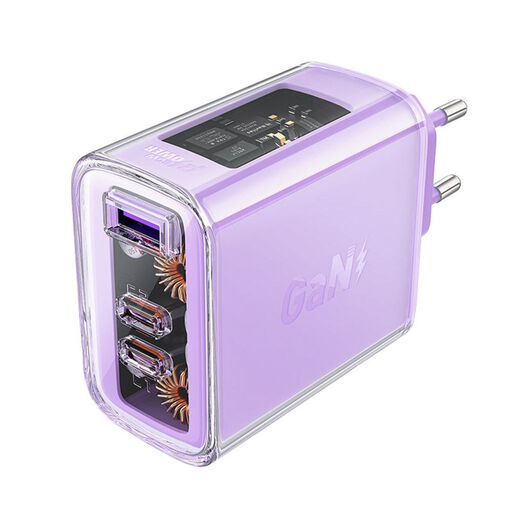
Why it stands out: This model combines a solid 65W of power with three ports in a striking, transparent casing. It's a versatile all-rounder for daily use.
Advantages:
Who is it for? Perfect for professionals, students, and frequent travellers who need a single, compact solution to replace their laptop charger while also charging other devices like smartphones and accessories.

Why it stands out: With an impressive total output of 140 watts and support for the latest PD 3.1 standard, this charger is a powerful hub for the most demanding setups.
Advantages:
Who is it for? For power users, creative professionals, and tech enthusiasts who own multiple power-hungry devices and need a no-compromise charging solution for their desk or travel bag.
The models presented cover a broad spectrum, but individual needs can vary greatly. If you are looking for a different power class or specific port combinations, you can find more options in our product range.
For a wider selection of charging solutions, including traditional models, explore our Type-A Charger category.
The main advantage lies in the higher efficiency and lower heat generation of the Gallium Nitride material compared to conventional silicon. This allows for the construction of chargers that are significantly smaller and lighter while delivering the same or even higher power.
Yes, GaN chargers with a USB-C port and the Power Delivery standard are universally compatible. The charger and the device communicate with each other to negotiate the optimal charging power. A powerful 100W charger will not damage a smartphone that can only draw 20W, as the power output is automatically adjusted.
To achieve maximum charging speed, especially at high wattages (over 60W), a suitable cable is required. Look for a USB-C cable that is explicitly rated for the corresponding power (e.g., 100W or 140W). A standard cable may limit the charging speed.