
Lieferung heute & morgen

Qualitätsgarantie

Willkommens-Angebote freischalten: KOSTENLOSE Lieferung | Bis zu 80 % RABATT | Kostenlose 30-Tage-JoyPlus-Testphase
App herunterladen
By Joybuy Product Recommendation Officer, August 30, 2026
A torque wrench is not an ordinary wrench. It's a precision instrument that determines whether a bolted connection on your vehicle is secure and durable or if it will lead to expensive material damage. Whether for carbon parts on a bicycle, the engine's cylinder head, or when installing lug nuts, applying the correct tightening torque is critical. However, the market is flooded with tools whose promises often don't match reality. Before making a purchase, you should be aware of the most common pitfalls that lead to frustration and unnecessary expense.
The 3 Most Common Mistakes When Buying a Torque Wrench:
To avoid a bad purchase, focus on the technical parameters relevant to your applications.
The required torque range is the most important criterion and depends directly on the field of application. The drive size (the square drive onto which the socket is placed) typically correlates with the torque range.
The way the target torque is signalled affects user comfort and precision.
Here are some models tailored to specific user profiles and their requirements.
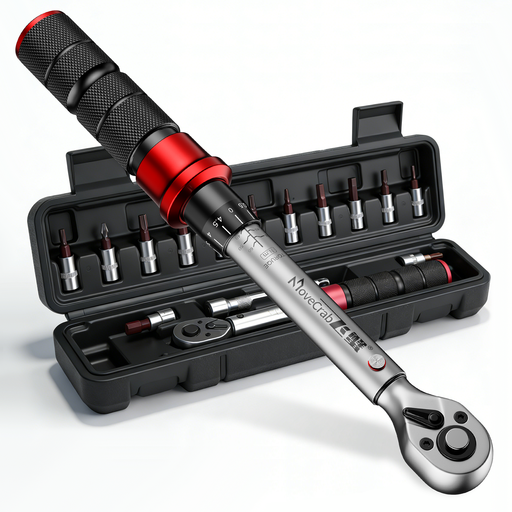
Why this model is a good fit: Perfect for cycling enthusiasts working on modern bikes with carbon components. The low torque range is precisely tailored to the requirements of stems, handlebars, and seatposts, where precision is essential.
This set bypasses the pitfall of inaccurate all-in-one wrenches by specialising in the precise, low range of 2-20 Nm. The Chrome Vanadium steel construction also prevents premature material wear.
Offers bidirectional measurement (for right- and left-hand threads) and comes with an 11-piece bit set that covers the most common screw profiles on a bicycle.
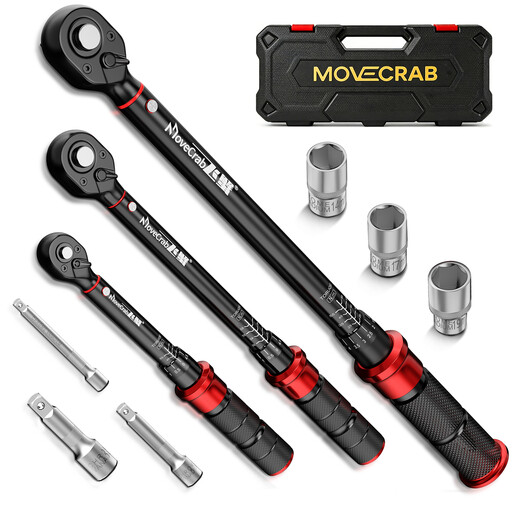
Why this model is a good fit: Ideal for the ambitious home mechanic who works on both motorcycles and cars. This set, with its multiple wrenches, covers almost all common tightening torques, from oil changes to wheel changes.
Instead of relying on a single, compromised wrench, this torque wrench set uses multiple tools to cover the wide range of 5-220 Nm. This ensures higher accuracy within each respective sub-range.
Provides a cost-effective, all-in-one solution for a workshop. The included extensions and adapters increase flexibility for hard-to-reach bolts.
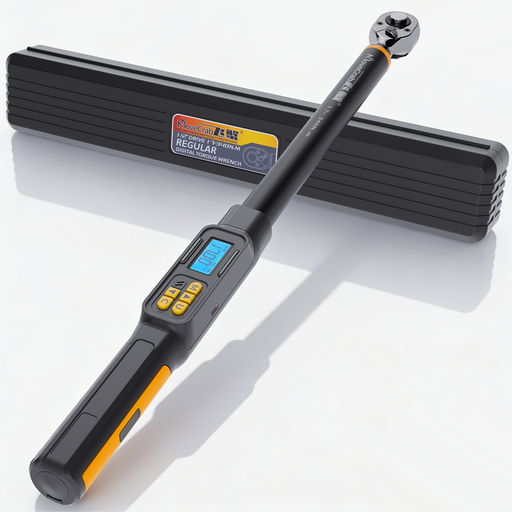
Why this model is a good fit: For professional mechanics and tech enthusiasts for whom maximum accuracy and process reliability are paramount. The wide torque range and digital features are ideal for demanding work on engines and chassis.
This digital torque wrench eliminates inaccuracies with a clear digital display and a high accuracy of ±2% (according to the manufacturer). The multi-stage alarm system prevents over-tightening more reliably than a purely mechanical click.
Offers advanced features such as 10 preset values, a memory for 500 data records, and a triple alarm system (vibration, sound, LED light) for maximum control.
We have compiled a complete, up-to-date list of products that fully meet these strict selection criteria and rigorous safety standards.
For professional use, annual calibration or calibration after approximately 5,000 cycles is recommended. For occasional home use, this is less frequently necessary. However, recalibration is mandatory if the tool has been dropped or subjected to a strong impact, as this can misalign the internal mechanism.
Generally, this is not recommended. Torque wrenches are measuring instruments for controlled tightening. Loosening tight bolts creates high, uncontrolled force spikes that can damage the calibration mechanism. Use a standard breaker bar or an impact wrench for loosening. Some models are explicitly approved for counter-clockwise tightening (e.g., for left-hand threads), but not for loosening with high force.
This applies to mechanical "click-type" wrenches. Inside, there is a spring that is compressed by turning the handle to set the target torque. If the spring remains under tension after work, it can fatigue over time and lose its precision. Therefore, the wrench should always be turned back to the lowest value on its scale after each use to release the spring's tension and maintain long-term accuracy. This is not necessary for digital torque wrenches.