
Lieferung heute & morgen

Qualitätsgarantie

Willkommens-Angebote freischalten: KOSTENLOSE Lieferung | Bis zu 80 % RABATT | Kostenlose 30-Tage-JoyPlus-Testphase
App herunterladen
Investing in a dash cam is a decision for greater road safety. However, the market is saturated with technical jargon and marketing promises that can make choosing one difficult. A front and rear 4K dash cam promises high-resolution recordings of your entire surroundings. But before you make a purchase, it's crucial to understand the common pitfalls that can lead to disappointment and unnecessary expense.
As your Joybuy Product Recommendation Officer, I'm here to help you cut through the noise. We'll highlight the critical features that define a reliable car camera and show you what to look for to make an informed choice.
Many models advertise impressive specifications, but not all deliver on their promises. Here are three common problems you should be aware of:
To avoid the pitfalls mentioned above, you should focus on the following non-negotiable technical features.
Resolution alone isn't the full story. A native 4K resolution (3840 x 2160 pixels), produced by a powerful image sensor, is the foundation for detail-rich recordings. Pay attention to the specifications of the built-in sensor. Models with sensors like the Sony STARVIS 2 sensor are designed to deliver sharp images even in low-light conditions and at high speeds. This technology significantly reduces motion blur and image noise, which can be crucial for evidence.
The number of channels determines the surveillance area:
Modern dash cams also offer essential connectivity features. A dash cam with an app and integrated Wi-Fi (often 5 GHz for faster transfers) allows direct access to recordings via your smartphone. A dash cam with GPS also records the exact location, speed, and route, providing valuable context in the event of an accident.
The car camera with parking mode monitors your vehicle even when it's parked. It is activated by vibrations (G-sensor) or motion and automatically starts a recording. This function requires a constant power supply, which is usually achieved via a hardwire kit. This is connected directly to the vehicle's fuse box.
Another important component is the type of power storage in the camera. Instead of conventional lithium-ion batteries, which are sensitive to heat, many high-quality models use supercapacitors. These are significantly more resistant to temperature extremes and more durable, increasing operational reliability in both summer and winter.
Based on the criteria mentioned, we have identified a few models that represent a smart choice for different user profiles.
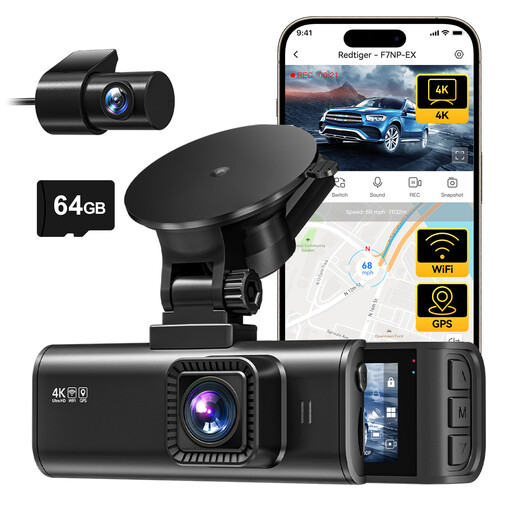
Why This Fits Their Persona: This model offers reliable 4K recording for the front and Full HD for the rear. It's a pragmatic solution for commuters who want seamless documentation of traffic events without getting bogged down in complex settings.
The camera delivers native 4K resolution on the front, avoiding the pitfall of interpolated image quality. Integrated GPS and Wi-Fi are standard, so there are no hidden costs for basic features.
A solid dual-camera system with all necessary features (GPS, Wi-Fi) in one package. A 64GB memory card is already included.

Why This Fits Their Persona: For users who value cutting-edge technology. This model combines a Sony STARVIS 2 IMX678 sensor for the front camera with a STARVIS IMX662 for the rear, offering advanced image processing for superior recording quality.
Instead of vague promises about night vision, this model relies on specifically named, high-quality sensors from Sony. The AI-powered image processing (AI ISP) ensures objectively better image quality in the dark, rather than just brightening the picture.
Excellent image quality thanks to dual Sony sensors and HDR for both channels. Fast 5 GHz Wi-Fi and the option to upgrade to a 3-channel system.
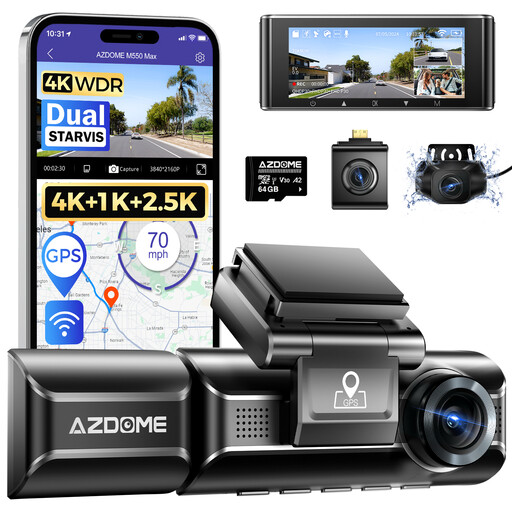
Why This Fits Their Persona: As a 3-channel dash cam, it provides comprehensive surveillance of the front, rear, and interior. This is ideal for professional drivers, taxi operators, or rideshare drivers who need to secure both traffic events and the passenger cabin.
This model makes it clear that a separate hardwire kit is required for 24-hour parking mode, thus avoiding unexpected additional costs. The interior camera has infrared LEDs for true night vision in the dark.
Comprehensive 3-channel recording (4K+1080P+2.5K). The use of two STARVIS sensors and a supercapacitor ensures high reliability and image quality.
If the models featured here don't perfectly match your needs, you can find a broader selection of cameras in our main category, curated based on objective criteria.
Yes, the use of a dash cam is generally permitted in Germany. However, the requirements of the General Data Protection Regulation (GDPR) must be observed. Permanent, indiscriminate filming of public space is not allowed. Modern dash cams solve this problem with a loop function that continuously overwrites old footage. Only in the event of an incident (e.g., triggered by the G-sensor) is the relevant video sequence saved permanently. This event-based recording is generally accepted as evidence by courts.
A battery stores energy chemically and is susceptible to high and low temperatures, which can affect its lifespan and reliability. A supercapacitor stores energy physically and is far more robust against extreme temperatures (-20°C to 70°C). This makes it the safer and more durable choice for a device that is permanently mounted behind the windshield.
The car camera with parking mode allows for the surveillance of your vehicle when the ignition is off. The camera remains in standby mode and begins recording when the G-sensor detects a vibration (e.g., a parking bump) or a motion sensor detects movement near the vehicle. To use this function, the dash cam needs a constant power supply. This is ensured by a hardwire kit, which is connected directly to the car's fuse box. This kit usually must be purchased separately.