
Lieferung heute & morgen

Qualitätsgarantie

Willkommens-Angebote freischalten: KOSTENLOSE Lieferung | Bis zu 80 % RABATT | Kostenlose 30-Tage-JoyPlus-Testphase
App herunterladen
Choosing the right artist pencils can be the difference between a fleeting sketch and a lasting work of art. However, the market is filled with tempting offers that don't always deliver on their promises. As your Joybuy Product Recommendation Officer, I'm here to help you navigate the marketing noise and make an informed decision based on objective criteria.
Many creatives invest in large sets, only to find that the colours fade or the leads break with every attempt to sharpen them. Before you make a purchase, you should be aware of the most common pitfalls.
To avoid these problems, it's crucial to understand the fundamental parameters that define high-quality pencils for drawing and colouring.
Instead of being swayed by the number of colours or the packaging, you should focus on three technical features. These determine the performance, durability, and range of application for your pencils.
The composition of the lead is the deciding factor for its drawing characteristics. Each type has specific properties:
High-quality pigments are the key to brilliant and permanent colours. Lightfastness indicates how resistant a colour is to UV radiation. Many manufacturers, like Faber-Castell, use a star rating system for this:
For works that will be exhibited or sold, high lightfastness is essential. For sketchbooks or drawing pencils for beginners, this factor may be less critical.
A good artist pencil is made from high-quality, well-dried wood (often cedar), which securely encases the lead. A continuous bond between the lead and the wooden barrel (SV bonding in the case of Faber-Castell) prevents the lead from breaking internally, even if the pencil is dropped. This also makes sharpening with a sharp sharpener much easier.
Based on these objective criteria, we have selected a few products from our range that are suitable for different user groups.
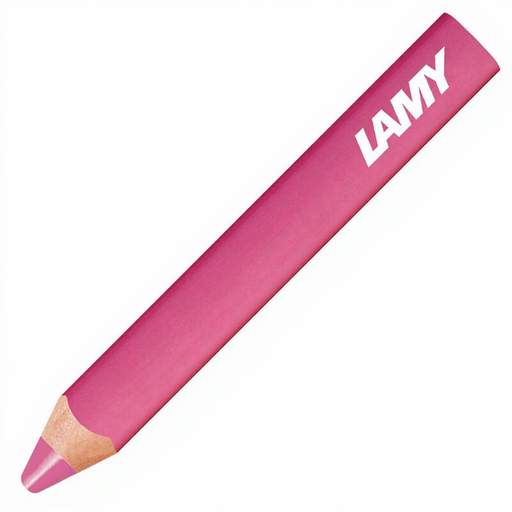
Why it's a great fit: The Lamy 3plus for kids is a 3-in-1 pencil that combines a coloured pencil, wax crayon, and watercolour pencil. Its ergonomic, square shape and compact length are ideal for small hands. It is robust and versatile, even on smooth surfaces like glass.
The extra-thick lead withstands high pressure, thus avoiding the frustration of brittle leads that is common with children.
3-in-1 functionality for maximum creativity. Wipes off smooth surfaces, which encourages experimentation.
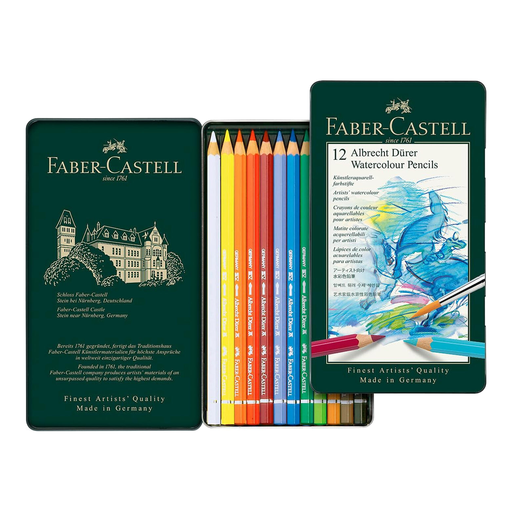
Why it's a great fit: This set offers an entry into the world of professional watercolour pencils. The high pigmentation and complete water solubility allow for impressive watercolour effects. It's a solid investment for anyone looking to advance their technique.
Avoids the "fading colours" trap with demonstrably high pigment quality and lightfastness, for which the Albrecht Dürer line is renowned.
The 3.8 mm thick lead is break-resistant thanks to SV bonding. The pigments can be fully dissolved and blended, whether wet or dry.
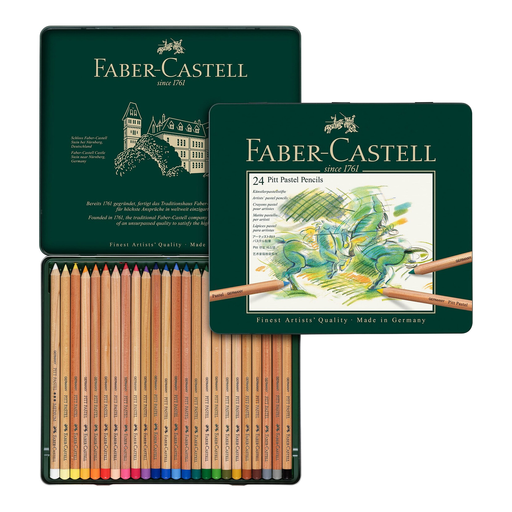
Why it's a great fit: These pastel pencils are designed for artists who want to combine the texture of pastel chalk with the precision of a pencil. They are ideal for fine lines, hatching, and adding detail to pastel drawings. The lead is wax- and oil-free.
This set avoids the "misleading labels" trap, as it is a highly specialised tool and not just a generic coloured pencil set.
High pigment concentration for intense colours that are easy to smudge and blend. The sturdy 4.3 mm lead allows for precise work.
We've compiled a complete, up-to-date list of products that fully meet these strict selection criteria and German safety regulations.
The main difference lies in the lead's binder. Normal coloured pencils use an oil- or wax-based binder, which is water-resistant. Watercolour pencils contain a water-soluble binder. This allows the applied colour pigments to be reactivated with water and painted like watercolour, enabling smooth transitions and glazing effects.
Always use a high-quality sharpener with a sharp blade, preferably a metal one. Turn the pencil slowly and evenly, rather than twisting the sharpener around the pencil. For very soft leads (e.g., in pastel pencils), sharpening with a sharp craft knife can be an alternative to shape the tip individually and minimise pressure on the lead.
Reputable manufacturers print the lightfastness rating directly on the pencil barrel. Look for symbols like stars (e.g., at Faber-Castell) or standardised codes from the American Society for Testing and Materials (ASTM), indicated as "LF" or "ASTM D6901" followed by a Roman numeral (I for excellent, II for very good). If such an indication is missing, the lightfastness is generally not designed for professional work.