
Lieferung heute & morgen

Qualitätsgarantie
App herunterladen
Kategorien
A bean-to-cup coffee machine transforms coffee beans into a finished coffee speciality at the touch of a button. The core principle of these devices, often called bean-to-cup machines, is the integration of all necessary components: a grinder, a brewing unit, and often a milk system. Selecting the right model depends on an analysis of its technical specifications and your individual needs. This guide highlights the key parameters for making an informed purchasing decision.
The performance and user-friendliness of a bean-to-cup coffee machine are determined by the interplay of its technical components. The following aspects are relevant for an objective evaluation.
The grinder is crucial for extracting the aromas from the coffee bean. There are two primary materials to consider:
Another factor is the number of adjustable grind settings. A higher number of levels allows for more precise adjustment to the specific bean type and desired coffee speciality, from a fine grind for espresso to a coarser one for a café crème.
For lovers of cappuccino or latte macchiato, the milk system is a key criterion.
The brewing unit is the heart of the machine, where the ground coffee is extracted with hot water. There are two main designs:
Regardless of the design, regular cleaning and descaling programmes are essential for the longevity and hygiene of the machine.
The following models have been selected based on their technical specifications and range of features.
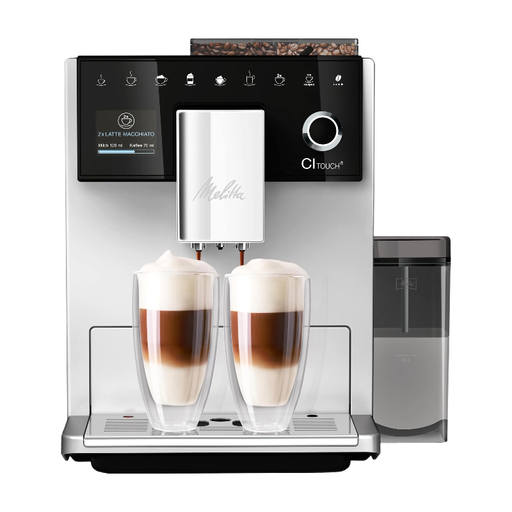
Why we recommend this product The Melitta CI Touch stands out for its high degree of flexibility and customisation. The dual-chamber "Manual Bean Select" system allows you to easily switch between two different types of beans, for example, for espresso and café crème. Additionally, up to four individual user profiles can be saved, storing preferences for coffee strength, temperature, and volume. The "Double Cup Mode" function allows for the simultaneous preparation of two cups, even for milk-based specialities.
Pros
Who it's for This model is ideal for households with multiple coffee drinkers who have different preferences and value a wide variety of coffee specialities, as well as the ability to use different types of beans.
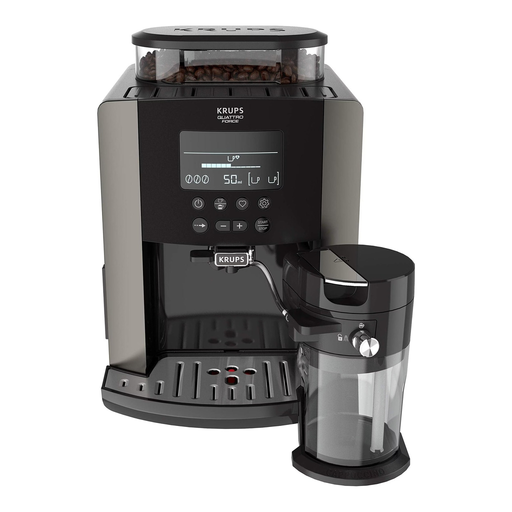
Why we recommend this product The KRUPS Arabica Latte EA819E focuses on efficiency and a compact design. Its Quattro Force technology is engineered for an optimal brewing process at 15 bar of pump pressure. A key feature is the short heat-up time of around 30 seconds, made possible by the integrated Thermoblock heating system. Operation is handled via a clear LCD display combined with physical buttons, allowing for intuitive use without a steep learning curve.
Pros
Who it's for This machine is a great choice for users who value quick start-up times and straightforward operation. It fits well in small offices or households where efficiency is a priority.
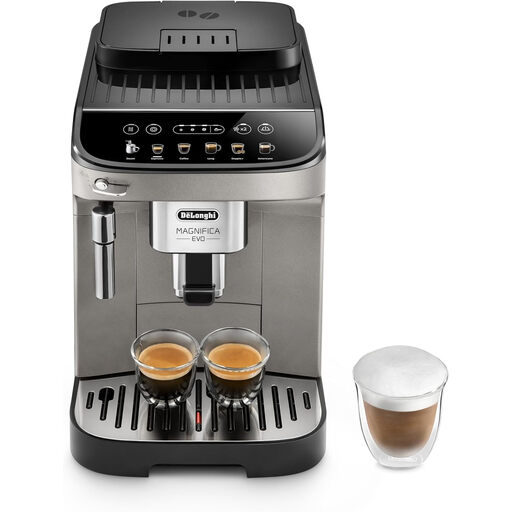
Why we recommend this product The De’Longhi Magnifica Evo combines intuitive operation with practical cleaning features. The soft-touch colour display with self-explanatory icons makes selecting one of the four direct-access recipes easy. A special feature is the traditional manual milk frothing nozzle, which gives the user full control over the milk foam's consistency. For maintenance, many components, such as the drip tray and the coffee grounds container, are removable and dishwasher-safe.
Pros
Who it's for This model is aimed at coffee lovers who want simple operation but also wish to retain control over manual milk frothing. It is also a worthwhile option for beginners in the world of bean-to-cup espresso machines.
The models presented here offer a cross-section of the available features. However, if you are looking for more specific functions or different designs, you will find an expanded selection in our main category. It's especially worth looking at other machines if you are specifically searching for a cappuccino maker.
Discover our entire range of coffee machines with milk here.
1. What is the difference between a bean-to-cup machine and a portafilter machine? A bean-to-cup machine performs all steps—grinding, brewing, and often milk frothing—fully automatically at the touch of a button. A portafilter machine (a type of espresso machine) requires manual steps: the coffee must be ground separately, filled into the portafilter, tamped (pressed down), and locked into place. It offers more control for enthusiasts but also requires more knowledge and effort.
2. How important is the grind setting on a bean-to-cup machine with a grinder? The grind setting is a crucial factor for the taste. A finer grind leads to a longer contact time between the water and coffee grounds, resulting in a stronger extraction—ideal for a robust espresso. A coarser grind is better suited for longer coffees like a café crème, as it prevents over-extraction and the resulting bitter taste. The ability to adjust the grind setting is therefore an important quality feature.
3. How often does a bean-to-cup machine need to be cleaned? The cleaning frequency depends on usage and water hardness. As a general rule: