
Lieferung heute & morgen

Qualitätsgarantie

Willkommens-Angebote freischalten: KOSTENLOSE Lieferung | Bis zu 80 % RABATT | Kostenlose 30-Tage-JoyPlus-Testphase
App herunterladen
Choosing a new built-in oven can quickly become overwhelming. Manufacturers advertise numerous features, but not all of them deliver on their promises. Especially with advanced functions like self-cleaning, there are pitfalls that can lead to disappointment. Before you make a decision, it's crucial to know the most common marketing traps and understand which technical features will truly make a difference in your kitchen.
A common issue is the term "self-cleaning." Many buyers only realise after their purchase that their appliance doesn't have the expected pyrolytic cleaning, but a less effective hydrolytic (steam) or catalytic function instead. Another disappointment is uneven heat distribution. An appliance advertised as a "convection oven" doesn't automatically guarantee that your cake will brown evenly on every level. Finally, a supposedly large oven cavity can be less practical than anticipated due to poorly placed shelf levels or bulky heating elements.
To make an informed decision, you should focus on a few crucial technical parameters. These features are the primary determinants of the convenience, performance, and safety of your future oven.
A self-cleaning oven is not necessarily an oven with pyrolysis. It is essential to know the differences:
For the least amount of cleaning effort, pyrolysis is the most comprehensive solution.
For home cooks and families who often bake on multiple levels simultaneously, even heat distribution is essential. A simple convection fan is often not enough. An advanced system like 3D Hotair actively and evenly distributes heat throughout the entire oven cavity using a ring heating element and a fan that changes its direction of rotation. This allows for baking biscuits on up to three trays at once without needing to swap them, and ensures consistent results for roasts and casseroles. Such a 3D Hotair oven is a worthwhile feature for anyone who values perfect baking results.
The oven cavity volume is specified in litres. An oven with 71 litres of net volume offers enough space for large roasts or baking for an entire family. Besides the sheer volume, also pay attention to the number of shelf levels, as these determine flexibility in daily use.
At the same time, energy consumption is an important factor. An energy-efficient oven with an A+ energy efficiency rating uses significantly less electricity, which makes a difference on your utility bill over the years. The consumption values for conventional heating (top/bottom heat) and fan-assisted/convection are listed separately on the EU energy label and provide a good basis for comparison. As a standalone built-in oven, the appliance can also be installed independently of the hob at any desired position in the kitchen, allowing for maximum design freedom.
Based on the criteria above, we have identified a model that is suitable for various user profiles.
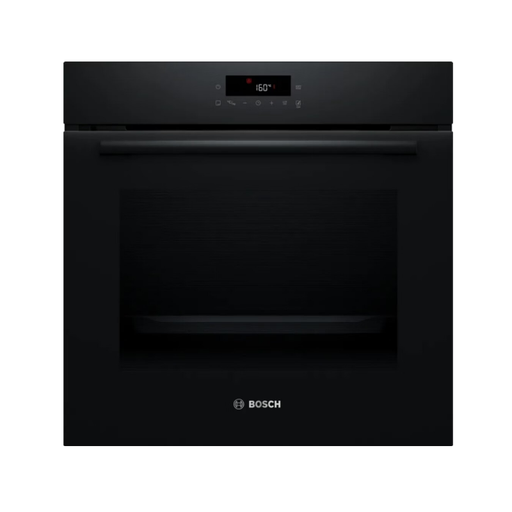
Why this model is a great fit: For families where time is of the essence, the 10 automatic programmes (AutoPilot 10) are a huge help. The large 71-litre cavity can handle big meals, and the pyrolytic function takes care of the unpleasant task of cleaning the oven.
This model offers true pyrolytic self-cleaning for a thorough clean. The 3D Hotair ensures even baking results on all levels, avoiding the disappointment of unevenly cooked food.
The combination of automatic programmes, large volume, and effective self-cleaning maximises convenience and saves valuable time in a busy family life. The A+ energy rating keeps running costs low.
Why this model is a great fit: For those modernising their kitchen, a cohesive look is paramount. This built-in oven in black, with its full-glass front and intuitive LED touch control panel, integrates seamlessly into a modern, handle-free kitchen design.
The design here is not just for show. The quadruple-glazed door is an essential safety feature for pyrolysis and ensures a very low exterior temperature. The functionality is every bit as good as the design.
Combines a high-end, modern aesthetic with powerful features like pyrolysis and 3D Hotair. The Bosch brand also stands for reliable quality and durability.
We have compiled a complete, up-to-date list of products that fully meet these strict selection criteria and UK safety regulations.
1. How often should you use the pyrolytic function on a Bosch oven? The frequency depends on how intensively you use the oven. With regular use, especially for roasting greasy foods, a pyrolytic clean every two to three months is recommended. For less frequent use or mainly for baking, a longer interval may be sufficient. The appliance itself does not set fixed intervals; you can start the cleaning cycle as needed.
2. What is the difference between 3D Hotair and normal convection (fan-assisted)? Normal fan-assisted convection uses a fan at the back to circulate the heat generated by the conventional top and bottom heating elements. With 3D Hotair, the air is also heated by its own ring element located directly at the fan. This allows for significantly faster and more even heat distribution throughout the entire oven cavity, leading to more consistent results on multiple levels.
3. Does a standalone built-in oven with pyrolysis require a special power connection? Yes, as a rule, ovens with pyrolysis require a hardwired connection due to the high power needed for the cleaning process. The Bosch HBA571BB4, for example, has a connected load of 3600 watts and requires a 16-amp fuse. The installation must be carried out by a qualified electrician. A standard wall plug is not sufficient or permissible for such appliances.