
Lieferung heute & morgen

Qualitätsgarantie

Willkommens-Angebote freischalten: KOSTENLOSE Lieferung | Bis zu 80 % RABATT | Kostenlose 30-Tage-JoyPlus-Testphase
App herunterladen
The world of art supplies can be overwhelming, especially when you're looking for a versatile tool for various creative endeavours. Whether for hand lettering, calligraphy, bullet journaling, or colouring in detailed designs, the right pens are crucial for the final result. A high-quality Brush Pen Set offers the flexibility needed to create both fine lines and broad, painterly strokes.
This article serves as a practical guide. It is designed to help you understand the features and differences between various sets and make an informed decision that suits your creative needs. We will focus on objective criteria such as nib type, ink type, and colour range.
To find the right set for your projects, it's helpful to understand a few basic characteristics. These criteria determine how the pens perform in practice and which techniques they are best suited for.
Many modern art pens are designed as dual-tip pens. This combination is extremely practical, as it combines two tools in one pen.
A set with a fineliner and brush tip therefore offers a wide range of applications, from calligraphy to illustration.
The ink is the heart of any pen. For brush pens, water-based inks are common and particularly advantageous for beginners. They are typically low-odour and can be easily cleaned from many surfaces.
A key advantage is their blendability. On suitable paper (e.g., watercolour paper), the colours can be mixed with a damp brush or a blender pen to create smooth transitions and effects, similar to a watercolour pencil set. This opens up additional creative possibilities without requiring a completely new set of materials. This is also useful for calligraphy pens for beginners, as small mistakes can often be corrected with a little water.
The number of colours in a set should match your primary use case.
Check whether the set includes a colour chart or has space for you to create your own swatch card. This makes organisation and quick selection of the right shade much easier.
The Ohuhu brush pens from the Maui series are known for their dual tips and water-based inks. Here, we present three set sizes suitable for different needs.
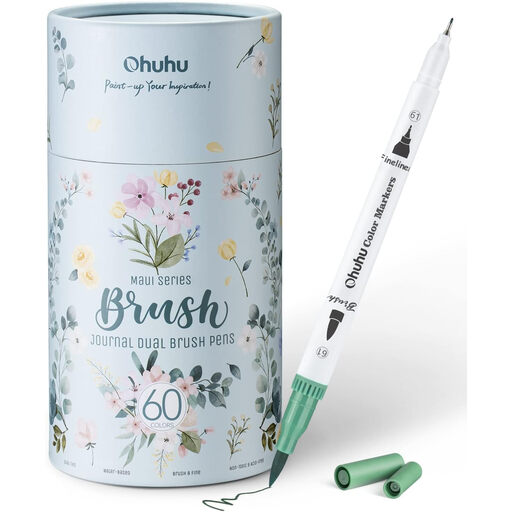
Why It Stands Out: This set offers a solid entry into the world of brush pens. It combines a versatile colour palette with the essential features needed for most hobbyist applications, including replacement nibs to extend the pens' lifespan.
Key Features:
Who It's For: This set is a great choice for beginners in hand lettering, students, and anyone looking for a versatile set for their bullet journal or for casual drawing.

Why It Stands Out: With 100 colours, this set provides a significantly expanded palette for more nuanced work. The included storage case keeps everything organised and makes the set portable.
Key Features:
Who It's For: Intermediate hobby artists and enthusiasts who want a larger colour selection for illustrations or colouring. The case also makes it attractive for anyone who likes to take their pens on the go.
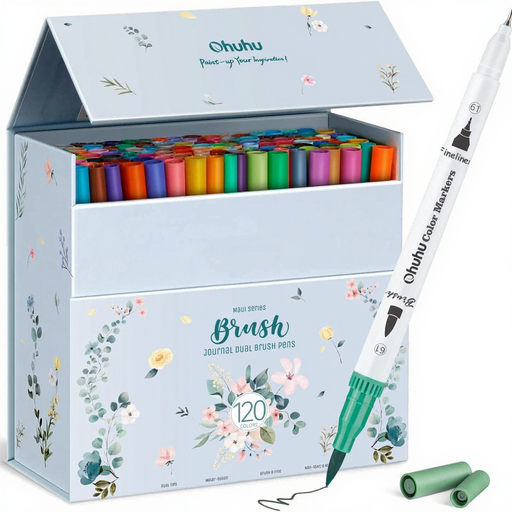
Why It Stands Out: This is the most comprehensive set in the Ohuhu Maui series, aimed at users who demand maximum colour variety. The generous inclusion of 8 replacement nibs underscores its focus on long-term use.
Key Features:
Who It's For: This set is ideal for dedicated artists, illustrators, and advanced hand lettering practitioners who need a maximum range of colours for complex and detailed projects.
The sets featured here provide an excellent foundation for many creative techniques. However, if you are looking for different nib types, alcohol-based inks, or specialised individual pens, there is much more to discover.
Explore our entire range of art pens and find the perfect tool for your creativity.
For starting out in hand lettering, dual-tip pens are an excellent choice. The flexible brush tip allows you to practice the characteristic thick and thin strokes, while the fineliner tip can be used for embellishments and corrections. Water-based ink is advantageous as it is more forgiving and can be easily adjusted with water on suitable paper.
The main advantage lies in their versatility. They combine two types of pens in one body: a fine tip for precise lines, outlines, and writing, and a broad, flexible brush tip for calligraphy, shading, and colouring in areas. This saves space in your pencil case and reduces the cost compared to buying separate types of pens.
Technically, it is possible to write or draw with brush pens on standard printer paper. However, the ink tends to bleed through on thin paper and can fray the paper fibres, which may damage the brush tip over time. For optimal results, especially when using blending techniques with water, it is recommended to use thicker paper (100 gsm or higher), mixed-media paper, or dedicated watercolour paper.