
Lieferung heute & morgen

Qualitätsgarantie

Willkommens-Angebote freischalten: KOSTENLOSE Lieferung | Bis zu 80 % RABATT | Kostenlose 30-Tage-JoyPlus-Testphase
App herunterladen
Upgrading your vehicle's interior lighting from traditional halogen bulbs to LED technology is a technical enhancement that offers functional advantages. LEDs are distinguished by their superior energy efficiency, longer lifespan, and expanded options for personalising the lighting atmosphere. This article analyses the technical criteria for selecting the right products and presents a selection of solutions for various applications.
The decision for an LED system should be based on an analysis of specific technical parameters to ensure compatibility and functionality.
The most fundamental distinction is between a direct replacement of existing bulbs and the installation of a complete ambient lighting system.
Modern vehicles monitor electrical components via a Canbus (Controller Area Network) system. Since LEDs have significantly lower power consumption than halogen bulbs, the system may incorrectly assume a faulty bulb and display an error message on the dashboard.
Products declared as Canbus error-free have an integrated load resistor. This simulates the higher power consumption of a halogen bulb, thereby preventing error messages. For vehicles without Canbus monitoring for the interior lighting, this feature is not essential.
The type of control defines the user convenience and customisation options:
Based on the technical criteria mentioned, we present three products for different applications.
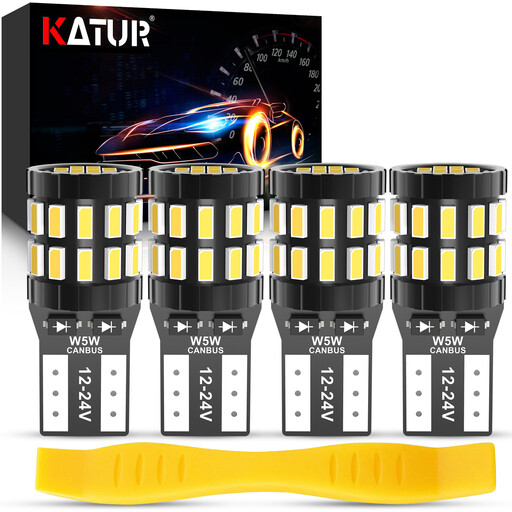
Why We Recommend This Product This bulb is designed as a direct plug-and-play replacement for common T10 W5W halogen lamps. Its integrated Canbus functionality addresses the issue of error messages in many European vehicle models. Equipped with 30 SMD chips of the 3014 type per bulb, it delivers high light output and 360-degree radiation, ensuring uniform illumination.
Pros
Who It's For This product is suitable for vehicle owners seeking a simple yet effective upgrade for their existing interior lighting (e.g., reading lights, door, or boot lighting) who value error-free operation in modern vehicles.
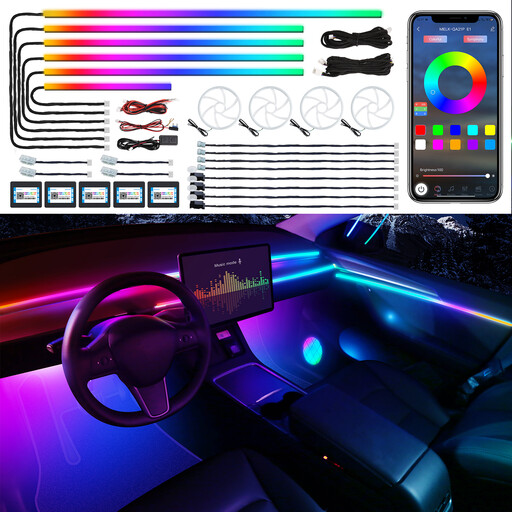
Why We Recommend This Product This kit is an all-in-one solution for retrofitting dynamic, full-coverage ambient lighting. It uses acrylic fibre optics instead of simple LED strips, which, according to the manufacturer, results in a more uniform and softer light distribution. Control via the "LotusLamp X" app and the ability to set up two separately controllable zones offer a high degree of customisation for the dashboard lighting, doors, and footwell.
Pros
Who It's For This kit is aimed at car enthusiasts and tuning fans who want to retrofit a comprehensive and technically sophisticated ambient lighting system and desire maximum control over colours and dynamic effects via an app.
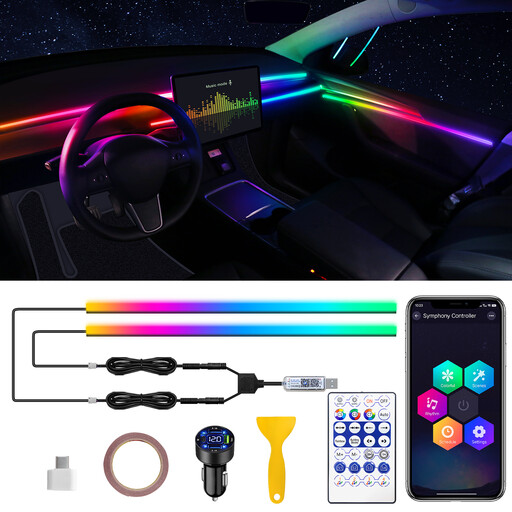
Why We Recommend This Product This solution focuses on the simple retrofitting of accent lighting, primarily for the dashboard. Its key advantage is the straightforward power supply via a USB or Type-C port, which eliminates the need to connect to the vehicle's electrical system. With three different control options (app, remote control, touch button), the kit offers high flexibility in operation.
Pros
Who It's For This product is ideal for users who want to retrofit modern dashboard lighting with dynamic colour effects but prefer a simple, non-permanent installation powered via USB.
The products featured cover specific use cases, from simple upgrades to comprehensive ambient lighting. If you are looking for other configurations, different socket types, or specialised bulbs, you will find a broader selection of solutions in our main category.
Discover our entire range of Interior Car Lighting here.
1. What does "Canbus error-free" mean for LED bulbs? "Canbus error-free" means the LED bulb is equipped with an integrated load resistor. This resistor artificially increases the LED's power consumption to a level similar to that of a conventional halogen bulb. This prevents the vehicle's diagnostic system (Canbus) from interpreting the LED as a faulty bulb and triggering a warning message on the dashboard.
2. Can you retrofit ambient lighting yourself? Yes, most ambient lighting retrofit kits available on the market are designed for do-it-yourself (DIY) installation. Simple systems with a USB connection only require routing the fibre optics and connecting to a power source. More comprehensive kits that connect to the 12V vehicle electrical system require basic knowledge of car electronics to safely route and connect the cables. Tools such as a pry tool for removing trim panels are often included in the kit.
3. How are LED strips powered in a car? There are two main methods: