
Lieferung heute & morgen

Qualitätsgarantie

Willkommens-Angebote freischalten: KOSTENLOSE Lieferung | Bis zu 80 % RABATT | Kostenlose 30-Tage-JoyPlus-Testphase
App herunterladen
Owners of large cat breeds like Maine Coons, Norwegian Forest Cats, or Ragdolls know the challenge: a standard cat tree often isn't enough. It wobbles, the perches are too small, and the scratching posts wear out quickly. The result is not just unhappy cats, but often scratched furniture as well.
This article serves as a guide. We'll introduce various models designed specifically for the needs of large or multiple cats. We focus on objective features like stability, size, and material quality to provide you with a solid basis for making an informed decision.
Choosing the right model depends on several factors. The following three criteria are particularly important for your cat's safety and comfort.
A cat tree for large cats must be one thing above all: stable. Large cats bring more weight and force, especially when jumping and climbing. Look for a wide, heavy base plate that serves as a solid foundation. Models with a product weight of over 20 kg generally offer greater stability. Additionally, an anti-tip kit for securing it to the wall is an important safety feature, especially for a floor-to-ceiling cat tree. Thick posts with a diameter of at least 9 cm also contribute to overall stability.
An XXL cat tree is distinguished by its generously sized components. The perches, hammocks, and condos should be large enough for a fully grown cat to stretch out comfortably. A lounge bed with a diameter of 40 cm or more is a good benchmark. For households with multiple cats, a climbing tree with various levels and retreats, such as a cat tree with a condo, is beneficial. This allows the animals to claim their own territories and avoid conflicts.
The longevity of a cat tree is largely determined by the quality of its materials. The scratching posts should be fully and tightly wrapped with durable natural sisal. This provides an ideal surface for claw maintenance and helps protect your furniture. The fabric on the lounging areas should be hard-wearing and, ideally, easy to clean. Removable and washable cushions are a practical feature that makes hygiene easier.
Based on the criteria mentioned above, we have compiled a selection of models that are suited for different needs due to their specific features.
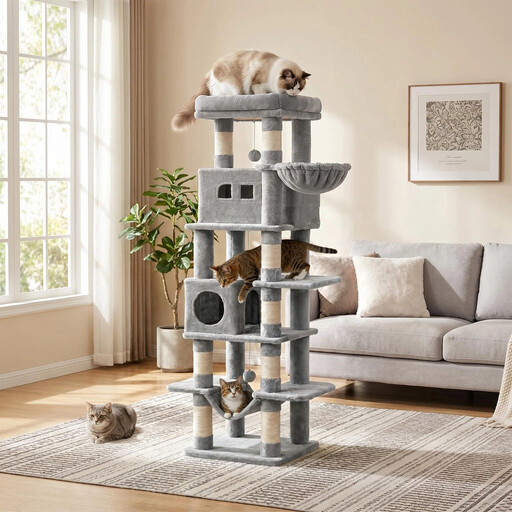
Why this model stands out: This 170 cm tall cat tree offers a well-designed structure with six levels. The combination of one large and one small cat condo, along with several open perches, creates a variety of resting zones. Of the 17 total support posts, 8 are wrapped in sisal, ensuring scratching opportunities on almost every level.
Advantages:
Who is this model for? This model is a great choice for multi-cat households or for large cats who appreciate a variety of lounging and hiding spots at different heights.
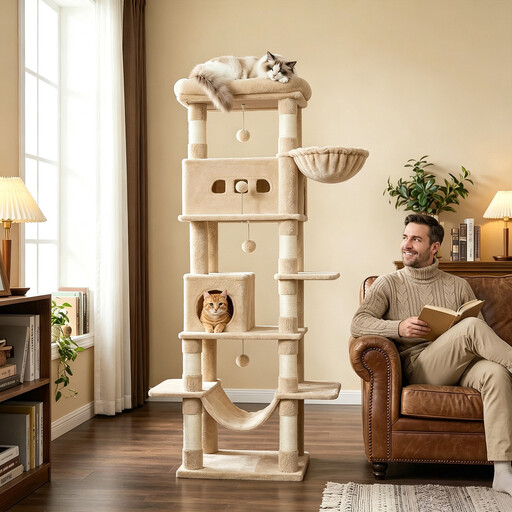
Why this model stands out: At 212.5 cm tall, this climbing tree is an imposing structure that makes optimal use of vertical space. The layout of the levels is designed to accommodate a cat's natural jumping behaviour. The spacious top perch and dual condos make it particularly appealing for a multi-cat household.
Advantages:
Who is this model for? Ideal for very active cats that love to climb, as well as for households where multiple pets need to coexist harmoniously. Its vertical design makes it relatively space-saving despite its size.
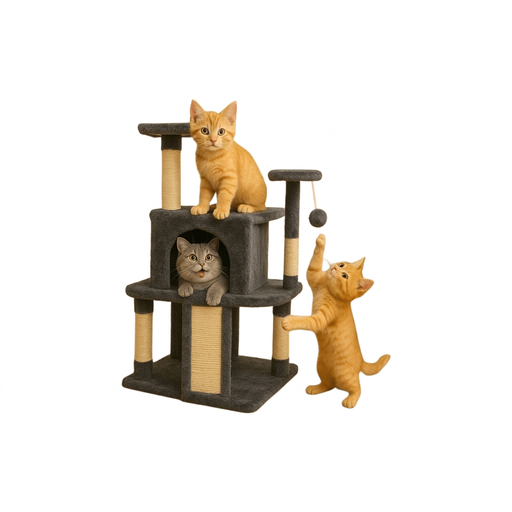
Why this model stands out: This model is a more compact alternative. With a height of 102 cm and a 43x43 cm footprint, it is intentionally designed to be space-saving. It is aimed specifically at owners of smaller cats or can serve as a supplementary tree to a larger one.
Advantages:
Who is this model for? This model is designed for small to medium-sized cat breeds or as a secondary tree in a multi-cat household. It is a practical solution for apartments with limited space.
If the cat trees featured here don't exactly match what you're looking for, or if you're seeking other smart products for daily life with your pet—such as special door solutions that give your cat more freedom of movement—it's worth taking a look at our broader selection.
Discover more products in our [Pet Door] category to find the perfect solution for your home.
1. What makes a cat tree stable? The stability of a cat tree depends on three main factors: a wide, heavy base plate that acts as a counterweight; thick, solid posts that support the structure; and an anti-tip kit that can be used to secure the tree to a wall.
2. How tall should a cat tree for a large cat be? Height is secondary to stability. Models from 150 cm upwards already offer good climbing opportunities for most large cats. More important than the absolute height are sufficiently large perches and a sturdy construction that won't wobble, even when they jump.
3. How do I get my cat used to a new cat tree? Place the new cat tree in a spot where your cat likes to spend time, such as near a window or their current favourite spot. You can spark their interest with catnip, treats, or by playing with a cat wand on the tree. Avoid forcing your cat to use it. Patience is key.