
Lieferung heute & morgen

Qualitätsgarantie

Willkommens-Angebote freischalten: KOSTENLOSE Lieferung | Bis zu 80 % RABATT | Kostenlose 30-Tage-JoyPlus-Testphase
App herunterladen
As the owner of a large cat breed like a Maine Coon, Ragdoll, or Norwegian Forest Cat, you know the challenge: standard cat trees are often not designed for the weight and strength of these animals. They wobble, wear out quickly, or, in the worst-case scenario, pose a safety risk. A wobbly climbing tree will be avoided by smart cats, which can lead to your furniture being used for scratching and climbing instead.
This article is intended to serve as your guide. We present a selection of cat trees whose construction is designed for stability and durability for large or heavy cats. The goal is to show you the essential features that make up a robust cat tree, so you can make an informed decision for the safety and well-being of your pet.
Before we get to specific product recommendations, here are some key criteria that are crucial when choosing a model for heavy or very active cats.
The foundation for a safe cat tree for large cats is its stability. A sturdy cat tree is characterized by several features:
The longevity and safety of a cat tree depend directly on the materials used. For a cat tree for a Maine Coon or similar breeds, thick posts are essential.
Large cats need more space to stretch out and relax. An XXL cat tree should therefore have appropriately sized elements. The hammocks, baskets, and viewing platforms must be large and stable enough to safely support the weight of a full-grown cat of 8 kg or more.
Based on the criteria mentioned above, we have compiled a selection of models that stand out for their stable construction and suitability for large cats.
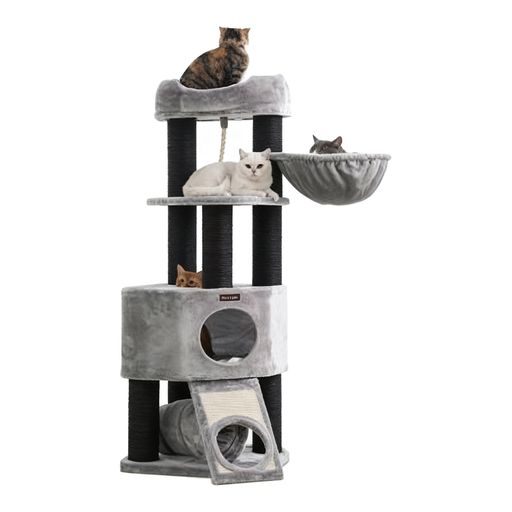
Why It Stands Out: This model was specifically designed to meet the demands of large and active cats. The construction consistently focuses on stability: the combination of a double-reinforced base plate, extremely thick posts with an 11.3 cm diameter, and a mandatory anti-tip kit for wall mounting creates a robust triangular support system. With a total weight of 23.2 kg, this climbing tree offers a solid foundation.
Pros:
Who It's For: Ideal for owners of adult, large, and heavy cat breeds who are looking for an uncompromisingly stable and durable all-in-one solution. This model is also an excellent choice for a multi-cat household.
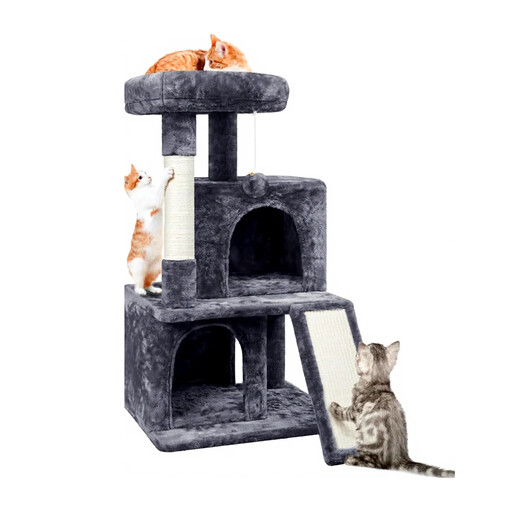
Why It Stands Out: This cat tree from Yaheetech offers a good balance of stability, compact size, and functionality. It is made from FSC-certified particleboard and features a wide base that provides a high level of fundamental stability. A key advantage in this category is the included anti-tip kit, which allows the tree to be additionally secured to the wall.
Pros:
Who It's For: A great choice for cat owners looking for a stable and secure cat tree with manageable dimensions. Thanks to the anti-tip kit, it is also suitable for owners of medium to large cats who want to play it safe.
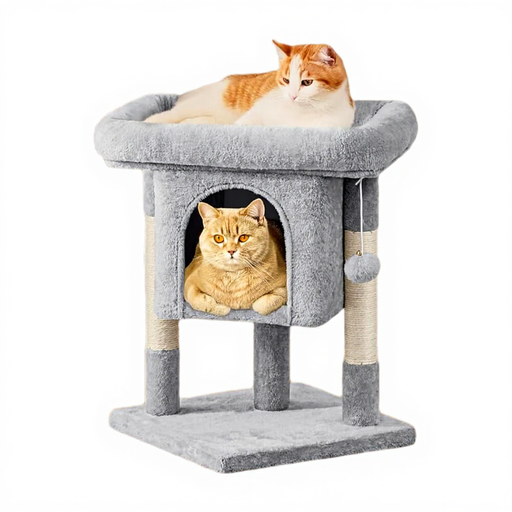
Why It Stands Out: This model is a compact and space-saving solution. It is specifically designed as a secure retreat for kittens or smaller cats. With a height of only 59 cm and a footprint of 40.5 x 40.5 cm, this cat tree fits well in smaller apartments or can serve as a supplement to a larger climbing tree.
Pros:
Who It's For: According to the manufacturer, this model is explicitly aimed at kittens and small to medium-sized cat breeds. It is a good first tree for young cats or as a secondary cat tree in another room. It is not sufficiently sized to be the sole cat tree for a full-grown Maine Coon.
If the models presented here do not fully meet your expectations or if you are looking for other designs and sizes, a broader selection may be helpful. A climbing tree for cats should always match the individual needs of your pet and your living situation.
? Explore more models in our Sisal Cat Tree Tower category
A sturdy cat tree can be identified by several objective features: a large, heavy base plate, a high total weight (often over 15-20 kg), thick posts with a diameter of more than 10 cm, and ideally, an included wall-mounting device (anti-tip kit). Before buying, check the product specifications for weight, dimensions, and material.
Height is secondary to stability. However, many cats, including large ones, appreciate elevated vantage points. A height of 140 cm to 180 cm is often a good compromise between climbing opportunity and stability. For floor-to-ceiling models, absolutely secure and firm tensioning or mounting to the ceiling is essential to ensure safety.
Place the new cat tree in an attractive location, for example, near a window or where the family frequently gathers. You can encourage acceptance by sprinkling some catnip on the perches, playing with your cat on and around the tree, or placing treats on the different levels. Avoid forcing the cat to use the tree. Patience and positive reinforcement are the keys here.