
Lieferung heute & morgen

Qualitätsgarantie

Willkommens-Angebote freischalten: KOSTENLOSE Lieferung | Bis zu 80 % RABATT | Kostenlose 30-Tage-JoyPlus-Testphase
App herunterladen
Choosing a new ceramic hob can be more complex than it first appears. The market is flooded with models, but not all of them deliver on their promises. As your Joybuy Product Recommendation Officer, I'm here to help you identify common pitfalls and make an informed decision based on facts, not marketing hype.
Three common problems often lead to post-purchase dissatisfaction:
To avoid a bad purchase, you should check three core technical aspects. These are crucial in determining the hob's functionality, safety, and compatibility with your kitchen.
A crucial criterion is whether you need a standalone ceramic hob or a cooker-controlled model.
The power rating, specified in watts (W), defines the maximum power consumption. High-power models (over 3,500 W), such as a 4-burner ceramic hob, typically require a high-voltage connection (400 V). Installation must be performed exclusively by a qualified electrician. Smaller appliances, like an electric double hob, can sometimes be operated via a standard socket (230 V).
The size of the hob must suit your kitchen and your cooking habits.
Modern hobs predominantly feature touch controls. These sensor control panels allow for precise operation with a single touch and are seamless to clean. Important additional features that simplify daily use and enhance safety include:
Based on these objective criteria, we have compiled a selection of products suitable for different user profiles.
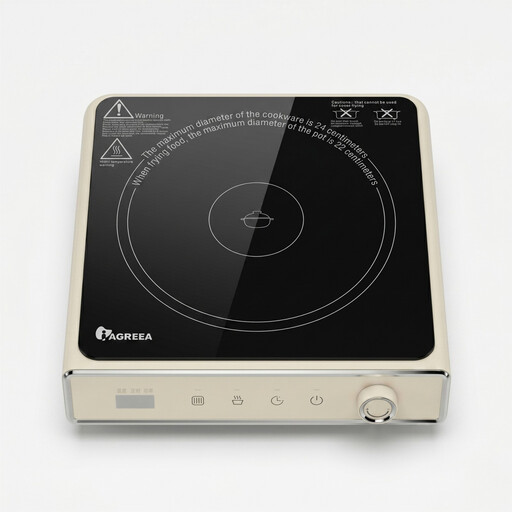
Why This Fits Their Persona: Weighing just 1.5 kg and featuring compact dimensions, this portable ceramic hot plate is a practical solution for student dorms, the office, or as a hot plate for camping trips. It only requires a standard power outlet.
The appliance includes key safety features like a 1-hour automatic shut-off and a residual heat indicator ("HO"), which are not standard on many portable devices.
Unlike induction, it works with all types of pots (steel, cast iron, glass, aluminium). The rotary knob control is intuitive and precise.

Why This Fits Their Persona: This 29 cm wide electric double hob is a space-saving built-in solution for small kitchens. With a total output of 3000 W, it provides enough power for the daily cooking needs of one to two people.
Despite its compact size, it integrates all essential safety features, including a child lock, residual heat indicator, and overheating protection. The heat-resistant glass surface is robust and easy to clean.
Nine adjustable power levels per cooking zone allow for precise temperature control. It is operated via a responsive touch control panel.
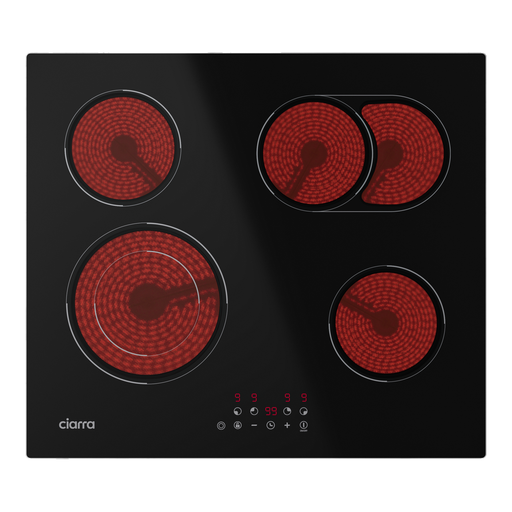
Why This Fits Their Persona: This 60cm built-in hob is designed for families and frequent cooks. With 6600 W of power and four zones, including flexible options, multiple dishes can be prepared simultaneously with ease.
It solves the problem of inflexible cooking zones with an oval roaster zone and a round dual-ring zone. This ensures energy is used efficiently and even large cookware is heated evenly.
The high flexibility of the cooking zones allows for the use of pots and pans of various shapes and sizes. A complete safety package is included as standard.
We have compiled a complete, up-to-date list of products that fully meet these strict selection criteria and German safety regulations.
A ceramic hob (also known as a glass-ceramic hob) generates heat via heating coils under the glass plate, which then heats the cookware. It is compatible with almost all types of pots and pans. An induction hob creates an electromagnetic field that directly heats the base of magnetisable cookware. This is generally faster and more energy-efficient but requires special cookware.
Self-installation is strongly discouraged, especially for hard-wired, high-power models. For safety and insurance reasons, the connection to the mains power must be carried out by a qualified electrician. Installation errors can lead to appliance damage, short circuits, or fires and will void the manufacturer's warranty.
After use, let the hob cool down completely until the residual heat indicator turns off. Remove loose debris with a soft cloth. For stubborn or burnt-on stains, use a special scraper designed for ceramic glass and a suitable cleaning agent. Absolutely avoid using abrasive sponges, steel wool, or harsh chemicals, as these can permanently scratch the surface.