
Lieferung heute & morgen

Qualitätsgarantie

Willkommens-Angebote freischalten: KOSTENLOSE Lieferung | Bis zu 80 % RABATT | Kostenlose 30-Tage-JoyPlus-Testphase
App herunterladen
The search for a new frying pan leads many health-conscious cooks to the ceramic pan, advertised as a non-toxic alternative. But the market is crowded and full of marketing claims that don't always deliver. Before you make a decision, it's crucial to understand the common pitfalls that often lead to disappointment and rapid wear and tear.
As your Joybuy Product Recommendation Officer, I'm here to help you separate relevant facts from exaggerated advertising claims. This guide focuses on the three most common problems with ceramic pans and shows you what to look for to find a durable and functional product.
The 3 Most Common Disappointments with Ceramic Pans:
To avoid the problems mentioned above, you should focus on three core technical features. These are the primary determinants of your new pan's longevity, performance, and safety.
A ceramic-coated frying pan is not made of solid ceramic. It consists of a metal body (usually aluminum or stainless steel) that is coated with a ceramic layer. The quality of this layer is critical.
A pan's performance depends directly on its ability to distribute heat quickly and evenly.
Two other features determine the versatility and convenience in your daily cooking routine.
Instead of making a one-size-fits-all recommendation, we have selected products tailored to specific needs and cooking habits.
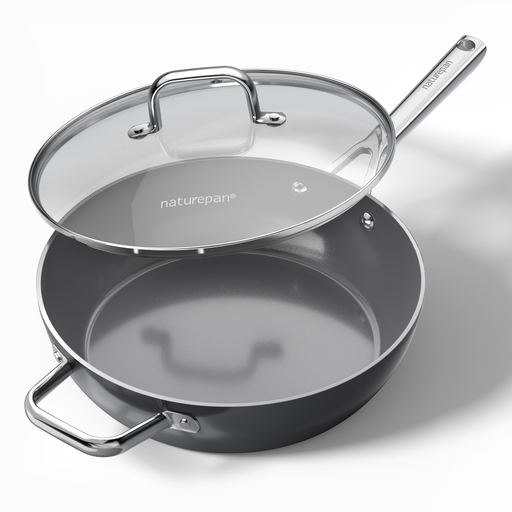
Why This Fits Their Persona: Ideal for families who cook larger quantities. The high sides and included lid make the pan extremely versatile for braises, sauces, and stews, reducing the need for additional cookware.
The diamond and titanium particle-reinforced coating is designed for longevity and resists rapid wear. The explicit declaration as PTFE/PFOA/PFAS-free comprehensively addresses the issue of harmful substances.
High versatility thanks to its deep design and lid. Oven-safe up to 260°C (500°F) for flexible cooking methods. Suitable for all cooktops, including induction.
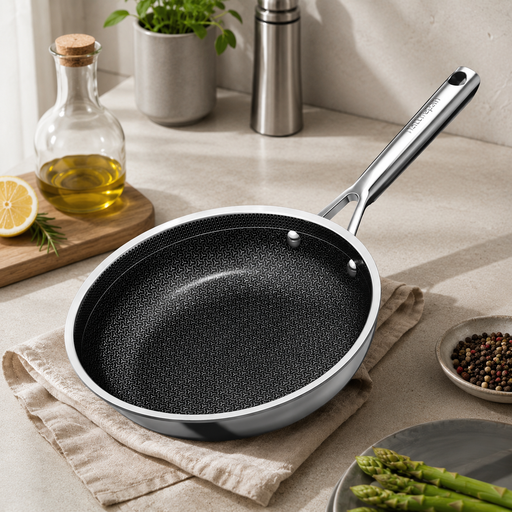
Why This Fits Their Persona: Perfect for chefs who want to combine the sharp searing of stainless steel with the non-stick properties of ceramic. The high oven-safe temperature and even heat distribution of the 5-ply construction are ideal for demanding recipes.
The laser-etched hexagonal pattern with raised stainless steel ridges protects the underlying ceramic coating from direct contact with utensils. This innovatively addresses the scratch-resistance problem and increases the pan's lifespan.
Hybrid technology for sharp searing and non-stick performance. 5-ply construction for excellent heat conduction. Very high oven safety (260°C / 500°F) and a PFAS-free coating.
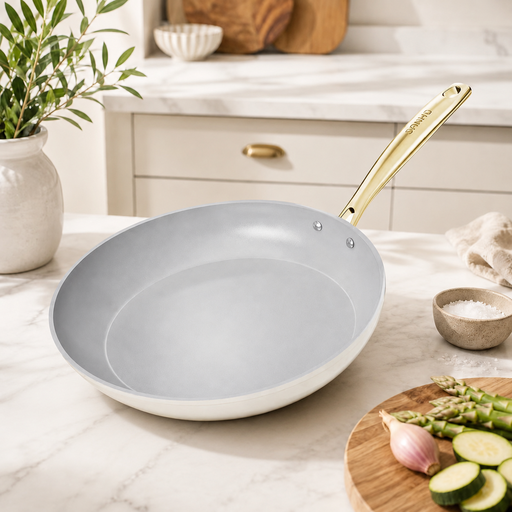
Why This Fits Their Persona: A reliable all-rounder in the most common 26 cm (10-inch) size. This pan covers most daily cooking needs, from fried eggs to sautéed vegetables or chicken fillets, without unnecessary frills.
The patented diamond-titanium coating offers greater durability than standard ceramic pans, counteracting the rapid decline in non-stick performance. It is also explicitly certified free of PFAS, PFOA, lead, and cadmium.
Balanced price-to-performance ratio. High oven safety (260°C / 500°F) and suitable for all cooktops, including induction. Robust, reinforced coating for daily use.
We have compiled a complete, up-to-date list of products that fully meet these strict selection criteria and safety regulations.
1. How long does a ceramic coating really last? The lifespan heavily depends on the quality of the coating and its care. A high-quality, reinforced coating (e.g., with titanium or diamond particles) can last for several years with proper use. Avoid overheating (do not heat it while empty on the highest setting), use only wooden or silicone utensils, and prefer hand washing to maximize its lifespan.
2. Is a ceramic pan truly a healthy pan? Ceramic coatings certified as free of PFAS, PFOA, and PTFE are considered a stable and safe cooking surface. Unlike traditional PTFE coatings (often known as Teflon), they do not release potentially harmful fumes if accidentally overheated. They also allow for cooking with very little oil, which can contribute to lower-fat meal preparation.
3. Why isn't my new ceramic pan working on my induction cooktop? For a pan to work on an induction cooktop, its base must be magnetic. Pure aluminum is not magnetic. Therefore, an induction-compatible ceramic pan must have a bonded base made of ferromagnetic stainless steel. When purchasing, look explicitly for the "suitable for all cooktops" label or the induction symbol (a coil).