
Lieferung heute & morgen

Qualitätsgarantie

Willkommens-Angebote freischalten: KOSTENLOSE Lieferung | Bis zu 80 % RABATT | Kostenlose 30-Tage-JoyPlus-Testphase
App herunterladen
Creating a tidy and stimulating child's room is a challenge for many parents. Books and toys quickly pile up and need a dedicated spot that is easily accessible to children. A well-designed children's bookshelf not only promotes tidiness but can also foster your child's independence and love of reading. This article introduces various concepts and models to help you choose the perfect nursery storage.
As a Joybuy product recommendation expert, my goal is to provide you with objective information and practical criteria so you can make an informed decision for your home.
Before you decide on a model, there are a few fundamental aspects to consider. These criteria will help you find a shelf that is safe, practical, and durable.
Safety in a child's room is the top priority. Look for models with rounded corners and edges to minimise the risk of injury. A sturdy construction is essential. Many shelves, especially taller models, come with an anti-tip kit. This device allows you to securely anchor the furniture to the wall, preventing it from tipping over if a child tries to climb on it. Check the maximum weight capacity of the individual compartments and the entire shelf.
A key aspect, especially in the Montessori bookshelf concept, is accessibility for the child. The shelf should be low enough for children to take out and put back their books and toys on their own. This promotes autonomy and helps develop a sense of order. Models that display books with the cover facing forward make it easier for toddlers who can't yet read to recognise their favourite books by their cover.
Wooden children's shelves or high-quality MDF (medium-density fibreboard) panels are a popular choice as they are robust and durable. Pay attention to the material classification, such as MDF (E1), which indicates a low-emission board. The surfaces should be treated with non-toxic, water-based paints. Also, consider what functions the shelf should serve. Do you only need space for books, or should it also function as a toy shelf? Combined solutions with compartments, boxes, or integrated toy chests offer flexible nursery storage options.
Here is a selection of different shelf types that meet various requirements for design, space, and functionality.
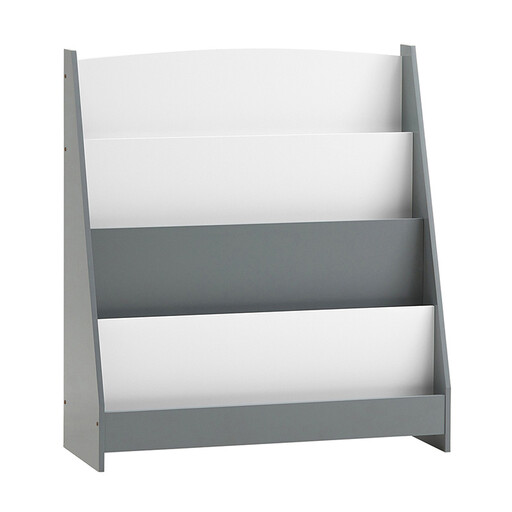
What makes it special This shelf from SoBuy is designed strictly according to Montessori principles. The four forward-facing compartments allow books to be displayed with their covers visible. With a height of 88 cm, children can comfortably access all levels and learn to organise their books themselves.
Pros
Who it's for This model is ideal for parents of toddlers and preschoolers who are looking for a classic Montessori bookshelf to encourage their child's love of reading and independence.
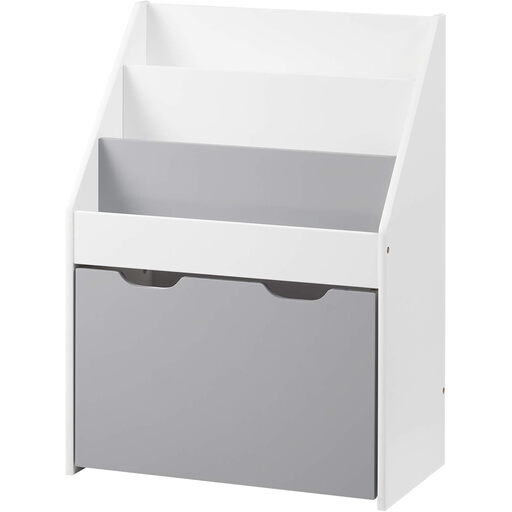
What makes it special The Woltu shelf is a multifunctional 2-in-1 solution. It combines three staggered book compartments with a spacious toy box on wheels. The trapezoidal design with a wide base ensures high stability.
Pros
Who it's for Perfect for families looking for a compact and versatile storage solution for books and toys. It is especially well-suited for smaller children's rooms where space needs to be used efficiently.
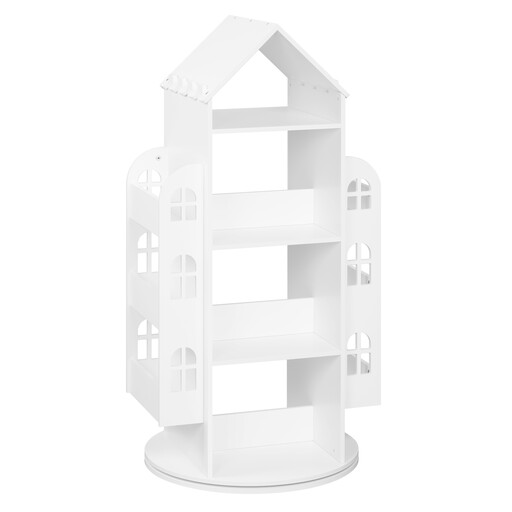
What makes it special This house-shaped shelf from Woltu is a true space-saving marvel. Thanks to a 360° rotating base, all compartments are easily accessible from any side. It offers ample storage space for books, toys, and decorations across four levels and in additional side compartments.
Pros
Who it's for This model is a great choice for children's rooms with limited floor space but high storage needs. The playful, rotating element makes tidying up and choosing books an interactive activity.
Sometimes, room design calls for a different type of furniture. If you're looking not just for storage but also for an element to structure the room, a room divider might be the right solution. It can visually separate play and sleep areas while providing plenty of storage space.
? Discover our selection of Room Divider Shelves here.
1. What defines a Montessori bookshelf? A Montessori bookshelf is designed to promote children's independence. Typical features include a low height, allowing the child to reach the books without help, and a forward-facing display. Instead of just seeing the narrow book spines, children can view the covers, which makes selection easier and encourages reading.
2. How do I securely attach a children's bookshelf to the wall? Most taller shelves come with an anti-tip kit. This set usually consists of a bracket, screws, and wall anchors. The bracket is attached to the top of the shelf and to the wall. It is important to use wall anchors that are suitable for your specific wall type (e.g., concrete, drywall). The manufacturer's assembly instructions should be followed closely to ensure a secure installation.
3. From what age is a dedicated bookshelf for children recommended? A dedicated bookshelf is beneficial for toddlers from around 1.5 to 2 years old. As soon as children start to grasp things independently and show interest in picture books, a low and accessible shelf helps to build a positive relationship with books. It establishes a routine from the beginning where books have a fixed and reachable place in the room.